Solar Street Lights, Street Lamps & Parking Lot Lights
ZHENYE SERIES integrated solar street lights and street lamps, solar parking lot lights, Q235 hot-dip galvanized solar light poles, LiFePO4 energy storage systems, and LED landscape lighting. Source factory quality with competitive pricing and 5-year warranty.
As a Guangdong-based solar street light manufacturer with over 12 years of production experience, we ship directly from our 10,000m² facility to buyers in 50+ countries. Each product line is backed by in-house R&D, rigorous quality testing, and dedicated after-sales support. Browse our complete catalog below or contact us for a factory-direct quote within 24 hours.
Integrated Solar Street Lights & Street Lamps
ZHENYE SERIES integrated solar street lights and street lamps — All-in-one design with MPPT controller, LiFePO4 lithium battery, and high-efficiency monocrystalline solar panel. From 100W to 300W, plus solar parking lot lights and Q235 hot-dip galvanized solar light poles, all with factory-direct pricing and 5-year warranty.
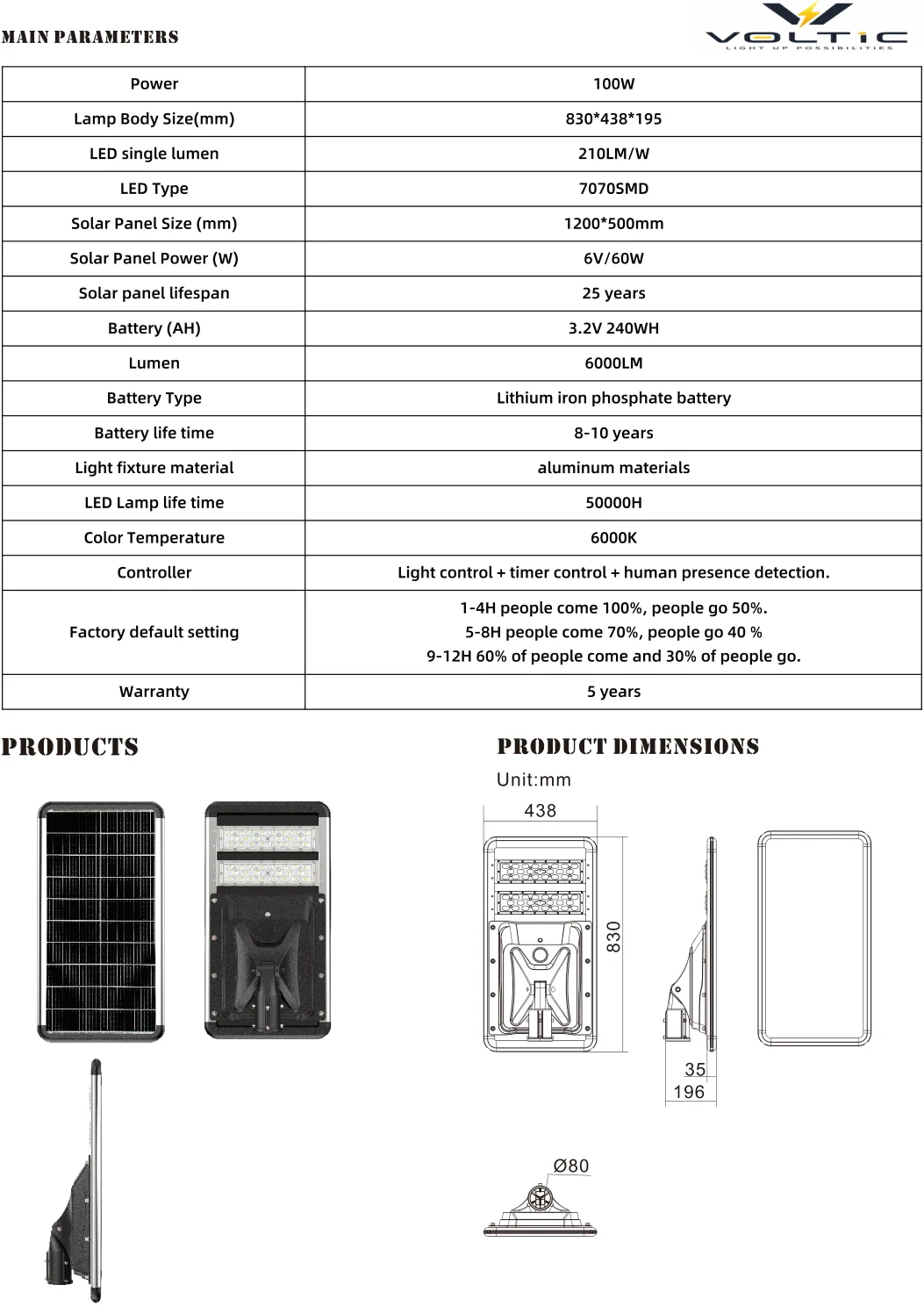
The ZHENYE SERIES represents our flagship integrated solar street light and street lamp lineup, purpose-built for infrastructure projects worldwide. Each unit combines an ADC12 die-cast aluminum housing, AL6063 heatsink, 7070SMD LED array (210LM/W), monocrystalline solar panel, and LiFePO4 battery into a single weatherproof assembly. Key features include MPPT charge control for 15-30% faster charging, intelligent motion-sensing dimming for all-night runtime, and anti-wind pole engineering rated for Level 15 typhoon conditions (50.9m/s). All four wattage models share the same proven architecture — simply choose the wattage that matches your road width and pole spacing requirements.
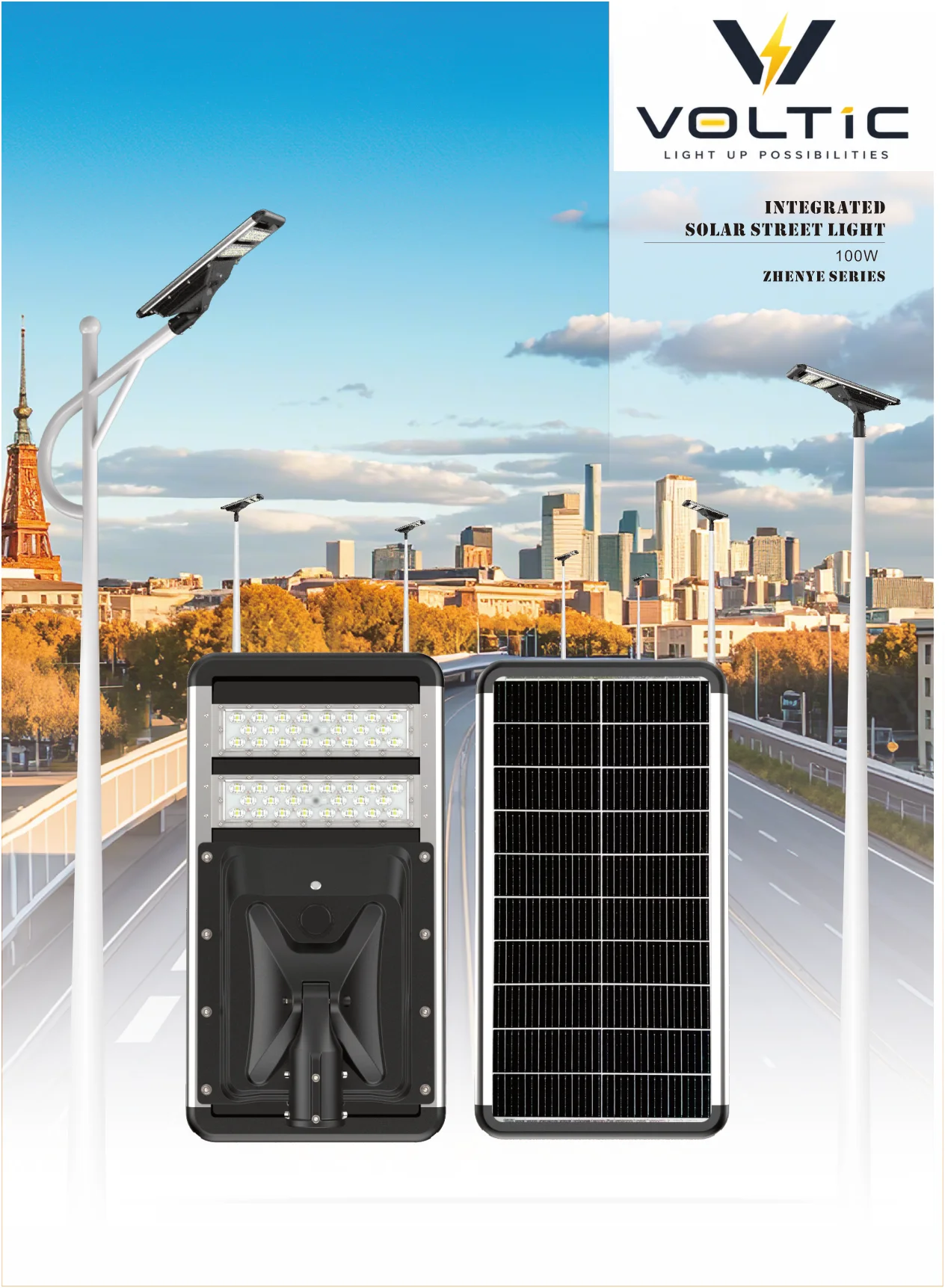
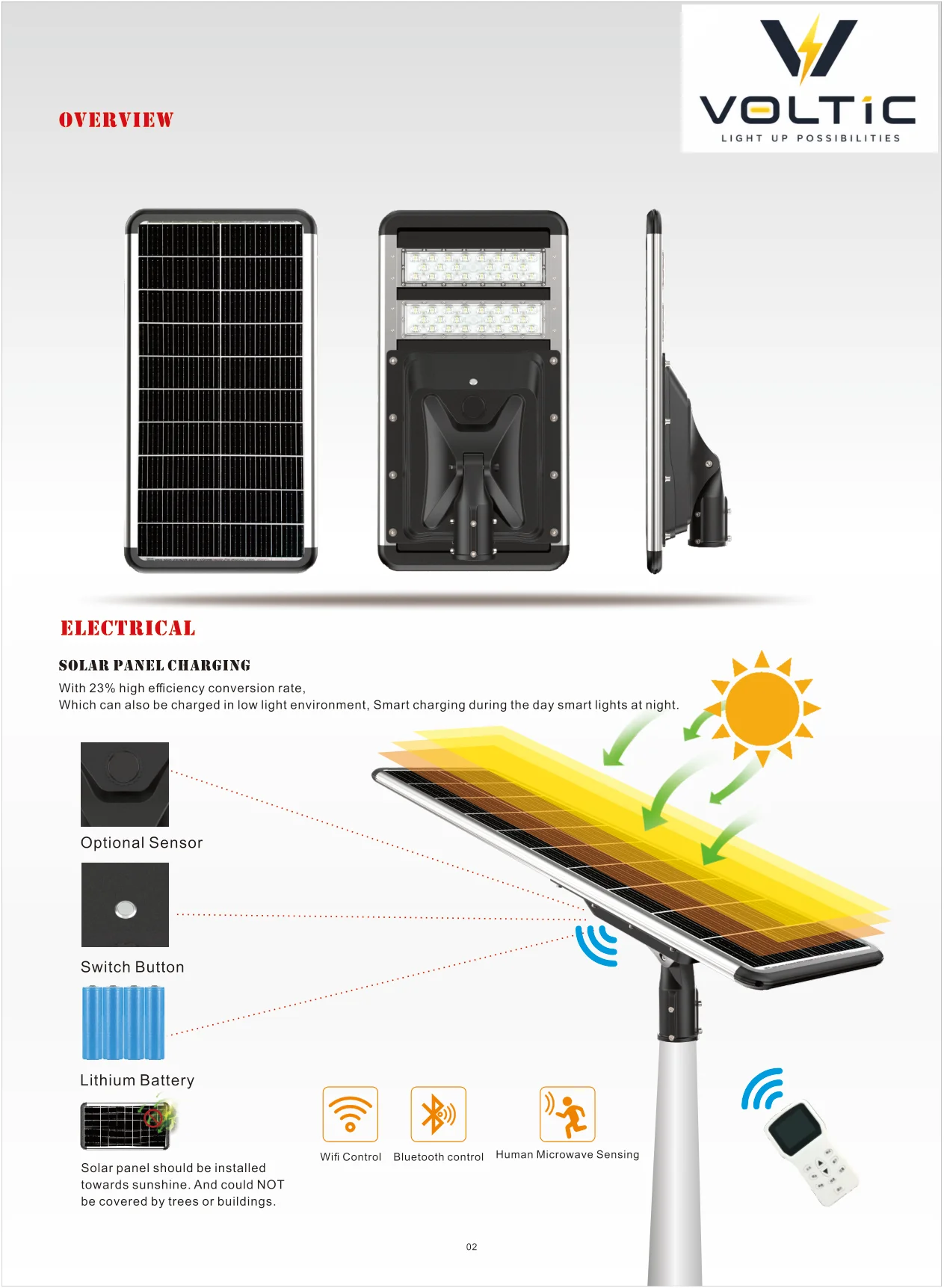
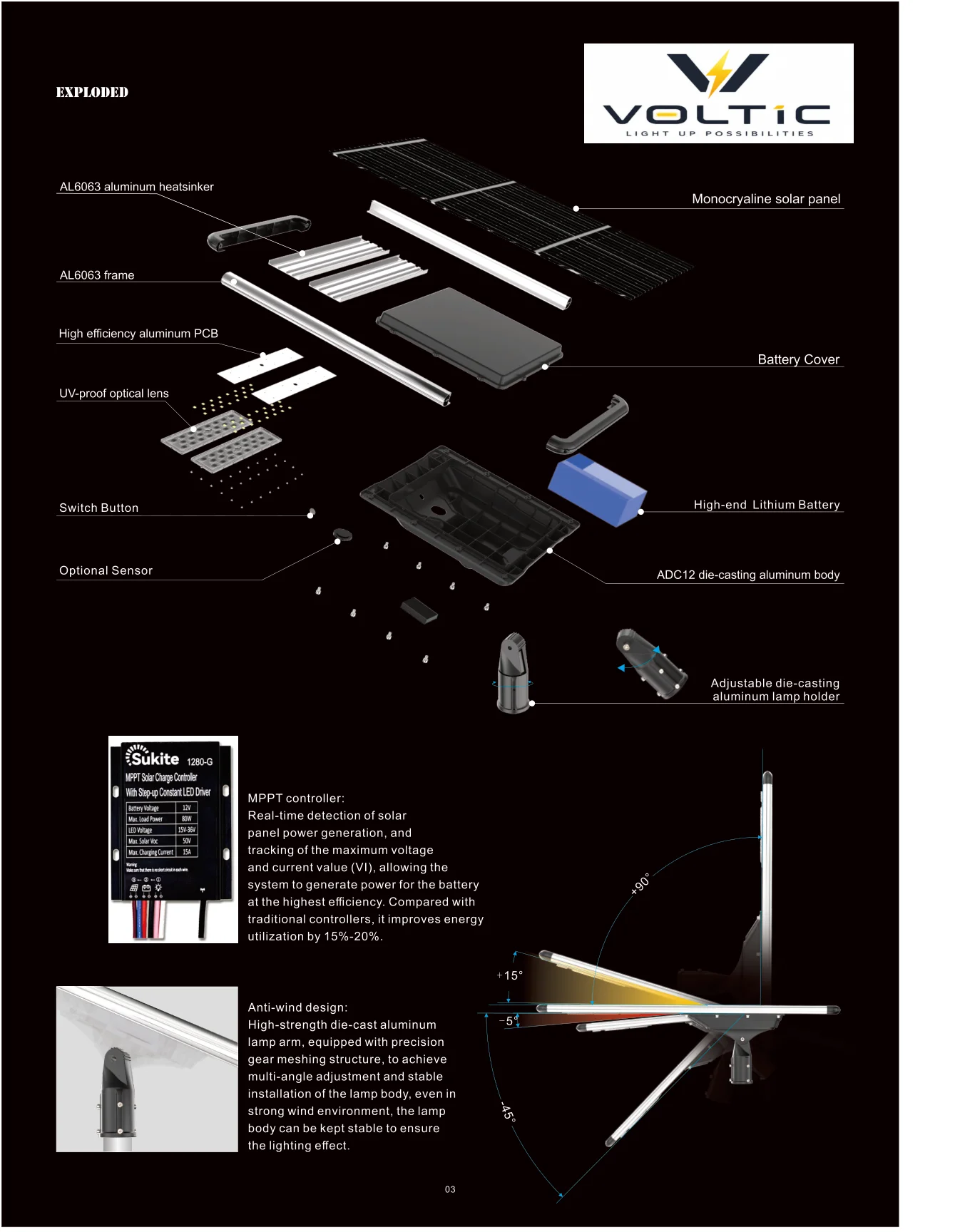
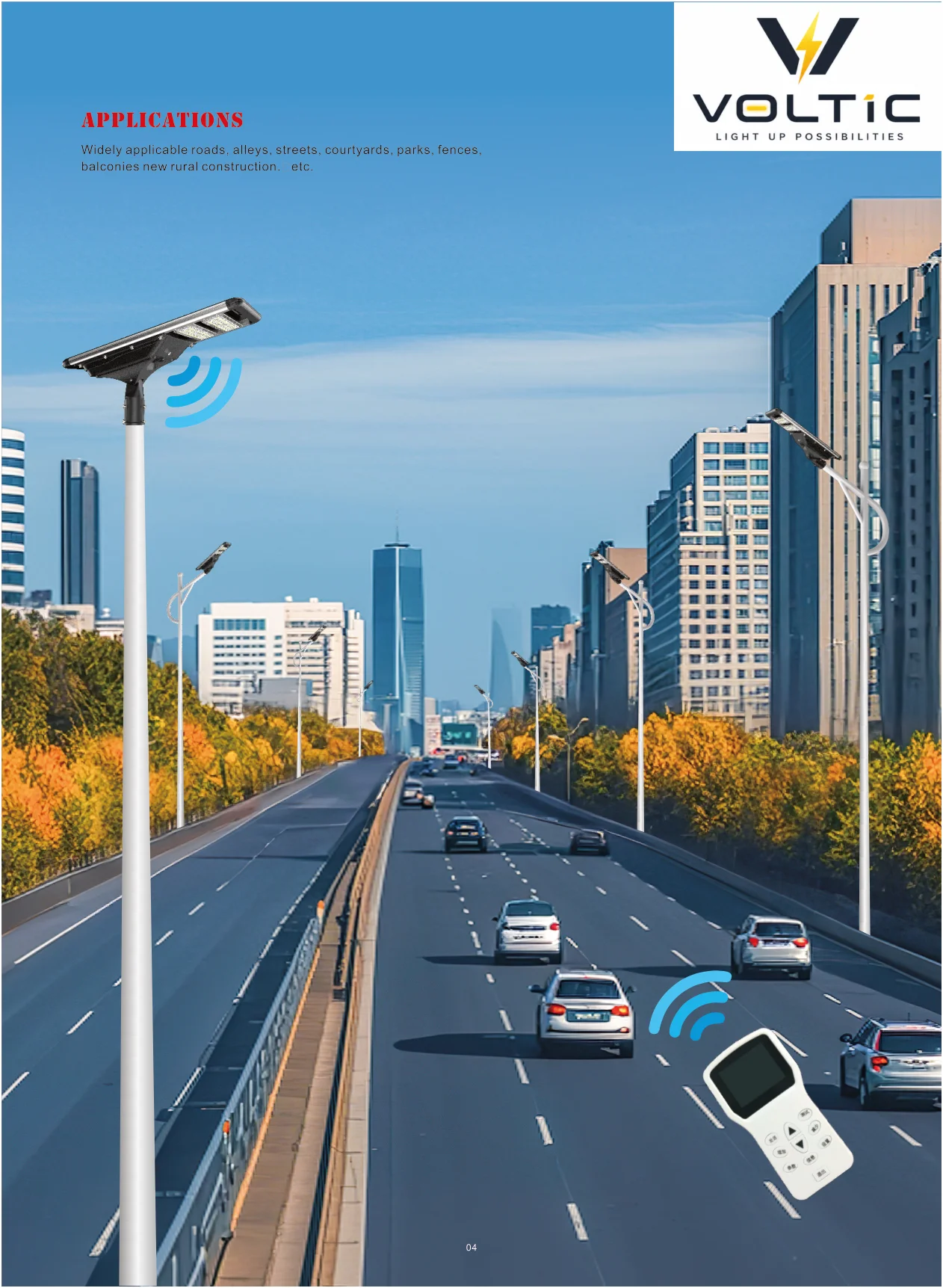
100W Integrated Solar Street Light
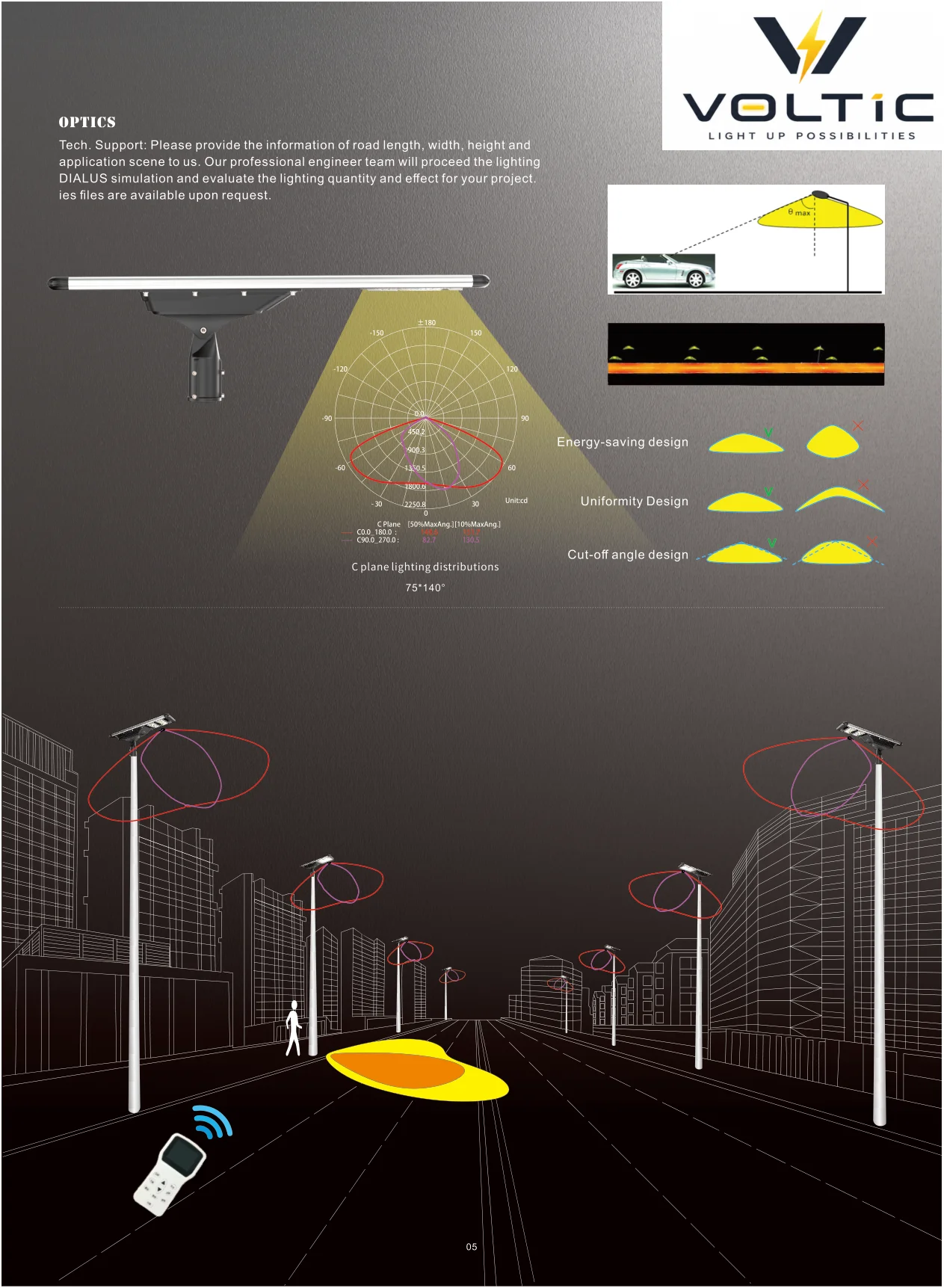
100W ZHENYE SERIES all-in-one solar street light with MPPT controller and LiFePO4 battery. Ideal for residential streets, courtyards, parks, and rural roads.
LiFePO4 Energy Storage Systems
Lithium iron phosphate battery technology for home, commercial, and portable energy storage. 17 product groups engineered for reliability and safety. 4,000+ charge cycles, 8-10 year design life. All systems support RS485, CAN, WiFi, and GPRS communication protocols for remote monitoring and management.
Our energy storage lineup covers residential wall-mounted batteries (5-15kWh), scalable rack-mounted systems (up to 30kWh+), portable power stations (500W-3000W), hybrid inverters, and foldable solar panels. Every unit uses LiFePO4 chemistry — thermally stable, non-toxic, and rated for 4,000+ deep cycles at 80-90% depth of discharge. Whether you need solar self-consumption optimization, off-grid independence, or reliable backup power, we offer a factory-direct solution with 3-5 year warranty coverage.

Complete Energy Storage Lineup
Home storage batteries, wall-mounted & rack systems, portable power stations, hybrid inverters, and foldable solar panels. All built with LiFePO4 chemistry for safety and longevity. Ideal for solar self-consumption, off-grid, and backup power. Each product group includes detailed specifications, model comparison charts, and technical documentation available for download.
LED Landscape Lighting Collection
8 product series, 100+ models for building facades, gardens, and outdoor architectural illumination. IP65/IP68 rated, stainless steel and aluminum construction. All fixtures undergo rigorous waterproof testing before shipment.
Our landscape lighting collection spans LED wall washers for facade illumination, in-ground uplights for dramatic accent effects, bollard lights for pathway safety, underwater lights for water features, flood lights for wide-area coverage, plus lawn lights, fence lights, and step lights. Each series offers multiple wattages, beam angles, and control options — from simple static white to full DMX512 RGB color-changing systems. Stainless steel 304/316 and die-cast aluminum housings ensure decades of corrosion-free operation in any climate, from tropical coastlines to arid deserts.
Professional Landscape Illumination
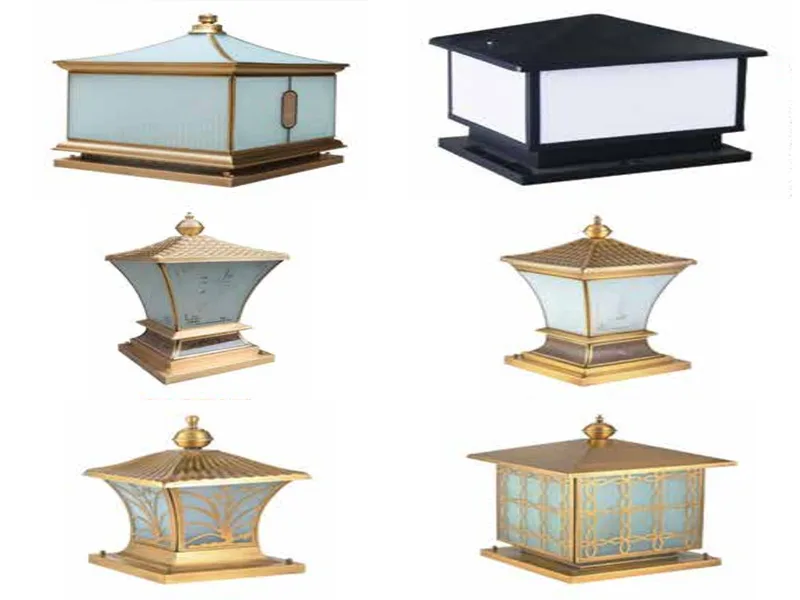
LED wall washers, in-ground lights, bollard lights, flood lights, underwater lights, lawn lights and more. IP65/IP68 rated for permanent outdoor installation. DMX512 control available for RGB color-changing projects.
Explore Our Products & Technology in Depth
Click each section below to expand detailed information about solar street light selection, energy storage applications, and landscape lighting specifications.
Solar Street Light Selection Guide — Power, Battery, Materials & Certifications
Power & brightness · Battery & solar panel sizing · Build quality & durability · Certifications & warranty
Solar Street Light Selection Guide — Power, Battery, Materials & Certifications
Power & brightness · Battery & solar panel sizing · Build quality & durability · Certifications & warranty
1. Power & Brightness Matching
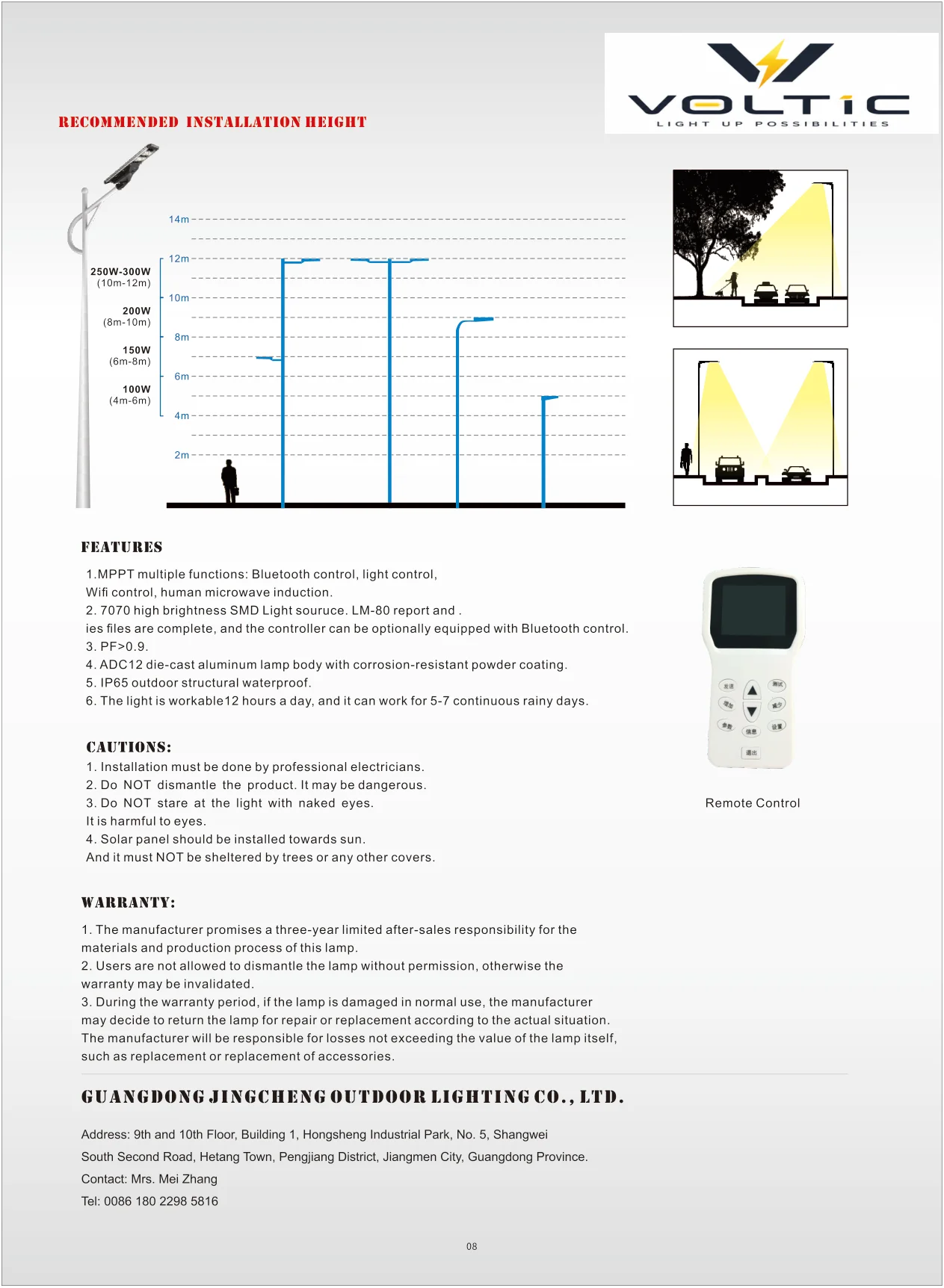
Wattage directly determines illumination range and brightness. The 100W model suits residential streets, courtyards and rural roads (25-30m pole spacing, 6-7m mounting height). The 150W handles secondary roads and parking lots (30-35m spacing, 7-8m height). The 200W covers main roads and logistics centers (35-40m spacing, 8-10m height). The 300W is engineered for highways, airports and large infrastructure (40-45m spacing, 10-12m height). Factor in road width, pole spacing, traffic volume and required lux levels. All ZHENYE SERIES models use 7070SMD LED chips at 210LM/W efficacy for maximum output with lower energy consumption, reducing solar panel and battery sizing costs.
2. Battery & Solar Panel Sizing
Battery capacity and panel wattage must match local sunlight conditions and required nightly runtime. Sun-rich regions perform well with standard configurations, while areas with frequent overcast weather benefit from upsized battery capacity for extended autonomy. All models use LiFePO4 batteries rated for 4,000+ cycles at 80-90% depth of discharge, with 8-10 years of daily cycling service. Monocrystalline panels offer 20-22% conversion efficiency with a 25-year power output warranty. The built-in MPPT controller charges 15-30% faster than PWM alternatives using maximum power point tracking technology, particularly advantageous in cold weather and low-light conditions. The smart controller supports light-sensing, timer-based, and motion-detection dimming modes to conserve battery overnight.
3. Build Quality & Extreme Environment Durability
The ADC12 die-cast aluminum housing with uniform wall thickness and structural integrity pairs with AL6063 heatsinks for efficient thermal conduction, keeping LED junction temperatures within safe limits throughout a 50,000-hour service life. We recommend Q235 hot-dip galvanized steel poles with complete wind resistance calculation reports (verified to GB 50009 structural loading standards) up to Level 15 typhoon (50.9m/s) — critical for coastal typhoon corridors and mountain pass installations. IP65-rated fixtures withstand coastal salt spray, desert heat, high-altitude low pressure, and freezing snow conditions. Every unit undergoes individual waterproof testing, 72-hour accelerated aging, and photometric verification before shipment.
4. Certifications & After-Sales Support
A qualified source factory should hold ISO9001 quality management certification, with products meeting CE and RoHS standards, backed by independent third-party LM-79 photometric test reports — essential documentation for government tender submissions and engineering acceptance. VOLTIC provides a 5-year complete warranty on all solar street lights with 25-year panel power output coverage, supported by factory-direct engineering support and spare parts availability. We offer deep OEM/ODM customization including specification adjustments, laser-engraved branding, custom packaging, and pole configuration tailoring, all with consistent 15-25 day lead times. FOB/CIF shipping is available from Guangzhou and Shenzhen ports with complete export documentation.
LiFePO4 Energy Storage — Safe, Long-Life, Full-Scenario Coverage
Residential wall-mounted · Rack-mounted commercial · Portable power stations · Hybrid inverters & PV solutions
LiFePO4 Energy Storage — Safe, Long-Life, Full-Scenario Coverage
Residential wall-mounted · Rack-mounted commercial · Portable power stations · Hybrid inverters & PV solutions
Residential Wall-Mounted Batteries
Designed for home solar storage with capacities from 5kWh to 15kWh in a compact wall-mount form factor. An intelligent BMS monitors individual cell voltage, current and temperature with multi-layer protection against overcharge, over-discharge, overheating, short circuits, and cell imbalance. Supports RS485, CAN and WiFi communication for remote monitoring, charge/discharge scheduling, and fault alerts via mobile app. Typical applications include solar self-consumption maximization, time-of-use arbitrage (charge low, discharge high), and critical load backup. Multiple units parallel for 30kWh+ capacity. Designed for 10+ years of daily cycling with 3-5 year factory warranty.
Rack-Mounted Commercial & Industrial Storage
Built for commercial and light industrial users in standard 19-inch rack format, starting at 5kWh per module with stackable expansion beyond 30kWh. Suitable for retail shops, office buildings, small factories, data centers and telecom base stations. Supports peak shaving, demand response, and automatic grid-to-battery switchover during outages to protect POS systems, surveillance equipment and lighting. Modular design simplifies transport, installation and future capacity upgrades. Communication interfaces compatible with leading inverter brands for flexible system integration with remote monitoring and diagnostics.
Portable Power Stations & Foldable Solar Panels
Portable stations cover 500W to 3000W with pure sine wave inverters (compatible with inductive loads like small motors and compressor coolers), AC universal outlets, DC outputs, USB-A and Type-C PD fast-charging ports. Ideal for camping, field operations, outdoor markets, emergency medical response and film production. Companion foldable monocrystalline panels enable true off-grid recharging. UN38.3 certified for air transport. At one-third the weight of equivalent lead-acid systems with zero noise and zero emissions — a clean, silent alternative to fuel generators, especially suited for noise-sensitive locations and eco-friendly campsites.
Hybrid Inverters & Complete PV Station Solutions
Single-phase and three-phase hybrid inverters intelligently manage power flow between solar arrays, batteries and the grid, automatically switching modes based on real-time electricity pricing, solar forecast and load demand to maximize self-consumption. Suitable for residential rooftop systems and commercial distributed PV projects. Features anti-islanding, over/under voltage/frequency protection, DC component suppression and power quality optimization compliant with national grid interconnection standards. For overseas markets, we provide region-specific configurations meeting local grid codes (e.g. EN50549 for Europe, AS4777 for Australia) with FOB/CIF container shipping from Guangzhou and Shenzhen ports.
LED Landscape Lighting — 8 Series, 100+ Models
Wall Washers · In-Ground · Bollard · Flood · Underwater · Lawn · Fence · Step Lights
LED Landscape Lighting — 8 Series, 100+ Models
Wall Washers · In-Ground · Bollard · Flood · Underwater · Lawn · Fence · Step Lights
LED Wall Washers
Engineered for building facades, bridge piers and large landscape walls, delivering uniform wash lighting that accentuates architectural contours and material textures. Available in single-color, RGB full-color and RGB+W (dedicated white) configurations with DMX512/RDM control for dynamic color-changing effects, chases and gradient transitions. High-strength extruded aluminum housing with tempered glass and independent lens arrays, supported by efficient thermal fins for continuous operation. Multiple beam angles (10° narrow to 60° wide) accommodate various mounting distances and wall heights.
LED In-Ground Lights
Flush-mounted in paving, pathways and plaza hardscapes for uplighting trees, sculptures and architectural columns. IP67/IP68 rated with 304/316 stainless steel load-bearing faceplates. Pre-installation sleeves simplify civil works and future fixture replacement. Integrated waterproof cable connectors and breathable valves prevent internal condensation from temperature differentials. Available in narrow spot, wide flood and asymmetric wall-wash distributions for diverse landscape lighting compositions.
LED Bollard Lights
Mounted on garden wall tops, balcony railing ends and decorative pillar caps, combining functional path lighting with architectural ornamentation. Available in 360° omnidirectional and single-side directional beam patterns with color temperatures from warm white 3000K to daylight 6000K. Aluminum and stainless steel housing options with electrostatic powder coating or brushed metal finishes for lasting corrosion resistance. Widely used in private villa gardens, luxury hotel landscapes, urban park pathways and residential community perimeter lighting. Series-wired installations create continuous guiding light ribbons that enhance nighttime spatial hierarchy and pedestrian safety.
LED Flood Lights
High-output wide-area illumination for architectural floodlighting, sports venue lighting, urban plaza illumination and large-scale outdoor events. Power range from 50W to 500W with modular fixture design — each module independently adjustable for tilt and pan to flexibly compose lighting layouts. High-transmittance tempered glass with optical-grade lens arrays ensures uniform distribution without dark spots or glare. Die-cast aluminum heatsinks with convective airflow channels maintain stable LED junction temperatures at sustained high power. IP65 rated for year-round outdoor use — a next-generation energy-efficient replacement for metal halide (slow startup, poor CRI) and high-pressure sodium (low color temperature, yellowish cast) fixtures.
LED Underwater Lights
Purpose-built for musical fountains, swimming pools, artificial lakes and waterfall features with IP68 maximum protection for reliable fully submerged operation at depths of several meters. 316L medical-grade stainless steel body with ultra-clear tempered glass resists chlorinated pool water and saltwater corrosion. Low-voltage 12V/24V SELV power supply strictly compliant with underwater electrical safety codes, with waterproof cabling and dedicated junction boxes. Available in warm white single-color, RGB full-color and DMX professional control versions, capable of synchronized water-jet and light choreography for dynamic water feature artistry. Multiple lens angles support everything from ambient pool floor wash to focused accent spotlighting.
LED Lawn, Fence & Step Lights
Lawn lights positioned along garden paths, landscape greenery and courtyard lawn edges provide low-level (30-60cm height) soft guidance, outlining routes without glare. Fence lights mounted on railings, balcony barriers and outdoor boundary dividers serve dual decorative and security alert functions. Step lights embedded into indoor/outdoor stair risers and ramp sidewalls illuminate each tread edge, significantly improving nighttime pedestrian safety (especially for elderly and children). All three categories operate on low-voltage 12V/24V power for simple DIY installation, with aluminum or stainless steel housings rated IP65. Color temperatures span 2700K warm white to 6000K daylight. Small solar panel and lithium battery kits enable zero-electricity, zero-wiring standalone operation. Multiple fixtures can be parallel-wired for grouped control with unified switching and dimming.
Detailed specification sheets and product drawings are available for every series. Request the complete product catalog and custom quotation.
Request Landscape Lighting Catalog Source Factory Capability — 10,000m² Manufacturing Base, End-to-End Production
Die-Casting · SMT Assembly · Battery Integration · Aging Tests · QC Laboratory
Source Factory Capability — 10,000m² Manufacturing Base, End-to-End Production
Die-Casting · SMT Assembly · Battery Integration · Aging Tests · QC Laboratory
VOLTIC operates a 10,000 square meter manufacturing facility in Guangdong Province, China, equipped for full-chain production from raw material processing to finished product assembly. Unlike trading companies that outsource production to multiple unknown workshops, we complete every core manufacturing step in-house: aluminum die-casting and forming, SMT circuit board assembly, lithium battery module welding and integration, LED optical lens mounting, solar panel lamination and encapsulation, and complete fixture waterproof testing. Vertical integration delivers three key advantages: elimination of middleman markups for genuine factory-direct pricing; full traceability with every unit carrying a unique QC code linked to its production batch, operator team, and test data; and reliable 15-25 day lead times independent of external supplier bottlenecks. The factory holds ISO9001:2015 certification and operates professional testing equipment including integrating sphere photometers, constant-temperature humidity aging chambers, salt spray corrosion testers, and IP waterproof rating test stations, ensuring consistent product quality and reliability across every shipment.
Aluminum Die-Casting Workshop
Multiple cold-chamber die-casting machines process ADC12 premium aluminum alloy into one-piece lamp housings with uniform wall thickness, dense grain structure, and smooth surface finish. In-house mold design and maintenance ensure dimensional precision. Castings undergo deburring, sandblasting, and aging treatment to relieve internal stress for long-term dimensional stability. AL6063 extruded aluminum heatsinks are produced in parallel for precision thermal-path assembly with the lamp body.
SMT Assembly & Electronics
Fully automated SMT pick-and-place lines mount LED chips with ±0.05mm precision onto aluminum-core PCBs. Reflow soldering ensures full, uniform solder joints for reliable electrical conductivity. Assembled boards pass AOI (Automated Optical Inspection) and powered burn-in testing to screen out cold solder joints and color temperature deviations. MPPT controllers and BMS protection boards are produced on parallel electronics assembly lines, forming a complete electrical system with LED arrays and battery modules.
Lithium Battery Module Assembly
LiFePO4 cells are capacity-matched and sorted, then automatically spot-welded with nickel tabs into series and parallel configurations. Welded modules are mounted into insulated support frames with balancing sense harnesses connected to the BMS protection board. Every assembled battery pack undergoes full charge-discharge cycle testing, internal resistance measurement, and dielectric withstand testing to verify rated capacity and electrical safety. The battery compartment features a sealed waterproof design with silicone gaskets achieving IP65 ingress protection.
Final Inspection & Shipping QC
Every completed solar street light passes five mandatory pre-shipment tests: integrating sphere luminous flux and color temperature measurement (IES LM-79 compliant), full-unit IP65 pressurized water spray testing, 72-hour continuous burn-in cycling (simulating day-night operation), visual and dimensional inspection, and ISTA-standard packaging drop and vibration sampling. Units passing all checks receive a unique traceability label with archived test data. Batch shipments include Certificates of Conformity, material test reports, and certification document copies.
Global Export Network & Customer Service — 50+ Countries, One-Stop Trade Support
Export Markets · Trade Terms & Logistics · OEM Customization · After-Sales Service
Global Export Network & Customer Service — 50+ Countries, One-Stop Trade Support
Export Markets · Trade Terms & Logistics · OEM Customization · After-Sales Service
Since 2013, VOLTIC has exported solar street lights and energy products to over 50 countries across Southeast Asia (Philippines, Vietnam, Thailand, Indonesia, Malaysia and 10+ more), the Middle East (Saudi Arabia, UAE, Iraq, Kuwait and 7+ more), Africa (Nigeria, Kenya, South Africa, Tanzania and 9+ more), South America (Brazil, Chile, Peru and 3+ more), Europe (Poland, Greece, Romania and 2+ more), and Oceania (Australia, New Zealand, Papua New Guinea). Our extensive cross-border trade experience covers import clearance requirements, product certification standards, and logistics procedures across these diverse markets. We offer overseas buyers comprehensive support spanning product selection and quotation, contract execution, production tracking, pre-shipment inspection, export documentation, and ocean freight booking — a genuine one-stop service from factory to destination port.
Trade Terms & Logistics Solutions
We support both FOB (Free On Board) and CIF (Cost, Insurance, Freight) Incoterms, shipping from Guangzhou Nansha and Shenzhen Yantian/Shekou ports. Long-standing partnerships with international logistics providers enable flexible transport options including Full Container Load (FCL), Less than Container Load (LCL) consolidation, and air freight express for urgent orders. Export documentation is complete and accurate: Commercial Invoice, Packing List, Bill of Lading, Certificate of Origin (FORM E/FORM F/CO), plus destination-specific certification packages (CE, RoHS, SASO, SONCAP, PVoC, etc.). For first-time importers, we can recommend reliable freight forwarders and customs brokers to ensure smooth cargo clearance at the destination port.
OEM/ODM Customization Process
We provide flexible OEM/ODM services for brand owners and project clients. Customization scope includes: technical parameter adjustments (wattage, color temperature, battery capacity, panel power), housing color customization (powder coating to specified RAL/Pantone colors), brand identity integration (laser engraving, silk-screen logo printing, custom nameplates), packaging design (neutral packaging, custom-branded color boxes, palletization), and pole configuration tailoring (height, arm count, flange dimensions, surface treatment). Process flow: client submits requirements → engineering feasibility assessment → confirmed proposal and quotation → sample production for approval → mass production → inspection and shipment. Sample lead time is typically 7-10 working days; bulk orders follow standard 15-25 day production schedules.
Pre-Sales Technical Support
Our application engineering team provides free technical consultation including: solar street light model and configuration recommendations based on project location solar irradiance data and roadway parameters; DIALux illumination simulation reports for lighting design verification; structural wind resistance calculations with foundation construction recommendations; and tender documentation support with complete certification packages. For large-scale projects, engineers can travel to the project site for on-site survey and technical discussions. We also coordinate third-party inspection services (SGS, TÜV, Intertek) for product verification and pre-shipment supervision at the client's cost.
After-Sales Warranty & Spare Parts
Solar street lights carry a 5-year complete warranty with 25-year panel power output coverage. Energy storage products carry 3-5 year warranties. Landscape lighting products carry 2-3 year warranties (specific terms per contract). Within the warranty period, replacement parts (LED modules, controllers, battery packs) for manufacturing or material defects are provided free of charge with detailed installation instructions and video guides — no need to return the entire unit to the factory. For bulk orders, we recommend reserving 2-3% of the order quantity as spare parts. Out-of-warranty replacement parts are supplied at cost. Our after-sales team responds within business hours via email and WhatsApp; complex technical issues receive remote video diagnosis and guidance from factory engineers. We value long-term partnerships over one-off transactions and are committed to supporting every customer throughout the product lifecycle.
Solar vs Grid-Powered Street Lights — Comprehensive Comparison & Selection Guide
Initial Investment · Installation Cost · Electricity Expense · Maintenance · Service Life · Environmental Impact
Solar vs Grid-Powered Street Lights — Comprehensive Comparison & Selection Guide
Initial Investment · Installation Cost · Electricity Expense · Maintenance · Service Life · Environmental Impact
When selecting outdoor roadway lighting, procurement decision-makers must weigh solar street lights against conventional grid-powered alternatives. The two technologies differ significantly in upfront investment structure, installation complexity, long-term operating costs, and environmental footprint. The following multi-dimensional comparison helps you evaluate which option best suits your specific project conditions. Generally, solar street lights offer the strongest advantages in areas without existing grid infrastructure or with unreliable power supply, new road construction projects, and temporary worksites. Grid-powered lights remain the mainstream choice in dense urban cores with mature electrical infrastructure and high lighting density. For intermediate scenarios — suburban roads, industrial parks, scenic parking lots — a detailed return-on-investment analysis is recommended before making the final decision.
Initial Investment & Installation Cost
Solar street lights typically have higher per-unit equipment costs than equivalent-brightness grid-powered fixtures, but their total installed cost is often lower. This is because grid-powered installations require significant additional civil works: cable trench excavation, underground cable laying, distribution panel installation, and potentially transformer capacity upgrades — items that typically account for 40-60% of the total project budget. Solar lights eliminate all grid connection costs, requiring only a pre-cast pole foundation and fixture mounting, which a two-person crew can complete in under two hours per unit. In remote off-grid locations, solar lights completely avoid the prohibitive expense of extending the electrical grid. Additionally, the modular nature of solar lighting enables phased investment and gradual expansion, reducing upfront capital pressure.
Operating Electricity Cost & Long-Term Savings
Solar street lights incur zero electricity costs throughout their operational life — all energy is harvested from sunlight. For a project with 100 street lights, each consuming approximately 400-600 kWh annually from the grid, yearly electricity expenditure ranges from USD $500 to $1,500 (depending on local commercial electricity rates). Over a 25-year design life, cumulative grid electricity costs can reach $12,500 to $37,500. In contrast, solar lights require only one lithium battery replacement at the 8-10 year mark, keeping lifetime maintenance costs far below the grid alternative. In regions with high industrial electricity prices — such as remote islands, mining operations, and off-grid communities — the economic case for solar is even stronger. Moreover, solar lights are completely unaffected by grid power outages, providing superior lighting reliability in developing countries with unstable electricity networks.
Maintenance Requirements & Service Life
Grid-powered street light maintenance primarily involves lamp replacement (LED fixtures last approximately 50,000 hours, roughly 8-10 years of nightly operation), troubleshooting cable joint leakage and distribution panel faults, and — in many regions — dealing with copper cable theft. Cable theft is particularly problematic: copper has scrap value, and a single stolen cable segment can black out an entire road section. Solar street lights, with their fully integrated self-contained design and no exposed cabling, fundamentally eliminate the cable theft problem. The primary maintenance activity is replacing the lithium battery once at the 8-10 year point — a lower-frequency, lower-cost intervention than the ongoing maintenance burden of grid-powered systems. Solar panel cleaning is largely handled by natural rain washing; in particularly dusty regions, manual cleaning every six months is recommended and requires no specialized personnel.
Recommended Applications & Selection Guidance
Solar street lights are strongly recommended for: rural roads and village infrastructure (weak or absent grid coverage), remote mountainous regions and islands (prohibitively expensive grid connection), scenic area parking lots and park pathways (environmental branding and zero electricity cost), industrial zones and mining sites (cost reduction in high-electricity-tariff areas), and temporary construction access roads and emergency response (rapid deployment without grid dependency). Grid-powered lights are recommended for: dense urban arterial roads (existing mature grid infrastructure and established maintenance regimes), city center areas with high lighting pole density (solar panel sunlight access may be obstructed by surrounding buildings), and specialized applications such as sports stadiums and large multi-level interchanges with strict uniformity requirements. A hybrid approach is also a pragmatic option: grid-powered fixtures on main arterials, solar-powered units on secondary roads and pedestrian paths — delivering meaningful reductions in overall electricity costs and carbon emissions while maintaining lighting performance where it matters most. Our technical team can assist with site-specific surveys and comparative proposal development — contact us to start the conversation.
Industry Applications & Partnership Models — From Single Projects to Strategic Supply
Government Procurement · EPC Contracting · Distribution & Agency · International Aid · Brand OEM
Industry Applications & Partnership Models — From Single Projects to Strategic Supply
Government Procurement · EPC Contracting · Distribution & Agency · International Aid · Brand OEM
VOLTIC has accumulated extensive project cooperation experience across 50+ countries, serving government municipal departments, international EPC contractors, brand distributors, international development aid agencies, and commercial chain enterprises. We offer flexible service models tailored to different partnership types — from sample evaluation to small-batch trial orders to long-term strategic supply agreements, all paced to match the client's procurement rhythm.
Government Procurement & Municipal Projects
We supply equipment and technical support for national and local government infrastructure development, rural electrification, and roadway lighting upgrade programs in compliance with international procurement standards. Our team is experienced with the procurement and tendering procedures of multilateral financial institutions including the World Bank, Asian Development Bank, and African Development Bank. We provide complete bid qualification documentation packages — ISO9001 certificates, CE/RoHS Declarations of Conformity, LM-79 photometric test reports, factory audit reports, bank reference letters, and past performance records. We support tender-specific product configuration and technical proposal customization, including assistance with technical deviation statements and bid clarification responses. For awarded contracts, we strictly adhere to contractual delivery schedules and packaging requirements, coordinate with third-party inspection agencies for Pre-Shipment Inspection (PSI), and assist with Certificate of Origin and other customs clearance documentation.
EPC Contractors & System Integrators
We provide solar street light and energy storage equipment supply and technical matching services for EPC (Engineering, Procurement, Construction) contractors, photovoltaic system integrators, and lighting engineering firms. Cooperation models are flexible: we can supply luminaires and poles independently (manufactured to client-provided design specifications), deliver complete supply packages including pole foundation anchors and installation manuals, or coordinate and recommend experienced overseas installation teams for construction support. We understand contractors' sensitivity to cost certainty and delivery reliability — quotations clearly lock in price validity periods and delivery milestone dates, avoiding post-award price escalation. For large-scale projects, we can dispatch technical personnel to the construction site during the initial installation phase for hands-on demonstration and quality inspection, helping contractor teams quickly master installation and maintenance procedures and reducing rework risk. Long-term contractor partners benefit from tiered volume pricing and priority production scheduling.
Brand Distributors & Regional Agents
For local distributors and regional agents with established sales channels and customer networks in their target markets, we offer competitive agency pricing, regional market protection, and brand OEM services. The cooperation journey typically begins with sample orders and small-batch trial shipments to validate product-market fit. Once market acceptance is confirmed, an annual framework agreement locks in pricing and production capacity, ensuring stable supply continuity. We fully support distributors marketing under their own brand — products can be laser-engraved with the distributor's logo, packaged in custom-designed color boxes with localized instruction manuals, and even have product specifications fine-tuned for local market preferences (e.g., enhanced heat dissipation for tropical climates, increased panel tilt angle for high-latitude regions). We respect distributors' accumulated local channel relationships and customer networks, committed to long-term win-win cooperation rather than bypassing intermediaries to compete for end customers.
International Aid & Sustainable Development Projects
We actively participate in sustainable energy and humanitarian projects funded by UNDP, the World Bank, the African Development Bank, and bilateral development agencies. Solar street lights and portable energy storage products — with their zero carbon emissions, grid independence, and rapid deployment characteristics — are particularly well-suited for school illumination, clinic power supply, refugee camp infrastructure, and post-disaster emergency reconstruction in remote, unelectrified regions. We accommodate the specialized procurement requirements of aid projects, including offering non-profit pricing tiers, submitting project-site technical suitability assessment reports, organizing community installation and usage training, and establishing localized spare parts supply and technical support service networks. We believe in the universal value of clean energy technology and are committed to participating — with reasonable margins — in public-benefit projects that contribute positively to global sustainable development, building long-term collaborative relationships with aid agencies, NGOs, and social enterprises.
Frequently Asked Technical Questions — Installation, Performance & Maintenance
Installation Siting · Winter Performance · Battery Lifespan · Wind & Water Resistance · Smart Controls
Frequently Asked Technical Questions — Installation, Performance & Maintenance
Installation Siting · Winter Performance · Battery Lifespan · Wind & Water Resistance · Smart Controls
Do solar street lights work during cloudy weather and winter?
Yes. ZHENYE SERIES solar street lights are engineered with sufficient battery autonomy to handle consecutive overcast days. Standard configurations support 2-3 days of normal operation (based on 10-12 hours nightly illumination) on a full battery charge, even with zero solar input. For regions with extended rainy or cloudy seasons, battery capacity can be upsized at the time of order. Winter low temperatures do affect LiFePO4 batteries to some degree, but the operating temperature range of -20°C to 60°C covers most inhabited regions. The MPPT controller delivers significantly better charging efficiency than PWM alternatives in cold and low-light conditions, maximizing the limited winter sunlight hours. For extreme cold regions (below -20°C), low-temperature-optimized battery cells with optional heating modules are available. Snow accumulation on the panel surface should be cleared to maintain charging efficiency. Overall, solar street lights perform consistently year-round in equatorial and low-latitude regions (most of Southeast Asia and Africa); higher-latitude installations benefit from upsized panel wattage and battery capacity to compensate for seasonal reductions in daylight hours.
How do I determine the best installation location and pole spacing?
Solar panel sunlight access is the primary siting consideration — ensure the panel mounting position is free from year-round shading (no building shadows, tree canopies, or other structures), oriented due south (Northern Hemisphere) or due north (Southern Hemisphere), with a tilt angle approximately equal to the local latitude for maximum annual solar irradiation. Pole spacing is determined by fixture wattage and roadway width: 100W models suit 25-30m spacing (6-7m pole height), 150W models suit 30-35m (7-8m height), 200W models suit 35-40m (8-10m height), and 300W models suit 40-45m (10-12m height). Alternating staggered placement on both sides of the road produces more uniform pavement illuminance than single-side mounting. Pole spacing should be reduced or wattage increased at curves, intersections, and gradients to ensure adequate illumination at traffic-safety-critical zones. We recommend using professional lighting design software such as DIALux for illuminance simulation — our technical team offers free lighting design and pole layout drawings based on your specific road parameters. Reinforced concrete pole foundations are recommended, with foundation dimensions calculated based on pole height and local wind load conditions.
What routine maintenance do solar street lights require?
Solar street light maintenance is significantly less demanding than grid-powered alternatives and primarily involves the following: First, periodic solar panel cleaning (recommended every 3-6 months, more frequently in dusty regions down to 1-2 months) using clean water rinsing with a soft cloth to remove accumulated dust and bird droppings and maintain photovoltaic conversion efficiency. Second, inspecting poles for tilt, loose bolts, or physical damage — post-typhoon and heavy storm walk-throughs are recommended. Third, monitoring nighttime illumination duration and brightness — noticeably shortened operating time or reduced brightness often signals early battery aging or panel shading that should be investigated promptly. Fourth, checking for vegetation around the pole base that may shade the solar panel or impede foundation drainage, and trimming as needed. Lithium batteries have an 8-10 year design life; capacity typically degrades to 70-80% of the initial rating by end of life, at which point battery pack replacement should be scheduled. The controller and LED light source are essentially maintenance-free under normal operating conditions, with design life covering the entire product lifecycle. We recommend establishing a simple maintenance log for larger projects, recording each unit's installation date, inspection findings, and replacement history for systematic asset management. For projects lacking on-site maintenance personnel, we offer remote technical guidance or can recommend third-party operations and maintenance service providers. Additionally, we suggest procuring 3-5% of the total fixture quantity as complete spare units at the initial order stage, along with 10-15% of consumable spare parts (LED modules, controllers, and sealing gaskets), to cover incidental repair needs over the coming years and avoid extended outages while waiting for international parts shipments. For projects exceeding 500 units, establishing a small local spare parts depot and training 1-2 maintenance technicians is recommended — we provide comprehensive training materials and video tutorials. A well-planned maintenance program significantly extends system service life, reduces total lifecycle cost, and ensures the installation continues to meet roadway lighting standards and public safety requirements.
Why LiFePO4 batteries over other battery types?
Lithium iron phosphate (LiFePO4) is widely recognized as the optimal battery chemistry for solar energy storage, outperforming both lead-acid and ternary lithium (NMC) batteries across safety, longevity, and total cost dimensions. On safety: LiFePO4's crystalline structure remains exceptionally stable at high temperatures — it will not catch fire or explode even under puncture, crush, or overcharge testing conditions, a fundamental safety advantage that ternary lithium cannot match and a prerequisite for indoor and occupied-space energy storage installations. On longevity: LiFePO4 delivers 4,000-6,000 charge cycles at 80% depth of discharge — over 10 years of daily cycling — compared to just 300-500 cycles for lead-acid and 800-1,200 for NMC, both of which require multiple replacements within a solar street light's 25-year design life, significantly increasing total lifecycle maintenance costs. On environmental impact: LiFePO4 contains no cobalt or other rare and ethically contentious minerals; its materials are widely sourced and recyclable, with a far lower environmental footprint in production and use than NMC batteries. On cost: while LiFePO4 carries a higher initial purchase price than lead-acid, the fact that lead-acid requires 5-8 replacements over the same service period makes LiFePO4's ten-year total cost of ownership actually lower. All VOLTIC solar street lights and energy storage products are equipped with Grade A LiFePO4 cells as standard, with complete battery test data and transparent technical specifications — customers can select with full confidence.
VOLTIC is driven by technology, grounded in quality, and supported by service — committed to delivering cost-effective solar lighting and energy storage solutions to customers worldwide. We understand that behind every street light is a community's safe passage, a project's successful delivery, and the beginning of a lasting partnership. Whether it is your first inquiry or the continuation of a long-term collaboration, we approach every customer with professionalism and integrity. Thank you for taking the time to explore our products and services — we look forward to the opportunity to contribute to your next project.