Does a Solar Street Light Need Earthing?
The answer depends on what the pole carries. A standalone solar street light is a self-contained extra-low-voltage DC system with no supply cable feeding it, so it normally needs no protective earth from a distribution board. As soon as the pole carries AC-powered equipment, or local wiring rules demand it, earthing becomes mandatory and must be designed, not improvised.
What is never optional is surge protection. A solar pole combines three things that attract surges: a large metal structure in open ground, a photovoltaic panel mounted at the highest point, and low-voltage electronics that sit at the end of that wiring. Before you order, settle three questions with your supplier: is the pole off-grid, hybrid, or feeding accessories; which local wiring rules govern the site; and what documentation will be provided to show the DC protection was tested to a recognised standard.
Why Lightning and Surges Still Threaten an Off-Grid Pole
A solar street light is one of the most exposed electrical assemblies on any site. The panel sits above the pole, the pole is a steel column in open ground, and DC wiring runs from the panel down past the controller to the battery.
A nearby strike induces a surge in that loop even when nothing is struck directly, and the damage lands on the electronics rather than on the structure. The failure sequence is predictable: the charge controller or LED driver absorbs the first hit, the battery management system takes the second, and the battery itself is usually the last casualty. In the field this shows up as a light that survived one storm season and then stopped charging, a controller with a burnt terminal block, or several units failing across one site after the same thunderstorm. That pattern — simultaneous failures spread across a project rather than scattered single-unit faults — is the clearest sign that the problem is surge, not manufacturing.
Lightning is not the only source. Switching transients from nearby machinery, welding on site, and even static build-up on a long DC run can damage the same components. For any project in a high-lightning region, or any pole that also carries a camera, an access point or a sensor, surge protection should be a line item in the quotation — not an accessory added after the first failure.
Which Standards Cover Earthing and Surge Protection?
Several standards touch this subject, and they cover different parts of the system, which is why tenders often ask for the wrong evidence. The table below maps each one to what it actually governs and what you should request from a supplier. Always confirm which edition and which market your project's engineer is working to.
| Standard | What it covers | What to ask the supplier for |
|---|---|---|
| IEC 62305 (lightning protection) | Lightning risk assessment and protection measures for structures and installations | A lightning risk assessment for the site, or a written statement of whether protection is required at all |
| IEC 61643-31 | Surge protective devices connected to the DC side of photovoltaic installations, up to 1 500 V DC | DC surge protector datasheets stating the test standard, voltage rating and enclosure protection. Note this standard excludes PV systems with energy storage, so ask how the supplier qualifies protection in a battery-coupled circuit |
| IEC 61643-11 | Surge protective devices for low-voltage AC power systems | AC surge protection data wherever the pole has a mains supply or an AC load |
| IEC 60598-2-3 | Particular safety requirements for luminaires used in road and street lighting | The luminaire's declaration of conformity and the market it is valid in |
| IEC 60364-4-41 | Protection against electric shock, including SELV and PELV circuits | Confirmation of the luminaire's protection class and how the DC circuit is isolated from earth |
| National wiring rules (AS/NZS 3000, BS 7671, NEC/NFPA 70 and equivalents) | The installation itself — earthing arrangements, conductor sizing, testing | A statement that the site's licensed electrician will confirm the earthing arrangement against the applicable local rules |
Two points are worth repeating because they cause most confusion in tenders. First, the standard that covers a surge protective device on a PV array's DC side is not the same as the standard covering an AC surge protector, so a document citing one says nothing about the other. Second, a battery-coupled system such as a solar street light falls outside the scope of the PV-only DC standard — see the exclusion in the table — which means the supplier has to state explicitly what their protection is tested to, rather than pointing at the PV standard and stopping there.
When an Earth Electrode Is Required
An earth electrode is a conductor deliberately put into contact with the general mass of earth, usually a driven rod or the buried cage cast into the foundation. Whether you need one is decided by the installation type and the local wiring rules, not by the solar technology. The following situations normally require earthing.
- A mains connection is present. Hybrid or grid-tied poles, and poles that charge from a mains circuit, are electrical installations and must be earthed in the same way as any other street lighting column under the national wiring rules.
- The pole carries AC-powered equipment. A camera, a wireless access point, a signage panel or a sensor with its own supply turns a self-contained DC pole into a structure carrying mains equipment. The equipment's own earthing requirement then applies to the pole.
- The pole is bonded to other earthed metalwork. Where a column shares a conductive path with adjacent structures, guardrails or fencing, equipotential bonding prevents dangerous potential differences during a fault.
- The site is exposed to lightning. Hilltops, coastal strips, open plains and tall poles above their surroundings raise the lightning risk. The assessment decides whether a full protection system, an earth electrode, or both are needed.
- Local rules mandate it. Many authorities require an earth electrode at every lighting column regardless of how the column is powered, and some require a test result before acceptance.
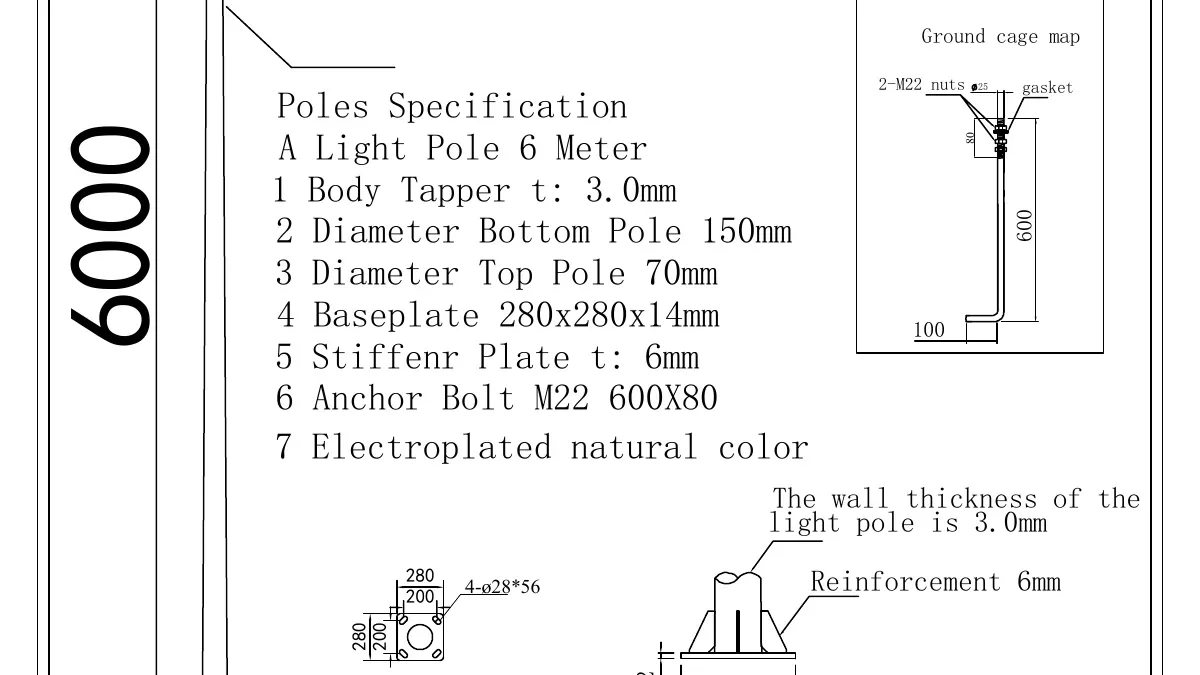
- The installation drawing says so. If the pole is supplied with an earthing terminal or a ground cage, the drawing exists because someone designed the connection. Follow it rather than deleting the detail to save time on site.
Bonding the Pole, Panel Frame and Enclosure
Earthing only works if the parts that must be at the same potential are actually connected. On a solar pole that means the pole body, the panel mounting frame, the luminaire housing, the enclosure or access door, and any accessories fitted to the same structure, all bonded as one continuous path.
Public utility earthing details for street lighting commonly show a copper bonding conductor in the 6–10 mm² range, a driven copper-bonded earth rod, and connections made by exothermic weld or a listed clamp. Your project's own drawing governs; ask the supplier to state the values they design to and provide the detail with the order.
Three practical points decide whether the connection survives. First, the bonding path must be continuous — a clamp that later corrodes or loosens breaks the path invisibly, so connections should be welded or made with a listed connector rated for the environment. Second, the joint between copper and galvanised steel is a corrosion couple: use a bimetallic or purpose-made clamp and inspect it at service intervals rather than bolting bare copper to a galvanised flange. Third, route the bonding conductor through the pole's access opening so it can be inspected and tested, and keep the earth connection accessible above the foundation rather than buried under the finished surface.
Where the foundation embeds a steel cage, that cage can serve as the electrode in many designs, which is why the drawing matters. A pole base is not only a structural part; it is frequently the point where the bonding path meets the ground, and it is the component most often installed by a civil contractor who never saw the earthing detail.
DC Surge Protection: Where the Device Goes
Surge protection on a solar pole is a small device in a specific place, and its position matters as much as its rating. It belongs on the wiring between the panel and the controller, as close to the electronics as the layout allows, with the shortest practical connection to the earthing point.
A protector mounted at the top of the pole with a metre of cable to the controller has already lost most of its effectiveness, because the voltage drop along that cable develops across the very equipment it was bought to protect.
| Where the equipment sits | What protects it | What to specify |
|---|---|---|
| DC circuit between panel and controller | DC surge protective device rated for the array's open-circuit voltage, mounted at the controller end | Test standard, DC voltage rating, enclosure protection suitable for the pole's environment, replaceable cartridge and a visible status indicator |
| Mains supply on a hybrid or mains-charged pole | AC surge protective device at the point where the supply enters the pole | AC test standard, rating matched to the supply, coordination with the upstream protection |
| Camera, Wi-Fi or telemetry cabling | Signal-line protector at the equipment end | Signal type, connector, and confirmation the protector shares the same earthing point as the pole |
Ask for a replaceable cartridge and a status indicator. Surge protectors are sacrificial: they absorb an event and then need replacing, and a protector that gives no indication of having failed leaves the installation looking protected when it no longer is. That is why surge protection belongs in the maintenance schedule alongside the battery health check, not only in the original bill of materials.
Installation Details That Decide Whether Earthing Works
Most earthing failures are installation failures rather than design failures. These are the details worth checking on site, with the drawing in hand and the electrician present. Where a value is not on your drawing, ask the supplier or the project engineer — do not take a number from a forum.
- Electrode type and depth. Confirm whether the design uses a driven rod, a buried conductor, or the foundation's cast-in cage, and install it to the drawing rather than to a convenient shorter depth.
- Connection method. Exothermic welding or a listed clamp, sized and rated for the conductor and the environment. A bolted joint tightened by hand and left in soil is not a durable connection.
- Conductor sizing. Determined by the local wiring rules and the prospective fault current. Get the size in writing from the engineer responsible for the installation.
- Corrosion protection at the interface. Copper-to-galvanised joints need a bimetallic connector, and the joint should be above the permanent water line wherever possible.
- Mechanical protection. The bonding conductor should not run unprotected where it can be cut, pulled or stood on, and it should be identifiable from the phase and neutral conductors.
- Testing and records. Measure and record the earthing resistance before backfilling and again at handover, and file the result with the as-built documentation.
What to Put in the RFQ and Tender Documents
A solar lighting tender that does not ask for earthing and surge documentation will receive quotations that cannot be compared. Add the items below to the technical section, and make it clear which party covers installation, because the factory supplies components while the site's electrical contractor makes the final connections.
| Document | What it proves | Who provides it |
|---|---|---|
| Installation drawing showing the pole base, access opening, cable entry and bonding terminal | That the earthing and cable route were designed, not improvised on site | Pole or luminaire supplier |
| Declaration of conformity for the luminaire, stating the market it is valid in | Product safety compliance for your destination market | Luminaire supplier |
| DC surge protector datasheet with test standard, voltage rating and enclosure protection | That the DC protection is a tested device and not a generic component | System supplier |
| Lightning risk assessment, or a written statement that it is not required | That the exposure was considered for this site | Project engineer, with supplier input |
| Foundation and anchor-bolt drawing with the wind calculation | That the structure and its embedded cage match the design wind load | Pole supplier |
| Statement of responsibility for earthing, testing and handover records | That someone owns the final electrical connection | Contractor, agreed at tender stage |
One rule of thumb is worth applying to every document on that list: if a supplier cannot say which standard a protective component is tested to, treat the claim as unverified until the datasheet arrives. That applies equally to declarations of conformity and to surge protectors. Ask which market the certificate is valid in, and who the certificate holder is.
Field Failures That Look Like Surge Damage
Not every dead controller is a lightning victim, and not every lightning victim looks dead immediately. Learn to tell the two apart before you start replacing parts, because the evidence points to very different conclusions about who pays for the repair.
Surge damage tends to appear across several units at one site after one event, often with visible marking on terminal blocks or a burnt smell at the controller. Battery ageing appears gradually, as shorter runtime night after night, and water ingress appears after rain with corrosion at the seals and connectors. A single unit failing outside a storm window is more likely a manufacturing or installation fault than a surge, and should be handled as a warranty case with photographs and the installation details.
Because the symptoms overlap, the practical approach is a sequence: check the battery, then the controller, then the wiring and connectors, then the panel, and only then look for surge evidence. That sequence is set out in our guide to solar street lights that are not working, and the documentation you need when a claim is legitimate is covered in the guide to warranty and spare parts.
Frequently Asked Questions
Does a solar street light need earthing?
A standalone solar street light with no mains connection normally does not need a protective earth, because it is a self-contained extra-low-voltage DC system. Earthing becomes necessary when the pole has a mains supply, carries AC-powered equipment, or when local wiring rules require an electrode at every lighting column.
Do solar panels need earthing?
Panel frames and mounting structures are commonly bonded to earth as part of the lightning protection and equipotential bonding design, particularly on exposed sites. Whether bonding is mandatory depends on the lightning risk assessment and the local electrical code for your project, so ask the project engineer to state the requirement in writing rather than deciding on site.
Can I simply drive an earth rod next to the pole?
Only if the design says so. A rod placed without a documented connection to the pole's bonding terminal may not provide the intended protection and can create a potential difference between the rod and the structure. The connection method, conductor size and rod location should come from the installation drawing, and the result should be tested and recorded.
What size earth conductor should a street light use?
Conductor size is set by the local wiring rules and the prospective fault current, so it has to come from the engineer responsible for the installation. Published utility earthing details for street lighting commonly show a copper bonding conductor in the 6–10 mm² range with connections made by exothermic weld or a listed clamp, but those published figures are not a substitute for your project's own design.
Do I need a surge protector on a 24 V DC solar street light?
Surge protection is worth specifying on any pole in a lightning-prone area, or any pole carrying electronics that a project cannot afford to replace repeatedly. Choose a DC surge protective device rated above the array's open-circuit voltage, mount it at the controller end, and require an independent test standard on the datasheet. Do not rely on the mains surge protector that came with unrelated equipment.
Is earthing covered by the warranty?
Warranties typically cover component defects, not the installation work. If a failure traces back to an earthing connection made on site, the claim will normally fall outside the product warranty, which is why the as-built earthing record and the handover test results matter. Confirm with the supplier which party owns the final connection and what evidence is required for a claim.
Next Step: Send Us Your Project Details
VOLTIC supplies complete solar street light systems from our own production lines, including the pole, the anchor-bolt cage and the installation documentation. Our poles are Q235 hot-dip galvanised with a 65–85 µm zinc layer to ISO 1461 and engineered for a 50.9 m/s design wind speed (Level 15 typhoon) verified to GB 50009.
The wind resistance calculation report is provided on request. Every luminaire ships with an MPPT controller, light and timer control, human-presence detection, an IP65 waterproof housing and a LiFePO4 battery, with a 50,000-hour LED life and an 8–10 year battery life in the specifications.
Send us your road or site parameters and tell us whether the poles will be standalone, hybrid, or carrying cameras and sensors. We will return pole heights, foundation and earthing details, and a factory-direct quotation that lists the protection components separately so your engineer can check them against the local rules. If you are still at design stage, the solar light pole guide covers pole selection, wind loads and the flange and anchor-bolt table, the site survey checklist sets out what to measure before ordering, and the certification guide explains which market approvals to ask for. To see the hardware, start from the solar street light pole range or the 100W solar street light, and contact our engineers with your project details.