Why the Pole Matters as Much as the Light
The solar street light pole is the structural backbone of any solar lighting installation. It carries the luminaire, resists wind loads, and determines the illumination pattern on the ground. A well-chosen Q235 hot-dip galvanized pole lasts 20+ years with routine inspection; a poorly chosen one can fail within a single typhoon season. This guide covers pole types, height selection, materials, and foundations so you can specify the right solar light pole for your project.
Types of Solar Light Poles
Most solar street light poles are tapered polygonal or conical steel structures in three configurations. Single-arm poles support one luminaire at the top, ideal for one-sided road lighting and parking lot perimeters. Double-arm poles carry two luminaires, commonly used on median strips to light both carriageways from one foundation. Top-mount (post-top) poles mount the fixture directly on the pole crown, popular for solar lampposts, plazas, parks, and residential courtyards. The integrated design of modern solar street lights means the panel and battery ride on the luminaire — no separate bracket arms needed on the pole body.
Matching Pole Height to Wattage
Pole height should be matched to luminaire wattage, road width, and pole spacing. Use the table below as a starting point — our engineers will fine-tune spacing and height from a DIALux simulation of your actual site:
| Luminaire | Pole Height | Spacing | Typical Application |
|---|---|---|---|
| 100W (6,000LM) | 6-7m | 25-30m | Residential streets, courtyards |
| 150W (9,000LM) | 7-8m | 30-35m | Secondary roads, parking lots |
| 200W (12,000LM) | 8-10m | 35-40m | Main roads, logistics centers |
| 300W (18,000LM) | 10-12m | 40-45m | Highways, airports, plazas |
Pole Specification Matrix: 6m to 12m
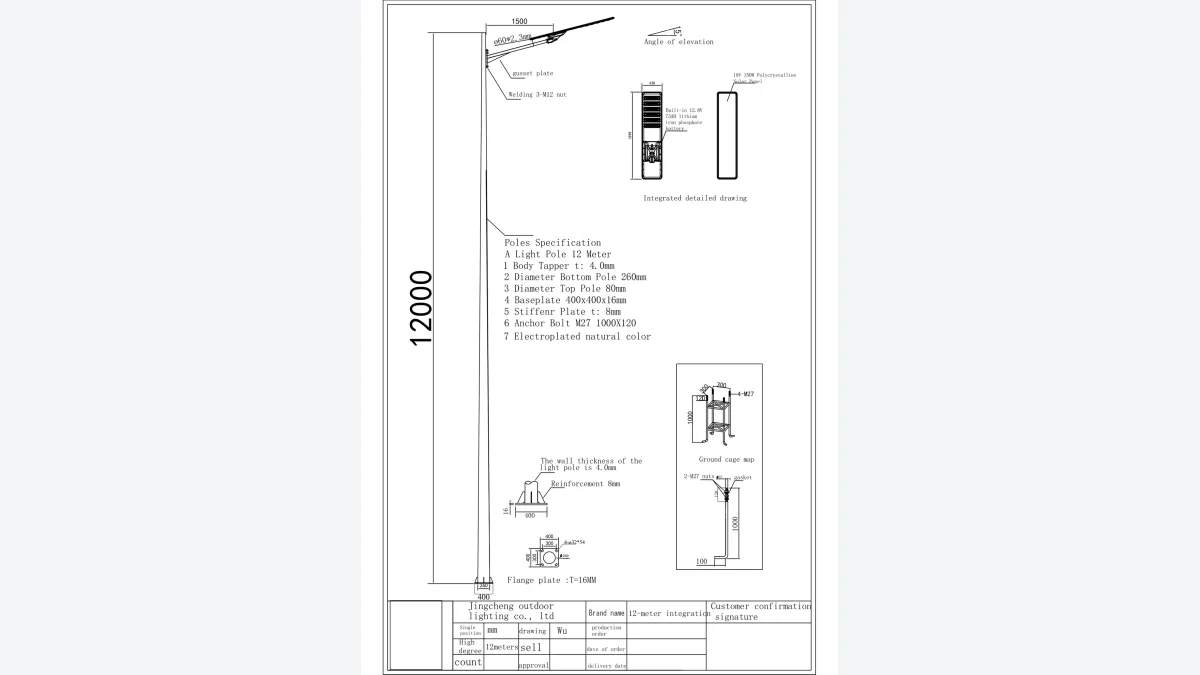
One row per height, for the civil contractor and the tender package: wall thickness, base plate, anchor bolt and embedment data for VOLTIC Q235 hot-dip galvanised poles. Every figure below is factory specification — the model drawing confirms the exact values for a specific order.
| Pole height | Wall thickness | Base plate (flange) | Anchor bolts | Embedment depth |
|---|---|---|---|---|
| 6m | 3.0mm | 280x280x14mm | 4 x M22 | 600mm |
| 8m | Quoted per model | 350x350x16mm | M24 | 800mm |
| 10m | Quoted per model | 400x400x16mm | M27 | 1,000mm |
| 12m | 5.0mm | 400x400x16mm | M27 | 1,000mm |
Across the 6-12m range poles measure 150-260mm at the base and 70-80mm at the top, with a 65-85µm zinc layer to ISO 1461 and a 4-bolt ground cage throughout. Design wind speed is 50.9m/s (Level 15 typhoon), verified to GB 50009, and the wind resistance calculation report is provided on request. Wall thickness for 8m and 10m poles is quoted per model — request the specification sheet if you need it before tender.
Materials & Surface Treatment
Poles are typically manufactured from Q235 high-strength steel. Wall thickness ranges from 3.0mm (6m poles) to 5.0mm (12m poles), with bottom diameters from 150mm to 260mm and top diameters of 70-80mm. Surface treatment is critical: hot-dip galvanizing per ISO 1461 deposits a 65-85µm zinc layer that protects against rust for decades, and is the recommended choice for coastal and high-humidity regions. Where aesthetics matter, electroplated natural-color or powder-coated finishes are available. Every VOLTIC pole ships with a rust prevention report, and wind resistance calculation reports are provided on request.
Foundations & Installation
A solar street light pole is only as good as its foundation. Standard practice: pour a reinforced concrete pad with an embedded 4-bolt ground cage (M22 for 6m poles up to M27 for 12m poles), allow the concrete to cure fully, then erect the pole, verify plumb, and torque the anchor bolts to specification. Foundation dimensions come from wind load calculations — for Level 15 typhoon zones (50.9m/s) the engineer should verify every size. Re-torque anchor bolts after the first major storm.
Wind Resistance & Safety
Pole failure in high winds is the most dangerous failure mode in solar street lighting. VOLTIC poles are engineered for Level 15 typhoon conditions (50.9m/s) with complete wind resistance calculation reports verified to GB 50009 structural loading standards — essential documentation for coastal projects, mountain passes, and government tenders. Always request the wind calc report with your quotation; if a supplier cannot provide one, question the structural design.
Solar Street Lights with Pole & Battery — Complete Kits
For turnkey procurement, we supply complete solar street light kits with pole and battery included: integrated luminaire, matching Q235 pole, ground cage, and installation documentation. One order, one responsible manufacturer, one warranty — the simplest way to equip villages, campuses, and commercial sites.
Send us your road or lot parameters and we will recommend pole heights, spacing, and foundation details from our solar street light pole range, with a factory-direct quotation.
Pole Standards, Loads, and What a Wind Report Really Shows
Pole design follows structural standards that specify loads, not just heights. The two load cases that matter: the wind load on the pole and luminaire (proportional to projected area, wind speed squared, and a shape factor) and the self-weight eccentricity of the arm. A wind report for a 12m pole in a 50.9m/s (Level 15 typhoon) zone must state: the basic wind pressure used, the height correction factor, the shape factor for the polygonal section, the resulting base moment, and the anchor bolt and foundation reactions. If a report is missing any of these numbers, it is a sales document, not engineering. For coastal projects, also confirm the report covers the extreme gust factor, not just the mean wind speed. A pole that survives the average storm but not the gust is a pole that fails in a hurricane season.
Flange, Foundation, and Anchor Bolt Dimensions
The pole-to-ground connection is where most field problems live. Typical VOLTIC pole specifications are a useful reference: 6m poles use a 280x280x14mm flange with four M22 anchor bolts embedded 600mm; 8m poles step up to a 350x350x16mm flange with M24 bolts at 800mm embedment; 10-12m poles use a 400x400x16mm flange with M27 bolts at 1,000mm. The foundation is a reinforced concrete pad with a pre-set ground cage; its size comes from the wind calculation, and the concrete must cure before erection — 7 days minimum in warm weather, longer in cool conditions. Two site errors cause most pole failures: pouring the foundation undersized or off-axis, and overtightening or undertorquing the anchor nuts. Confirm the torque specification with the factory; it is usually stamped in the installation drawing.
Single-Arm, Double-Arm, or Top-Mount: The Decision Framework
The arm configuration should follow the road layout, not personal preference. Single-arm poles suit one-sided lighting on narrow roads and parking lot perimeters. Double-arm poles earn their extra cost on medians and wide two-way roads, where one foundation and one pole replace two poles and two foundations. Top-mount (post-top) poles mount the fixture directly on the crown and are the standard for solar lampposts in plazas, parks, campuses, and residential courtyards — the fixture itself carries the panel and battery, so no arm hardware is needed. The tie-breaker is maintenance access: a top-mount fixture on a 12m pole requires a lift or a lowering mechanism; a single-arm fixture on an 8m pole can usually be serviced from a ladder. If your site has no lift access, keep poles at or below 8m or specify a lowering device.
Transport, Delivery, and On-Site Assembly
Poles are long goods: a 12m pole does not fit a standard 40ft container lengthwise — it ships diagonally or in two sections with a bolted or telescopic joint, so confirm the sectioning plan with the factory before booking freight. On arrival, inspect for transit damage, especially the galvanized coating near the flange welds; touch up any scratches with zinc-rich paint immediately, because rust starts at the scratch. Assembly is mechanical: align the ground cage, lift the pole with a crane or pole trailer, plumb it with a level, torque the nuts in a star pattern, and fit the arm and luminaire before tightening the final connections. A complete installation kit should include the ground cage, anchor bolts, nuts, washers, and a gasket — confirm these are in the quotation, because they are frequently omitted and impossible to buy locally in project regions.