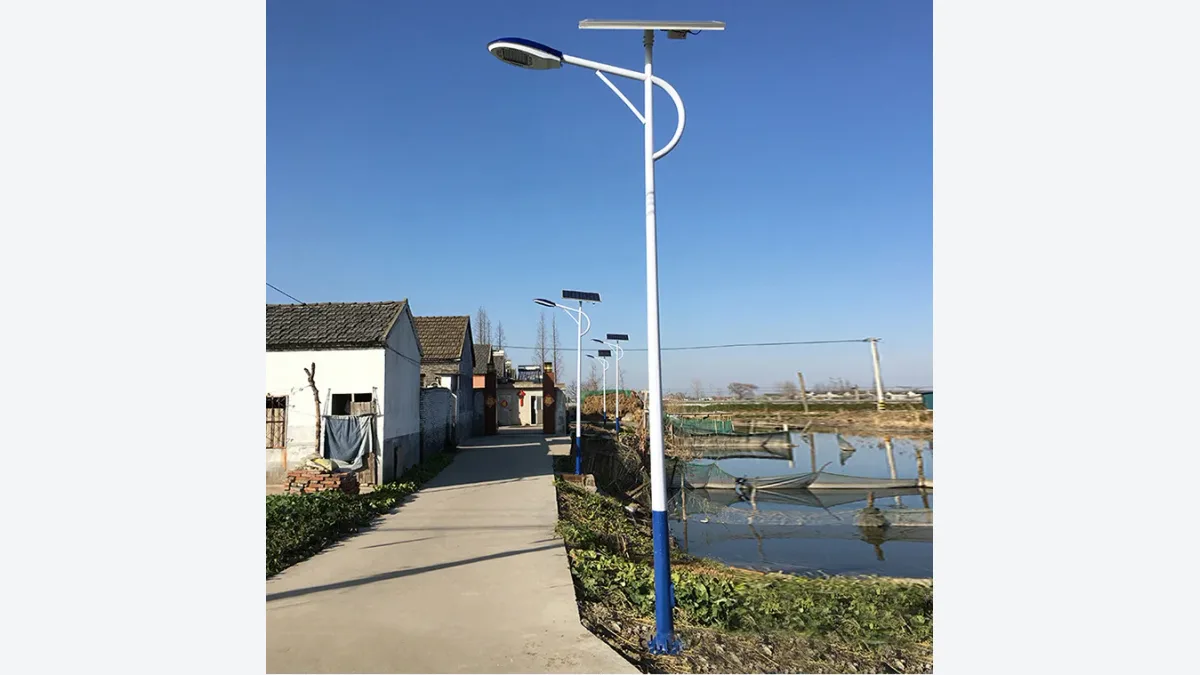
Lumen Output & Coverage
The first thing to understand about solar street light wattage is that wattage is an input, not an output. What actually determines how well a road is lit is lumen output — the amount of visible light the fixture produces. A quality LED at 210LM/W means a 100W fixture produces about 6,000 lumens, while a 300W fixture produces about 18,000 lumens. The wattage tells you the power draw; the lumen figure tells you what you see on the road.
Matching Wattage to Site Type
| Wattage | Lumen Output | Pole Height | Spacing | Typical Sites |
|---|---|---|---|---|
| 100W | 6,000LM | 6-7m | 25-30m | Residential streets, courtyards, rural roads |
| 150W | 9,000LM | 7-8m | 30-35m | Secondary roads, parking lots, plazas |
| 200W | 12,000LM | 8-10m | 35-40m | Main roads, logistics centers |
| 300W | 18,000LM | 10-12m | 40-45m | Highways, airports, large plazas |
Pole Height & Spacing
Higher wattage fixtures mount higher and spread further apart. The 100W model works best at 6-7m on 25-30m spacing; the 300W model needs 10-12m poles at 40-45m spacing. This is not a small difference: a highway installation might use one-third fewer poles at 300W than at 100W, but each pole and foundation is heavier and more expensive. Pole selection must follow wattage — a 300W fixture cannot safely mount on a light 6m pole. Match the Q235 hot-dip galvanized pole to the fixture, not the other way around.
Installation & Cost Considerations
For the same road length, 300W units mean fewer poles, less civil work, and lower per-meter installed cost on wide highways — but a higher price per unit. On narrow residential streets, 100W units at closer spacing give more even illumination for less money. Also consider battery autonomy: all ZHENYE SERIES models carry enough LiFePO4 capacity for 2-3 overcast days, and the MPPT controller charges 15-30% faster than PWM alternatives in low light.
Which Model Do You Actually Need?
Start from the road: width, required lux level, and pole spacing decide the lumen requirement; the lumen requirement decides the wattage. If you are between models, choose the higher wattage — undersizing a solar street light is the most common and most expensive mistake in the industry. Compare the 100W, 150W, 200W and 300W models in our catalog, or send us your road parameters for a free DIALux lighting design and a factory-direct quotation.
Street Lighting Standards and Illuminance Levels
Wattage selection ultimately comes down to the illuminance your road classification requires. Most national standards (EN 13201 in Europe, the CJJ 45 code in China, and similar codes elsewhere) classify roads and set average maintained illuminance: a residential street typically needs 5-15 lux, a collector road 15-25 lux, a major arterial 20-40 lux, and a highway interchange up to 50 lux. Uniformity matters too — the ratio of minimum to average illuminance should stay above about 0.4 for road safety. Your supplier should be able to provide a DIALux simulation showing the lux map for your road width, pole spacing, and mounting height before you commit. If a salesperson quotes wattage without asking about road width and pole spacing, they are selling a box, not a lighting solution.
A Worked Budget Comparison: 100W vs 300W
Consider a 2 km road section, 12m wide. With 100W units at 25m spacing, single-side mounting, you need about 80 poles, 80 fixtures, and 80 foundations. With 300W units at 45m spacing, you need about 45 poles — but each pole is heavier (10-12m class), the foundations are larger, and each fixture costs several times more. On total installed cost, the 300W layout usually wins on wide, high-speed roads because civil works dominate; the 100W layout wins on narrow residential streets because fixture cost dominates. The crossover point depends on local labor rates and concrete prices. Ask your supplier for both layouts side by side — a factory with real project experience will produce the comparison without being asked twice.
Common Wattage Mistakes Buyers Make
Four mistakes appear again and again. First, choosing by wattage alone: a 150W light with 6,000 lumens and a 150W light with 9,000 lumens are different products; compare lumens at the fixture. Second, ignoring autonomy: a battery sized for 6 hours in a region with a 12-hour night fails in the first month; confirm the autonomy assumption matches your location. Third, mounting mismatch: putting a 300W fixture on a light 6m pole is both a lighting error and a structural risk — the pole must be specified for the fixture weight and wind load. Fourth, forgetting the pole entirely: many quotes exclude the Q235 galvanized pole and foundation hardware, which is 20-30% of a complete installation. A complete quote includes the pole; a partial quote does not.
When to Oversize and When to Stay Lean
If your site is between two wattage classes, oversize — an undersized solar street light is the most expensive mistake to correct after installation, because the correction means new fixtures, new pole heights, or closer spacing. Oversizing has a real cost too, so the rule is: size from the lux requirement, then add one class only when the site has tree shading, long rainy seasons, or high security expectations. For standard residential and village roads, the 100W class with correct spacing is the economical answer; for highways and major arterials, the 300W class with correct spacing is the safe one. Everything in between is a judgment call your lighting engineer should make with the lux map in front of them.