Why Battery Placement Is a Specification Decision
Most solar street light quotations list a battery capacity and stop there. Where that battery physically sits — inside the luminaire, in a box on the pole, or in the ground — decides theft exposure, operating temperature, service access, cable length and foundation design. Placement belongs in the specification, not in the installation drawing.
Those consequences are priced and scheduled, so the decision has to be made while the bill of materials is still open, with the site conditions in front of you rather than with a standard drawing copied from the last project.
The Four Places a Battery Can Sit
Almost every stand-alone solar street light uses one of four arrangements: the battery inside the luminaire, an enclosure mounted on the pole, an enclosure buried beside or beneath the pole, or a cabinet at ground level serving one or several lights. Each changes the bill of materials and the maintenance routine.
| Arrangement | Typical fit | Main advantage | Main risk |
|---|---|---|---|
| Inside the luminaire (integrated) | Paths, residential streets, parking areas | No external battery cabling; one lift to install | Sits in the sun; replacement means opening the luminaire |
| Box mounted on the pole | Stand-alone systems with no ground space | Accessible from a ladder; heat separated from the driver | Visible hardware; height and lock become specification items |
| Buried enclosure | Hot or high-wind sites; exposed boxes not acceptable | Hidden and shaded; removes weight from the pole | Water table and ground movement; service needs excavation |
| Ground cabinet or central bank | Campuses, compounds, clusters of poles | One protected enclosure instead of many small ones | Long DC runs, voltage drop, more joints to seal |
Integrated: The Battery Inside the Luminaire
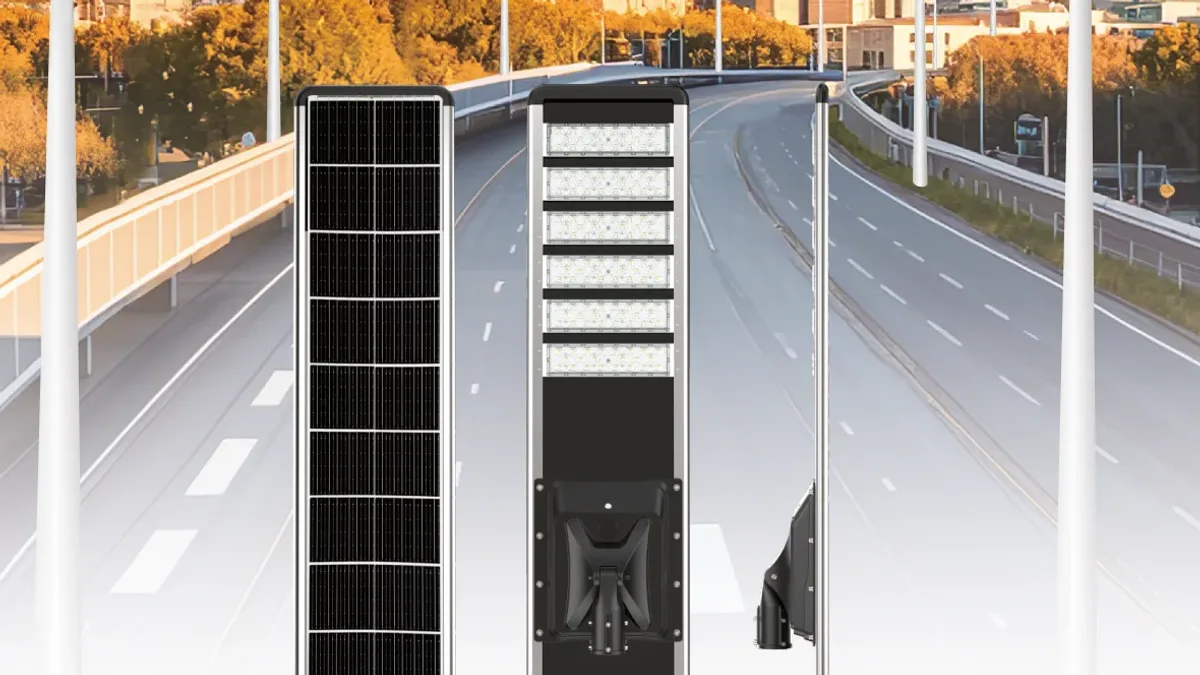
In an integrated light the panel, controller, battery and driver share one housing, so there is no external battery cable to route, seal or lose. Installation is one lift, and the factory controls every connection. The trade-off is thermal: the enclosure sits in the same sun as the panel.
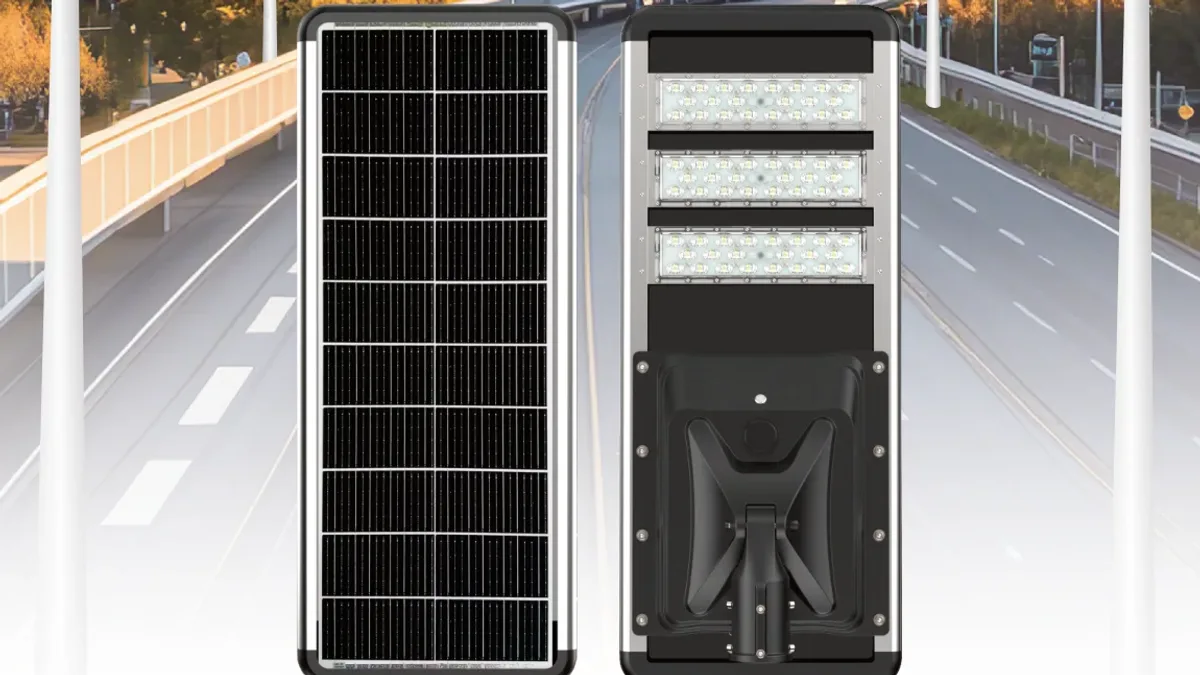
The pack lives behind a battery cover in an IP65 housing, which keeps rain and dust out but does not air-condition anything, so the temperature inside tracks ambient temperature and sun load. The specification questions that matter are the cell chemistry, the charging and discharging temperature window of that exact cell, and what the supplier states about capacity retention at the end of the warranty period. Integrated designs also fix the maximum pack size, because the enclosure sets the volume — which is why an integrated light and a split-type system are not interchangeable on a large road, as our guide to all-in-one versus split-type solar street lights explains.
Pole-Mounted Battery Box
A box clamped or banded to the pole keeps the battery accessible from a ladder and moves it away from the luminaire's heat. National tender specifications commonly describe this arrangement, including a vented, corrosion-resistant metal enclosure with a locking arrangement. Height above ground becomes a specification number rather than an installer's choice.
Public technical guidelines show how differently the same decision can be written. A national guideline for stand-alone solar street lighting in Nepal describes both a pole-mounted battery box and an underground battery, and calls the pole-mounted box common practice for stand-alone systems. A state renewable-energy agency specification in India fixes the pack at a minimum height above ground level in an enclosure rated IP66, with the battery conforming to a recognised safety standard and carrying a minimum five-year warranty. The lesson is that the height, the ingress rating and the lock are tender items: if they are not written, they are not quoted.
Buried and Underground Enclosures
Burying the battery removes it from sight and from direct sun, which helps in hot climates and reduces casual theft. It also introduces water, condensation, root and ground-movement risk, and every inspection becomes an excavation. Published design guides often specify a burial depth of at least half a metre.
The engineering answers are straightforward but must be specified: a sealed or correctly vented enclosure, cable entries that face downward, a duct so the cable can be replaced without reopening the trench, and a drawing showing exactly where the box sits. Ask for the water table and the local flood history, because a buried box on a site that floods once a year is a warranty claim waiting to happen.
Ground Cabinets and Centralised Banks
A cabinet at ground level can serve one pole or a group of lights, which suits sites where several small batteries are harder to protect than one locked enclosure. The electrical penalty is longer DC runs between the enclosure and each controller, and every additional metre adds voltage drop and a joint to seal.
Centralised storage suits compounds and industrial estates where a service team already visits the site. It concentrates the failure point: one flooded or vandalised cabinet affects every light it feeds, while one integrated light going dark affects a single pole. Where it is chosen, state the cable type, the maximum run length and the permitted voltage drop, not only the pack capacity.
Temperature: The Variable You Cannot See
A lithium iron phosphate battery ages fastest when it is hot and charges worst when it is cold, so the enclosure temperature window matters more than the nameplate capacity. A shaded box on a pole and an unshaded one in the same street can differ by many degrees on a summer afternoon.
Cell datasheets commonly publish a charging window that is narrower than the discharge window, and a pack asked to charge below its stated minimum will either be protected by the battery management system and simply not charge, or will be charged when it should not be. The useful question to a supplier is therefore not the capacity alone but the charging and discharging temperature window of this pack, and what the warranty says about capacity at the end of five years in this climate. Our solar battery selection guide covers how to read that specification sheet.
Theft, Access and Maintenance Reality
Placement is a security decision. A battery at ground level is easier to cut free than one eight metres up a pole, but a box near the ground is easier to inspect without a lift. Maintenance frequency, available equipment and local theft history should decide the answer, not habit.
Write the security detail into the clause: enclosure material and thickness, lock type, tamper-resistant fasteners, and whether the fixings are reversible with a standard tool. Decide as well how the pack will be replaced when it eventually fails, because a design that needs a crane for a routine battery swap adds cost to every year of the project. For fleets, the spares policy is covered in our warranty and spare parts guide.
Cable Runs, Sealing and Voltage Drop
Separating the battery from the controller adds DC cable, connectors and glands, and every one of them is a potential water path. Long low-voltage runs also lose voltage, so published design guidance often caps the drop across the array-to-battery circuit at a few percent.
Two consequences follow. The cable becomes part of the specification: conductor size, insulation, UV resistance and connector type. And the cable entry becomes a maintenance item: specify downward-facing entries, a drip loop before every gland, and an inspection point in the annual routine, because water that reaches a battery compartment usually arrived along a cable.
What a Tender Usually Writes
When a tender specifies the battery, it usually fixes placement as well: a minimum height above ground, an ingress protection rating, a vented and lockable enclosure, a label on the outside, and a set of documents. These clauses exist so that the battery can be inspected and replaced without engineering judgement.
| Clause | What to state | Why it matters later |
|---|---|---|
| Placement | Inside the luminaire, pole-mounted, buried, or in a ground cabinet, named explicitly | Sets installation method, foundation and maintenance access |
| Height above ground | A number in metres, not "where accessible" | Sets the reach needed for inspection and exposure to splash and tampering |
| Enclosure rating and material | Ingress protection number, enclosure material, ventilation method where required | Water and dust protection decides whether the installation lasts five years or fifteen |
| Lock and fasteners | Lock type and tamper-resistant fixings named | Security is a purchase decision, not an installation habit |
| Battery identification | Chemistry, nominal voltage, capacity in Wh, charging temperature window | Lets a replacement pack be sourced against a written record |
| Cable and documentation | Conductor size, maximum run, permitted voltage drop; datasheet, ratings, warranty terms | Prevents under-sized DC cable and supports warranty claims |
What VOLTIC Publishes Today
VOLTIC's standard ZHENYE series carries the battery inside the luminaire: a lithium iron phosphate pack published at 3.2 V and 240, 360, 480 or 720 Wh, behind a battery cover, in an IP65 housing. Those are the numbers on our product pages, not estimates.
The pack is paired with a monocrystalline panel and an MPPT controller, with a published battery service life of 8 to 10 years inside a five-year product warranty and a 25-year panel power-output warranty. If your tender requires a separate pole-mounted box, an underground enclosure or a centralised bank, treat that as a project-level configuration: the pack, enclosure and cable run then have to be defined together, and the enclosure rating, cable length and warranty position should be confirmed in writing before the order is placed. VOLTIC publishes CE and RoHS conformity and operates an ISO 9001 quality system; as with any supplier, confirm which document your market's authority accepts before you rely on it. Relevant model pages are the 100W integrated solar street light, the 300W integrated solar street light, and the solar street light pole.
Frequently Asked Questions
Should the battery be inside the light or in a separate box?
Either can work. An integrated battery removes external cabling and speeds installation; a separate box is easier to replace and can be positioned for temperature. Decide from theft risk, climate, service access and what the tender requires, then state the choice in writing so it is quoted, not assumed.
How high above ground should a pole-mounted battery box be?
There is no universal number. Some tender specifications fix a minimum height, one state agency specification uses three metres, and others leave it to the installer. If your project has a published requirement, quote it; otherwise specify a height above flood and splash level that a technician can reach from site equipment.
Can a buried battery box be checked without digging it up?
Partly. Bring the battery voltage and temperature to a connector above ground, or fit a monitoring module so state of charge is reported, and the routine check becomes a reading rather than an excavation. The enclosure and glands still need a physical inspection, so plan that into the maintenance schedule.
Does battery placement change the battery size?
It changes what the battery has to survive, not the energy it must store. A hot enclosure shortens service life, and a cold one reduces usable capacity on winter nights, so both are usually answered with more margin. Size the pack for the load and autonomy first, then adjust for the enclosure environment.
Is an underground battery more or less likely to be stolen?
Usually less, because it is out of sight and needs a spade rather than a wrench. That advantage disappears where the enclosure is visible, unsecured, or where water forces it above ground. Judge theft risk on the site, and specify the lock, the fasteners and the enclosure material rather than relying on height alone.
What documents should come with the battery?
Ask for the pack datasheet with capacity, nominal voltage, chemistry and the charging temperature window; the enclosure's ingress protection rating; the warranty terms partitioned by component; and the maintenance instructions. Those four items let an installer and a warranty claim both be handled without reopening the design.
Next Step: Send the Site Conditions, Not Just the Battery Size
A quotation that answers only the capacity question will not tell you whether the battery will still be there, still be cool, and still be reachable in year eight. Send the site conditions and the placement your project needs, and the configuration can be checked against them rather than assumed.
The useful inputs are the country and nearest city, the road or area type and pole height, the number of poles, the required autonomy in cloudy days, whether the site floods, whether the poles are already installed, and the tender clause for the battery if one exists. Send your site details and we will confirm which arrangement fits your project.