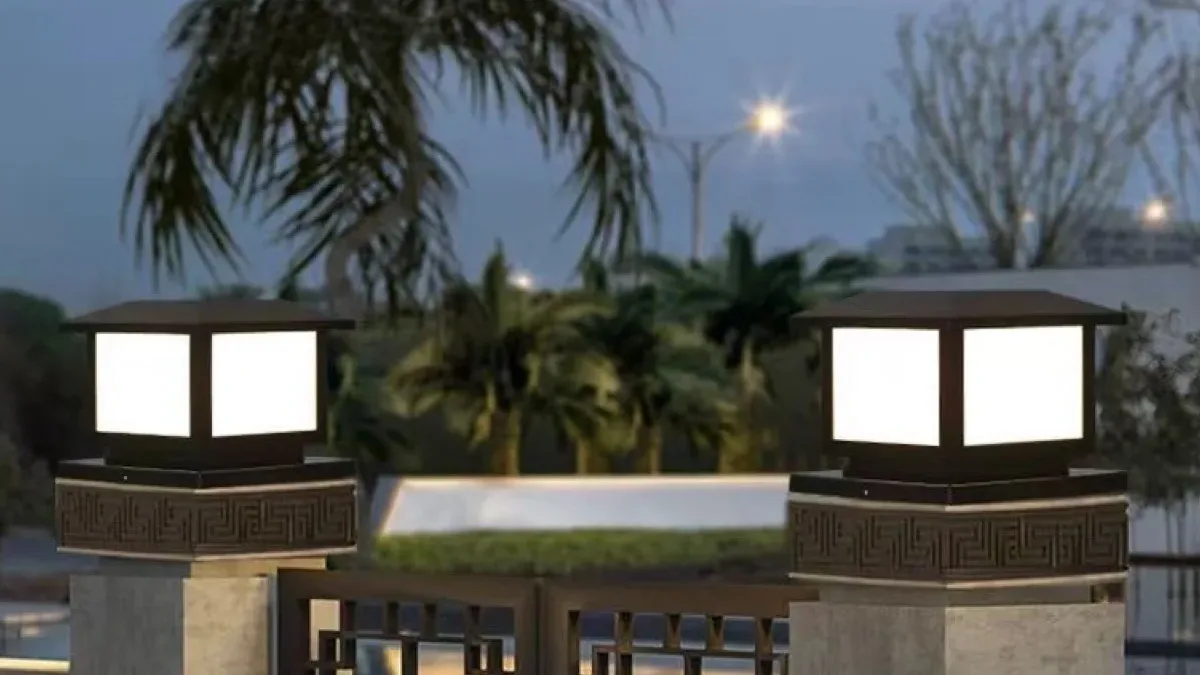
Why Wire Size Decides How a Landscape Lighting Project Looks
Landscape lighting is judged at night, at the last fixture on the run, not at the transformer. If the cable is undersized, the fixtures nearest the transformer look correct and every fixture after them is visibly weaker. The cable never appears in a catalogue photograph, yet it decides whether the installation looks designed or improvised.
Voltage drop is the name for that difference, and it is a design quantity rather than a defect: it can be calculated before a single trench is opened and held to a target by changing one of four numbers. The landscape lighting selection guide covers the fixture side of the same decision.
What Voltage Drop Is and Why Low-Voltage Systems Feel It First
Voltage drop is the voltage lost in the conductors between the transformer and the fixture, because copper is not a perfect conductor. The loss is proportional to current and to run length. At 12 V a 1 V loss is more than 8 % of the supply; at 230 V it is under half a percent.
That is why a 12 V or 24 V system dims where a mains circuit of the same length would not. The fixture still draws its watts, so the current is higher: a 60 W fixture takes 5 A at 12 V against roughly 0.26 A at 230 V, and higher current through a small conductor produces a larger drop.
There is no single code limit for low-voltage landscape cable, so the working limit is the fixture itself. Ask the supplier for the rated input voltage range of the series you are ordering, and design so the drop stays inside that range at the worst fixture on the run.
The Four Numbers That Decide the Cable
Four numbers set the cable: the transformer output voltage, the connected load in watts, the one-way run length in metres and the conductor cross-section. Change any one of them and the drop changes. A fifth input — the rated input voltage range of the fixture — tells you how much drop the project can accept.
Write them down before comparing gauges, because the usual mistake is to pick a cable out of habit and then discover that the layout has to change:
- Transformer output voltage — 12 V or 24 V, and the tap in use.
- Connected load — the sum of every fixture wattage on that circuit, not the transformer rating.
- One-way run length — transformer terminals to farthest fixture, along the cable route including vertical rises.
- Conductor cross-section — in AWG or mm², with resistance taken from the cable datasheet, not from memory.
The Voltage-Drop Formula, With a Worked Example
For a two-conductor run the working formula is Vd = 2 × L × I × R, where L is the one-way length in metres, I is the current in amperes and R is the conductor resistance in ohms per metre. The factor of two accounts for the supply conductor and the return conductor.
Take a 12 V circuit with a single 60 W fixture 30 m from the transformer. The current is 60 ÷ 12 = 5 A, and 12 AWG copper has a resistance of about 0.00521 ohm per metre. so the drop is 2 × 30 × 5 × 0.00521 = 1.56 V — 13 % of 12 V, enough to make that fixture visibly dimmer than one wired beside the transformer.
Move the same 60 W to 24 V and the current falls to 2.5 A: the drop across the same 30 m becomes 0.78 V, only 3.3 % of the supply. Copper resistance also rises with temperature — near 60 °C the first figure becomes about 1.81 V — so leave margin rather than designing to the last decimal.
Copper Cable Reference and Run-Length Limits at 3 %
A 3 % drop is a common working target, and it is far easier to design to than to inspect afterwards. The first table gives standard copper resistance for the gauges used on landscape work; the second converts that resistance into a maximum one-way run length for a load lumped at the far end.
| Conductor | Area | Resistance, single conductor | Resistance, two-conductor run |
|---|---|---|---|
| 18 AWG | 0.82 mm² | 20.9 ohm per km | 4.18 ohm per 100 m |
| 16 AWG | 1.31 mm² | 13.2 ohm per km | 2.64 ohm per 100 m |
| 14 AWG | 2.08 mm² | 8.3 ohm per km | 1.66 ohm per 100 m |
| 12 AWG | 3.31 mm² | 5.2 ohm per km | 1.04 ohm per 100 m |
| 10 AWG | 5.26 mm² | 3.3 ohm per km | 0.66 ohm per 100 m |
| 8 AWG | 8.37 mm² | 2.1 ohm per km | 0.41 ohm per 100 m |
| Conductor | 12 V, 20 W | 12 V, 40 W | 12 V, 60 W | 24 V, 40 W | 24 V, 80 W | 24 V, 120 W |
|---|---|---|---|---|---|---|
| 18 AWG | 5 m | 3 m | 2 m | 10 m | 5 m | 3 m |
| 16 AWG | 8 m | 4 m | 3 m | 16 m | 8 m | 6 m |
| 14 AWG | 13 m | 7 m | 4 m | 26 m | 13 m | 9 m |
| 12 AWG | 21 m | 10 m | 7 m | 41 m | 21 m | 14 m |
| 10 AWG | 33 m | 16 m | 11 m | 66 m | 33 m | 22 m |
| 8 AWG | 52 m | 26 m | 17 m | 105 m | 52 m | 35 m |
Both tables assume copper at 20 °C, a two-conductor run and the whole load lumped at the far end. Connector and transformer losses are excluded, so plan a run meaningfully shorter than the table value and increase the gauge when the layout allows it.
Load at the End of the Run versus Loads Spread Along It
A real run is rarely one load at the far end. Five 7 W fixtures spaced every 6 m along 30 m of 12 AWG each contribute drop, but every segment carries only the load downstream of it, so the current falls as the run progresses.
Add the five segments — 0.182 V, 0.146 V, 0.109 V, 0.073 V and 0.036 V — for a total of 0.55 V, or 4.6 % of 12 V. If the same 35 W were drawn by one fixture at the far end the drop would be 0.91 V, or 7.6 %: spreading the load cut it by about 40 % without touching the cable.
On 24 V the same distributed run totals 0.27 V, or 1.1 %, and the worst lumped case 0.46 V, or 1.9 %. Topology, not only cable gauge, decides whether the last fixture matches the first.
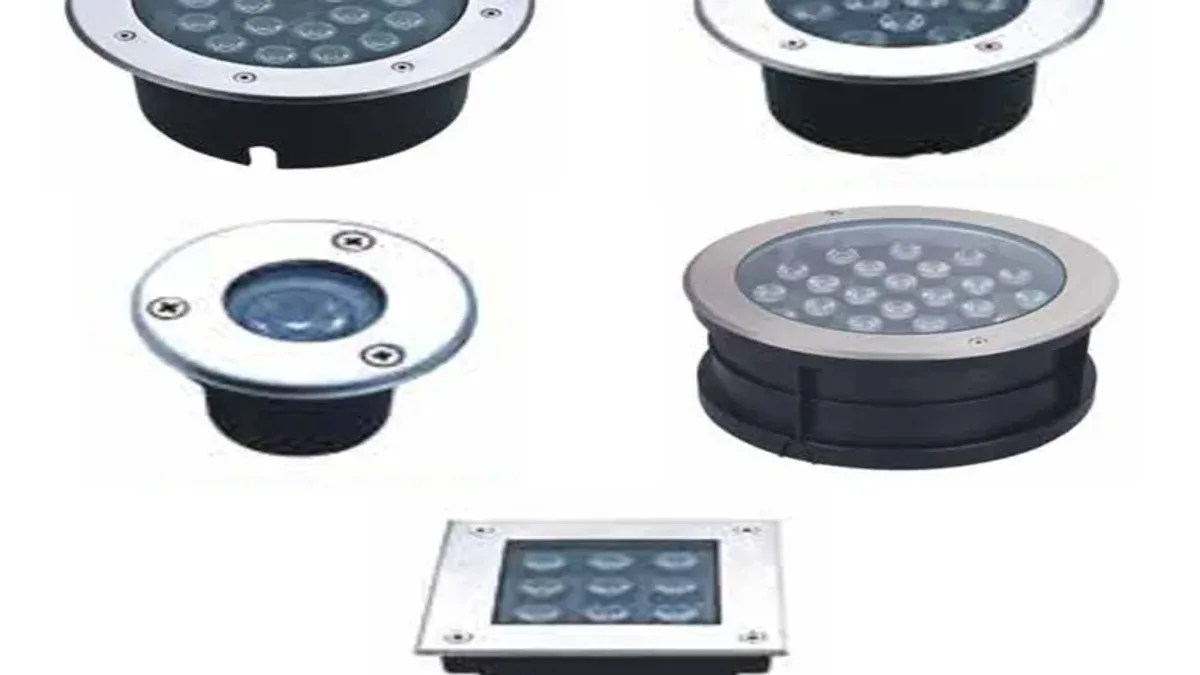
Home-run wiring removes most downstream accumulation at the cost of more cable and more joints to seal; a daisy chain saves cable and asks for a heavier gauge, a higher voltage or both. Strings of small bollard lights along a path and in-ground uplights along a facade are where the choice shows up fastest.
Sizing the Transformer: Connected Load, Headroom and Taps
Add up the connected wattage of every fixture on the transformer, then add headroom: a common practice is to keep the connected load at or below 80 % of the rating, which means sizing the transformer at roughly 1.25 times the total load. Modern LED fixtures draw far less than the halogen loads those rules assumed.
Multi-tap transformers offer outputs such as 12, 13, 14 and 15 V. The longest run is normally connected to the highest tap, so the first fixture sits slightly above nominal and the last lands close to nominal. Record which tap each circuit uses on the as-built drawing: a service visit years later should not have to guess.
Two practical points. Some magnetic transformers have a minimum connected load below which they should not be run — check the transformer datasheet rather than a forum. And the transformer primary is mains voltage: the enclosure, its protection device and the supply connection belong to a qualified electrician.
Choosing System Voltage: 12 V or 24 V
For the same wattage, doubling the system voltage halves the current and cuts the voltage drop to a quarter, because the drop depends on current. A run that misses a 3 % target at 12 V is usually comfortable at 24 V, so long runs and heavier loads belong on the higher voltage.
12 V remains the natural choice for short garden runs, for decorative ranges offered only at 12 V and for retrofits onto an existing transformer. Confirm the voltage and the rated input range of each series in writing, and never mix 12 V and 24 V fixtures on one transformer. Where a submerged fixture is involved — the underwater light series, for example — keep the run short and use a safety-isolated supply with earth-leakage protection.
Measuring Voltage Drop on a Working Installation
Measure under load. Connect every fixture on the circuit, then read the voltage at the transformer terminals and at the fixture farthest from it, using a true-RMS meter. The difference is the drop the installation actually has. A reading taken with the fixtures disconnected proves nothing, because with no current there is nothing to lose voltage across the cable.
Dimming at the end of a run, flicker, or drivers that drop out on cold nights usually points to one of five causes: cable smaller than the calculation required, a run longer than planned, a loose or corroded connection, water inside a junction box, or the wrong voltage tap. Connections are cheaper to check than cable is to replace, so examine every joint before ordering heavier wire.
Note also whether the supply is AC or DC: use a meter that handles both, and treat the primary side as mains work.
What to Write Into the Specification
Voltage drop is easy to hold at design stage and hard to argue about after handover. Four lines in the specification remove most of the argument: the target drop, the gauge and maximum run length for each circuit, the rating required of every buried joint, and a measured value taken at commissioning on the farthest fixture of each run.
- Design target — for example, “drop at the farthest fixture not to exceed 3 % of nominal voltage, from conductor resistance at 20 °C”.
- Cable schedule — gauge, maximum run length and circuit load per transformer, listed run by run.
- Joints and enclosures — IP68 junction boxes for buried connections, connectors above the water table.
- Commissioning record — voltage measured at the transformer and at the farthest fixture of every run, energised, recorded per circuit.
Frequently Asked Questions
What size cable should I use for low-voltage landscape lighting?
Start from the calculation rather than from habit: 12 AWG is a common trunk size and 14–16 AWG is often enough for short fixture drops, but the answer depends on load and length. On 12 V a 60 W load lumped 30 m away needs more than 12 AWG.
How do I calculate voltage drop for landscape lighting?
Divide the connected watts by the system voltage to get amperes, find the conductor resistance in ohms per metre, then apply Vd = 2 × L × I × R, where L is the one-way run length. Compare the result with the nominal voltage, and with the fixture input range.
Is 12 AWG good enough for landscape lighting?
For many garden runs, yes; for long or heavily loaded ones, no. At a 3 % target on 12 V, 12 AWG supports a lumped 60 W load about 7 m from the transformer, or a lumped 20 W load about 21 m. On a 24 V system the same cable carries 41 m at 40 W.
Should landscape lighting be 12 V or 24 V?
Choose 24 V when runs are long or the connected load is high, because the current is halved and the drop falls to a quarter. Choose 12 V for short decorative runs. Never mix the two voltages on one transformer.
What size transformer do I need for landscape lights?
Add the wattage of every fixture on the transformer and allow headroom: a common rule is to keep the connected load at or below 80 % of the rating, so size the transformer at least 1.25 times the total. Then choose the voltage tap for the longest run and record it.
Why are my landscape lights dim at the end of the run?
Voltage drop is the most likely cause, and it is confirmed by measuring under load at the transformer and at the farthest fixture. Before changing cable, check the connections for corrosion or water, confirm the voltage tap, and confirm the transformer is not overloaded.
Next Step: Send the Fixture List and the Layout
Send us the fixture series and quantity, the spacing, the one-way run length of each circuit and where the transformer will sit. With those four inputs we can return a recommended system voltage, a cable gauge and a transformer size for each circuit.
Our LED landscape lighting range covers eight series, from wall washers and flood lights to bollards, in-ground uplights, lawn lights, tile lights and submersible fixtures, with CE, RoHS and ISO 9001 documentation available for project submissions.