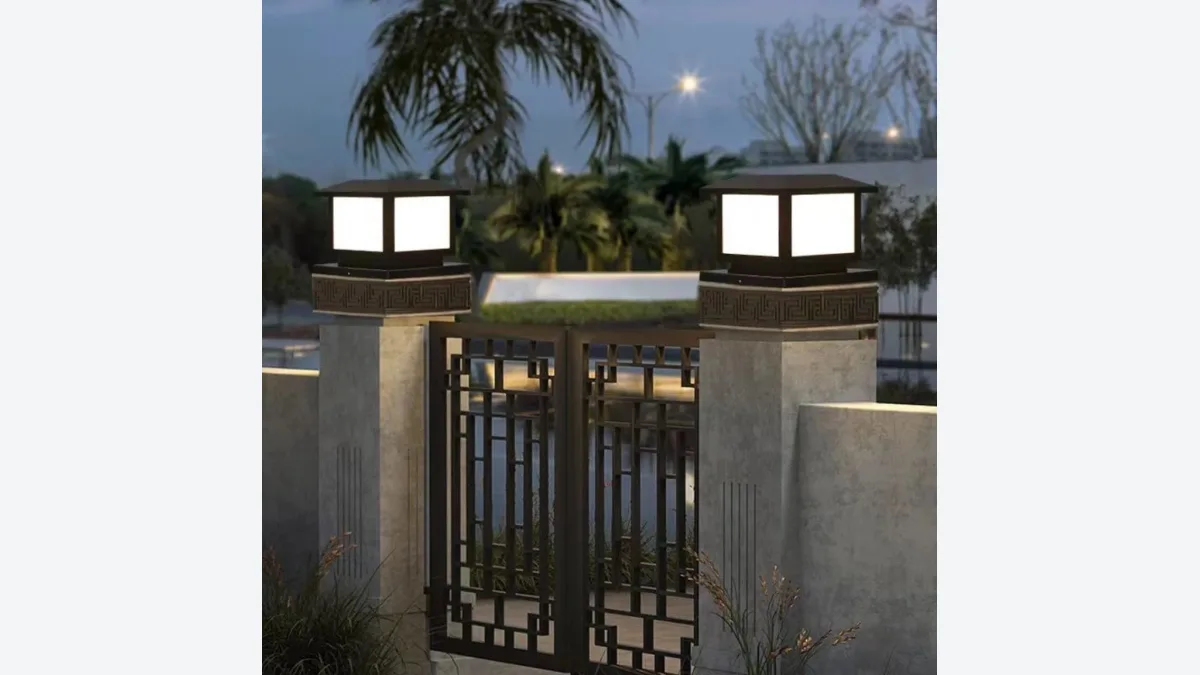
What Dusk-to-Dawn Means
Dusk-to-dawn lighting is a control mode where the fixture turns itself on automatically at sunset and off at sunrise — no timer, no manual switch, no electricity bill. Solar dusk-to-dawn lights are the simplest form of autonomous outdoor lighting: the photocell senses ambient light, the battery runs the LED through the night, and the panel recharges it the next day. You install them once and forget them for years.
How the Photocell Works
A photocell (light sensor) measures ambient illumination and triggers the switch: when light levels fall below a threshold at dusk, the fixture turns on; when levels rise at dawn, it turns off. Quality controllers add hysteresis so a car headlight, lightning flash, or streetlight glare does not flicker the fixture on and off. In ZHENYE SERIES units, the MPPT controller integrates light control, timer control, and human presence detection — you can run full dusk-to-dawn mode, or a hybrid mode where the light dims to 30% standby after midnight and returns to 100% when motion is detected.
Motion-Sensing vs Continuous Dusk-to-Dawn
Continuous dusk-to-dawn lighting guarantees illumination all night — the right choice for roads, parking lots, commercial perimeters, and security-sensitive areas where every hour of darkness must be covered. Motion-activated solar security lights stay at low standby and jump to full brightness on movement — ideal for driveways, backyards, and entrances where battery autonomy matters more than continuous coverage. The best commercial compromise is dusk-to-dawn with motion boost: full brightness on detection, low standby otherwise, all night long.
Battery Autonomy: The Real Limit
The practical limit of any solar light is battery autonomy — how many nights it can run without sunshine. Quality systems carry 2-3 days of autonomy as standard (based on 10-12 hour nights), which covers most overcast weather. For regions with long rainy seasons, specify upsized battery capacity at order time. LiFePO4 batteries rated for 4,000+ cycles and 8-10 years of daily service, combined with an MPPT controller that charges 15-30% faster in low light, keep dusk-to-dawn operation reliable through winter.
Choosing the Right Light for Your Site
Match the control mode to the site: roads and parking lots need continuous dusk-to-dawn coverage (see our solar parking lot lights and the 150W integrated solar street light for 7-8m poles at 30-35m spacing), while entrances and perimeters benefit from motion-activated solar security lights. Check the same five specs you would for any outdoor solar light: lumen output, battery chemistry, panel wattage, IP rating, and warranty. Send us your site details and nightly coverage requirement — we will recommend the right mode, wattage, and configuration.
Photocell Thresholds and Common Setup Mistakes
The photocell threshold — the lux level at which the light switches — decides when your night actually starts. Too low a threshold and the light stays off through early evening darkness; too high and it burns battery during twilight. Most quality controllers ship with a sensible default and a small adjustment range. Three setup mistakes cause most field complaints. First, mounting the sensor where the fixture’s own light hits it: the light turns itself off the moment it turns on — the classic feedback loop. Second, aiming the sensor toward a bright streetlight or billboard, which delays switch-on by an hour. Third, ignoring the hysteresis setting: without it, passing headlights flicker the fixture. On integrated solar lights, the sensor is built in and fixed, so the checklist is simply: confirm the default threshold suits your latitude, and test one night before commissioning the full batch.
Battery Autonomy Math
Work the numbers before you buy. A 100W integrated light on dusk-to-dawn mode runs about 11 hours a night at full output where I am writing this — roughly 1,100WH of nightly consumption. A 240WH LiFePO4 pack cannot do that at full brightness, which is why dusk-to-dawn fixtures use dimming schedules: 100% for the first 4 hours, 70% for the middle, 30% for the final hours. With a weighted average of about 50% output, the same light consumes about 550WH a night, and a 240WH pack delivers one usable night per charge with MPPT charging restored the next day. If your site needs full brightness all night, specify the battery accordingly — this is the single most common mismatch between expectation and specification in solar lighting.
Winter and High-Latitude Performance
Winter is the stress test for dusk-to-dawn solar lighting. Nights lengthen, sun angles drop, and panels produce a fraction of summer output. At 40 degrees north, December daylight can deliver 30-40% of June’s energy. Three mitigations make winter survivable: a larger panel (panel wattage, not battery, is the winter bottleneck), a lower standby level (20-30% instead of 50%), and an MPPT controller, which recovers 15-30% more energy in low light than PWM. If your project is above about 45 degrees latitude, ask the factory for a winter-performance calculation before ordering — a system sized on summer sunshine alone will not make it through January.
Combining Dusk-to-Dawn with Motion Detection
The most practical configuration for mixed sites is dusk-to-dawn base lighting with motion boost. The fixture runs at 30% standby all night — enough for orientation and basic security — and jumps to 100% for 30-60 seconds when motion is detected. This combination covers the security requirement of continuous light with the battery economy of motion activation. It works especially well for parking lots, backyards, and perimeter paths where you want the road or yard visible at all times but full brightness only when someone is there. When comparing quotes, ask whether the controller supports this hybrid mode — many cheap fixtures offer either continuous or motion-only, not both.