1. Determine Your Energy Needs
Start by calculating your daily energy consumption. For homes, a typical daily usage ranges from 5kWh to 30kWh. Choose a battery system that can cover at least one full day of usage. VOLTIC offers wall-mounted systems from 5kWh to 15kWh and rack-mounted systems scaling up to 30kWh+.
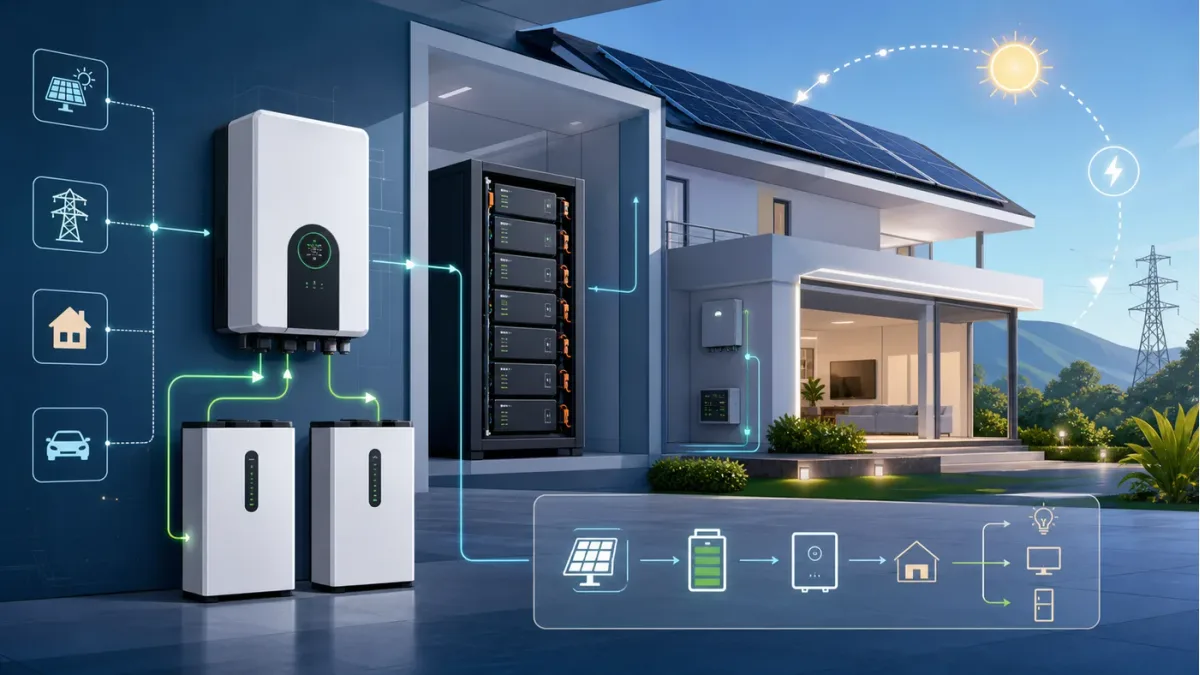
2. Wall-Mounted vs Rack-Mounted Systems
| Feature | Wall-Mounted | Rack-Mounted |
|---|---|---|
| Space | Compact, mounts on wall | Requires dedicated rack space |
| Capacity | 5-15kWh per unit | Scalable, 5-30kWh+ |
| Installation | Simple, 2-3 hours | Moderate, half-day |
| Best For | Homes, small offices | Commercial, industrial |
| Expandability | Limited (parallel 2-4 units) | High (stackable modules) |
3. Battery Chemistry: Why LiFePO4?
All VOLTIC energy storage systems use LiFePO4 (lithium iron phosphate) chemistry. Unlike NMC batteries used in EVs, LiFePO4 is thermally stable — it won’t catch fire even when punctured. Key advantages: 4000-6000 cycles (10+ years at one cycle/day), 80-90% depth of discharge, -20°C to 60°C operating range, and zero maintenance.
4. Inverter Compatibility
Ensure your hybrid inverter is compatible with the battery’s voltage range (typically 48V for home systems). VOLTIC systems support communication protocols including RS485, CAN, WiFi, and GPRS for remote monitoring. Check inverter brand compatibility before purchase.
5. Portable Power Stations
For off-grid adventures, camping, or emergency backup, portable power stations (500W-3000W) offer plug-and-play convenience. VOLTIC portable units include built-in inverters, multiple output ports (AC, DC, USB, Type-C), and foldable solar panel compatibility for true off-grid charging.
6. Warranty and Certification
Look for CE, RoHS, and UN38.3 certifications. VOLTIC energy storage products carry 3-5 year warranties with factory-direct support. Verify that the manufacturer provides local after-sales service or remote technical assistance.
Explore our solar batteries and energy storage range for wall-mounted, rack, and portable systems.
Capacity Sizing with a Worked Example
Size home storage from the loads you actually want to back up. A typical essential-load list: router 10W, fridge 60W average, LED lighting 30W, TV 80W, phone charging 15W — about 195W running, roughly 1.5-2kWh over an evening and night. With LiFePO4 at 80% DoD and one day of autonomy, that points to a 5kWh system; two days of autonomy, 10kWh. If you want to run an air conditioner or an induction cooker in an outage, the inverter rating — not the battery — becomes the constraint: 2-3kW inverters handle a fridge and lights easily, while a 3.5kW AC needs a 5kW inverter. The rule: size the battery from daily energy, size the inverter from the largest simultaneous load, and add 20% margin to both.
Grid-Tied, Hybrid, or Off-Grid: What Each System Does
The same battery hardware serves three different strategies. A grid-tied (no battery) system exports surplus solar and buys power at night — cheap, but useless in an outage. A hybrid system with battery storage keeps the grid as backup, charges the battery from surplus solar, and switches over in milliseconds during an outage — the standard for most homeowners today. A fully off-grid system has no grid at all and must carry its own autonomy, which usually means 1.5-2x the battery of a hybrid system. Choose by two questions: does your grid fail often, and does your utility pay fairly for exported power? Frequent outages and low export rates both push toward hybrid with a larger battery.
BMS, Communication, and Monitoring
The battery management system is the difference between a battery and a fire hazard. A proper BMS balances cells, protects against overcharge, over-discharge, over-temperature, and short circuit, and reports state of charge to the inverter. Communication protocol matters for integration: RS485 and CAN are the industrial standards that most inverters speak, while WiFi and GPRS enable app monitoring — useful for seeing your state of charge remotely and scheduling charge/discharge around time-of-use tariffs. When comparing quotes, ask which inverter brands the battery is certified to pair with; an "any inverter" claim is usually marketing. Also confirm the BMS supports firmware updates, because battery-inverter communication bugs are patched, not replaced.
Installation, Safety, and Certification
Installation rules exist because energy storage is a fire-safety device. Wall-mounted batteries go on a load-bearing wall, away from direct sunlight, with clearance for airflow; rack batteries need a ventilated, accessible space. The electrical work — AC wiring, breaker sizing, inverter connection — belongs to a licensed electrician in most jurisdictions. Before buying, verify the certifications that apply to your market: CE, UN38.3 for the cells, IEC 62619 for the battery system, and IEC 62109 for the inverter are the common ones. And check the installation manual before you pay: some manufacturers require professional installation for the warranty to be valid, and a self-install that voids the warranty is an expensive mistake.