1. Understand the Main Landscape Lighting Types
Each type of landscape light serves a different purpose. Here's a quick overview of the 8 major categories:
| Type | Best For | Typical IP Rating |
|---|---|---|
| LED Wall Washer | Building facades, feature walls | IP65 |
| In-Ground Light | Pathways, driveways, plazas | IP67/IP68 |
| Bollard Light | Garden paths, perimeters | IP65 |
| Flood Light | Large area illumination | IP65 |
| Underwater Light | Ponds, fountains, pools | IP68 |
| Lawn Light | Gardens, landscaping | IP65 |
| Fence Light | Railings, boundary walls | IP65 |
| Step Light | Staircases, ramps | IP65 |
2. IP Rating: The Most Critical Specification
For outdoor landscape lighting, IP rating determines how well the fixture withstands water and dust. IP65 is the minimum for exposed outdoor use (rain, dust). IP67 can handle temporary submersion. IP68 is required for permanently submerged applications like underwater lights and in-ground lights in wet areas.
3. Material Selection
Stainless steel (304/316) offers best corrosion resistance for coastal and high-humidity environments. Die-cast aluminum provides a good balance of durability and cost for general outdoor use. Tempered glass diffusers with silicone gaskets ensure long-term waterproof sealing. Avoid plastic-bodied fixtures for permanent installations.
4. Beam Angle and Light Distribution
Wall washers typically use wide beam angles (30-60°) to evenly illuminate large surfaces. In-ground uplights use narrow beams (10-25°) for accent lighting. Bollard lights use 360° or directional beams depending on placement. Match the beam angle to your lighting objective — accent, wash, or area illumination.
5. Control Options
Modern landscape lighting supports DMX512 for professional RGB color-changing installations, RF/wireless for simple remote control, and static single-color for basic applications. RGB+W (RGB with dedicated white) fixtures offer both color effects and functional white light in one unit.
6. Installation Considerations
In-ground lights require proper drainage (gravel base) to prevent water pooling. Underwater lights need low-voltage (12V/24V) with proper grounding. Wall washers need mounting brackets rated for the fixture weight. Always use waterproof cable connectors and junction boxes rated for outdoor burial.
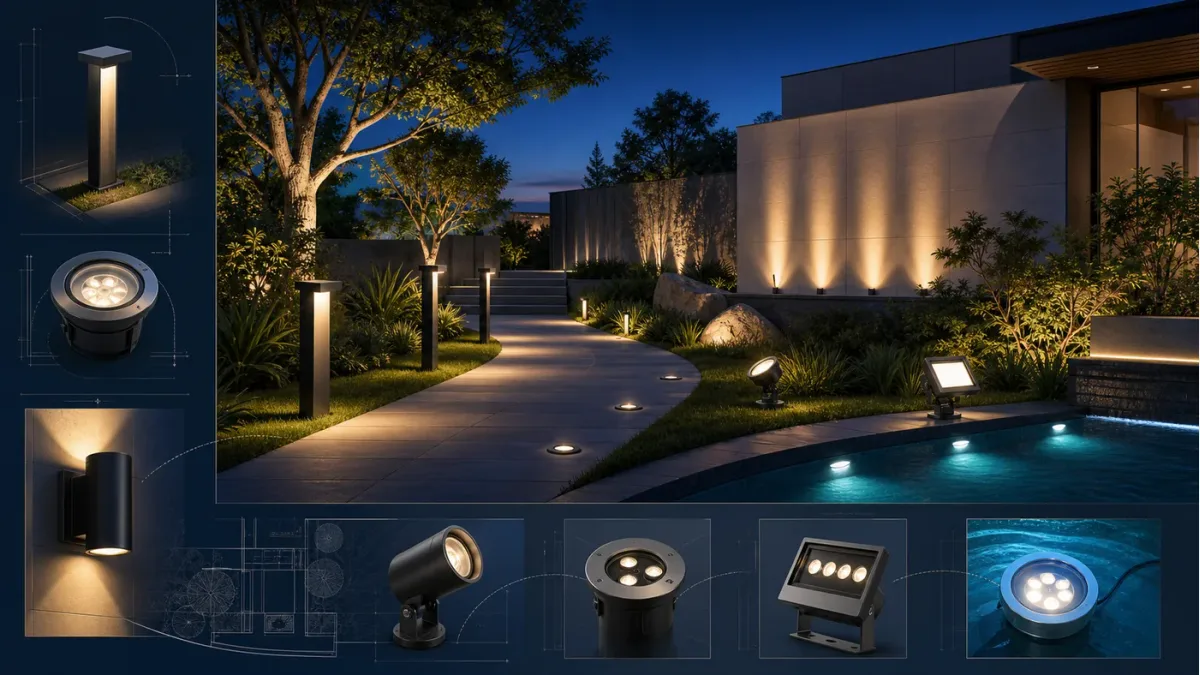
Explore our LED landscape lighting series — 8 series, 100+ models with IP65/IP68 ratings.
Lighting Design Basics: Working in Layers
Professional landscape lighting is built in layers, and each layer has its own fixture type. The ambient layer washes surfaces softly — wall washers on facades, flood lights for broad pools of light. The accent layer highlights features — in-ground uplights on trees and sculptures, spot beams on signs and art. The task layer covers functional needs — bollard and step lights for safe walking, path lights for navigation. The rule of three applies: use about three accent lights for every one flood light, keep ambient levels low enough that accents remain visible, and avoid the common mistake of lighting everything at the same level, which produces a flat, parking-lot look no matter how expensive the fixtures. A good design alternates light and shadow; shadow is what gives a garden depth at night.
Project-Type Selection Guide
Different project types call for different series. Residential gardens: bollard lights along paths, lawn lights in planting beds, wall lights at entries, one or two accent in-ground uplights on specimen trees — 12V systems for DIY simplicity. Hotel and resort landscapes: wall washers on facades, RGB underwater lights in pools and fountains, bollards on walkways, with DMX control for seasonal color scenes. Commercial plazas and mixed-use projects: higher-wattage flood lights and wall washers for uniform ambient coverage, inground lights in hardscape, and step lights for level changes, all IP65 or better for year-round service. Parks and civic spaces: bollards and path lights for safety, flood lights for feature structures, and vandal-resistant construction — impact-rated housings and tamper-proof screws are not optional on public sites.
DMX, Smart Control, and Maintenance
Control choice scales with project size. Static single-color fixtures need no control wiring at all — they run on a photocell or timer. Simple RF remotes group fixtures and dim scenes without cabling — fine for residential and small commercial. DMX512 is the professional standard for RGB projects: every fixture gets an address, and a controller drives color changes, chases, and scenes in sync — the choice for hotels, landmark facades, and fountain shows. Whatever the control system, plan maintenance before installation: fixtures fail, and the fixture you cannot reach or cannot replace without digging up the paving is the fixture that stays dark. Specify replaceable light engines, keep 3-5% spares of every series, and document the DMX addressing chart in the handover file — a project without its addressing chart becomes a mystery box after the first technician leaves.
Waterproofing Details That Decide Lifespan
Landscape fixtures fail at the connections, not the LED. The three details that decide a fixture’s real IP performance: the cable gland and how the cable enters the housing (a downward gland sheds water; an upward one collects it), the junction box (IP68-rated, buried with the connector well above the water table), and the breather valve — sealed fixtures that cannot breathe build condensation inside and fog the lens. For in-ground lights, install them in a sleeve so the fixture can be lifted for service without breaking the surrounding paving. For underwater lights, use low-voltage 12V/24V with an SELV transformer and dedicated earth leakage protection. These details are invisible in the catalog photo and decisive in the tenth year.