Lithium Iron Phosphate (LiFePO4) Overview
LiFePO4 batteries operate at 3.2V nominal voltage and are the preferred choice for solar lighting, home energy storage, and portable power applications. Known for thermal stability, safety, and long cycle life, they outperform lead-acid in virtually every metric that matters for solar applications.
Performance Comparison
| Feature | LiFePO4 | Lead-Acid |
|---|---|---|
| Service Life | 8-10 years | 2-3 years |
| Charge Cycles | 4000-6000 | 300-500 |
| Depth of Discharge | 80-90% | 50% max |
| Temperature Range | -20°C to 60°C | 0°C to 40°C |
| Weight (per kWh) | ~8 kg | ~25 kg |
| Maintenance | None required | Regular checks |
| Efficiency | 95-98% | 70-85% |
| Safety | Thermally stable | Risk of acid leak |
Application by Battery Type
Solar Street Lights
LiFePO4 is the clear winner. Integrated solar street lights (like ZHENYE SERIES) use 3.2V 240WH-720WH LiFePO4 packs that last the full 8-10 year design life. Lead-acid would need replacement 2-3 times over the same period, negating any upfront cost advantage.
Home Energy Storage
For daily cycling (charge during solar day, discharge at night), LiFePO4's 4000+ cycle life means 10+ years of service. Lead-acid degrades rapidly under deep cycling and requires ventilation for hydrogen gas — a dealbreaker for indoor installation.
Portable Power Stations
Weight is critical for portable applications. A 1kWh LiFePO4 pack weighs ~8kg vs ~25kg for lead-acid. LiFePO4 also handles partial state-of-charge operation without sulfation damage.
When Lead-Acid Still Makes Sense
For projects with extremely tight initial budgets and where weight/size are not constraints, sealed lead-acid batteries remain an option. VOLTIC offers compatible systems for customers who prefer this route. However, the total cost of ownership (including 2-3 replacements) almost always favors LiFePO4 over a 10-year horizon.
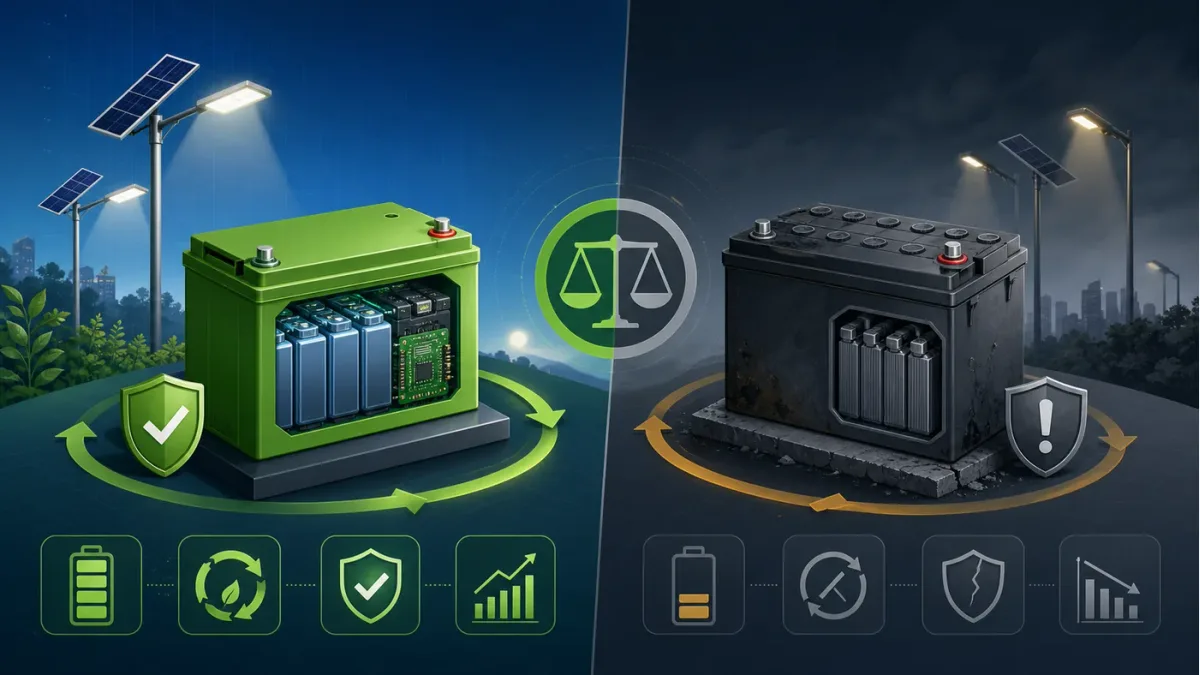
All ZHENYE SERIES solar street lights ship with Grade A LiFePO4 batteries as standard — see our battery and energy storage range for complete systems.
The 10-Year Total Cost Calculation
Run the numbers over ten years and the chemistry choice stops being an opinion. Take a 100AH 12V bank (1.2kWh usable at 50% DoD for lead-acid, 960WH usable at 80% DoD for LiFePO4). A lead-acid bank at roughly 300-500 cycles needs replacement every 2-3 years in nightly service: four replacements over a decade, plus disposal and the labor of swapping 30kg of battery. A LiFePO4 bank at 4,000+ cycles serves the whole decade without replacement. Even if lithium costs 3-4x per watt-hour upfront, the decade total — one lithium purchase versus four lead-acid purchases plus labor — comes out in lithium’s favor by a wide margin. Add the solar panel side: because lithium accepts charge at up to 1C and uses the MPPT window more efficiently, you need a smaller panel for the same recharge, which compounds the saving.
Cold Climate Performance Compared
Temperature is where the two chemistries diverge most. Sealed lead-acid loses capacity sharply below 10 degrees C and its cycle life halves for every 8-10 degrees of sustained cold; at -20 degrees C a lead-acid bank delivers roughly half its rated capacity. LiFePO4 holds capacity far better — typically 80-90% at -10 degrees C with low-temperature cells — and its discharge curve stays flat, so a light keeps full brightness until the battery is nearly empty, instead of dimming gradually as lead-acid voltage sags. The charging side matters too: lead-acid needs temperature-compensated charging or it overcharges in summer and undercharges in winter; LiFePO4 with a BMS handles the same range with simpler, safer management. For any project above 35 degrees latitude, specify low-temperature cells and confirm the controller’s temperature sensor.
Weight, Transport, and Installation
Weight is a line item, not a detail. An equivalent usable-capacity bank weighs about three times more in lead-acid: a 1.2kWh lead-acid bank is roughly 30kg, the LiFePO4 equivalent about 10kg. On a solar street light, that difference decides whether the battery mounts inside the housing or on a separate pole box — and every gram on a 10m pole is a gram of wind load and foundation cost. In home storage, weight decides whether you can wall-mount the unit or need floor space and a rack. Transport is regulated for both: lead-acid is corrosive-class cargo; lithium requires UN38.3 documentation and is restricted on air freight. Neither is a blocker, but both should be in the plan before the purchase order, not discovered at customs.
Common Myths About Lithium Batteries
Three myths keep buyers on lead-acid longer than the numbers justify. Myth one: "lithium explodes." LiFePO4 is thermally stable and does not have the runaway failure mode of cobalt-based lithium; the fire incidents in the news are almost entirely NMC or unmarked cells. Myth two: "lithium needs special chargers." Any quality MPPT controller with a settable absorption voltage charges LiFePO4 correctly; the battery’s BMS provides the final protection layer. Myth three: "lithium is overkill for solar lighting." That was true a decade ago; today the cycle-life advantage means lithium is cheaper per decade of service in nightly use. The real remaining argument for lead-acid is the absolute lowest first cost — valid for a one-year pilot, not for infrastructure.