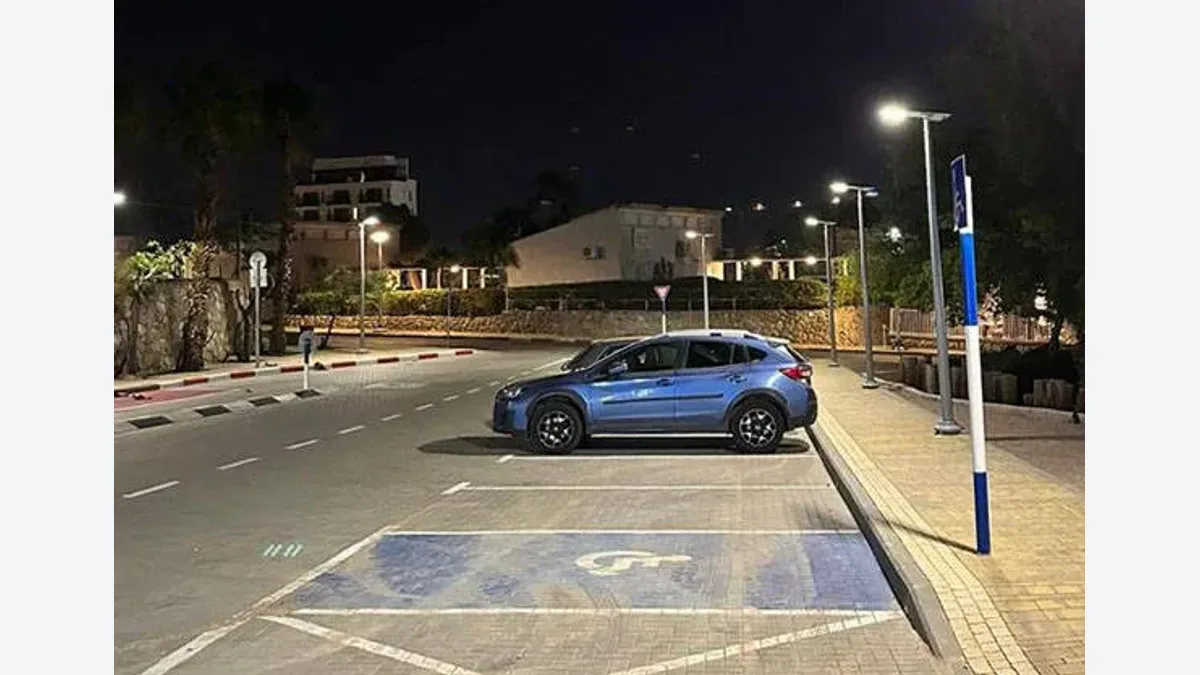
Why Solar Parking Lot Lights Make Sense
Parking lots are one of the highest-ROI applications for solar lighting. A typical commercial lot runs 8-12 hours of illumination per night, 365 days a year — a constant electricity bill with grid-powered fixtures. Solar parking lot lights eliminate that cost entirely while removing the need for trenching, conduit, and connection to the local grid. For new lots, remote sites, and lots where grid extension quotes run into tens of thousands of dollars, the solar option often pays for itself before the grid connection would have been completed. Modern integrated units combine a monocrystalline panel, MPPT controller, and LiFePO4 battery in one housing, so installation is a two-hour job per pole: mount the fixture, raise the pole, done.
Solar Parking Lot Lights Cost Breakdown
The cost of solar parking lot lights breaks into three parts: the fixture itself, the pole and foundation, and installation labor. The table below shows typical figures for a 150W integrated unit — the most popular choice for commercial parking lots:
| Component | Specification | Typical Cost |
|---|---|---|
| 150W integrated solar parking lot light | 9,000LM, 90W panel, 360WH LiFePO4 battery | Factory-direct pricing |
| Q235 hot-dip galvanized pole | 8m, flange + ground cage | Factory-direct pricing |
| Foundation & installation | Reinforced concrete pad, 2-person crew | ~2 hours per pole |
| Electricity (grid alternative) | 150W x 11h/night equivalent | $40-90 per unit per year |
Request a factory quote for exact solar parking lot lights cost in your market — our sales engineers respond within 24 hours with a complete bill of materials for your lot size.
Choosing the Right Wattage for Your Parking Lot
Wattage selection depends on lot size, mounting height, and required illuminance. As a rule of thumb for 8m poles with 20-25m spacing: 100W units (6,000LM) suit small lots and perimeter rows; 150W units (9,000LM) are the workhorse for standard commercial parking lots; 200W units (12,000LM) cover large retail lots and logistics yards; 300W units (18,000LM) are for airports, stadiums, and very large facilities. Motion-sensing dimming makes a 150W unit behave like a much brighter light exactly when it matters: 100% output when vehicles or pedestrians are present, dropping to 30% standby during quiet hours — saving battery for the whole night while meeting security expectations.
ROI: How Quickly Do Solar Parking Lot Lights Pay Back?
The payback calculation is straightforward: compare the avoided grid electricity cost plus avoided trenching against the fixture price difference. A 100-pole lot with grid fixtures consuming roughly 400-600 kWh per pole per year at commercial rates of $0.10-0.25/kWh spends $4,000-15,000 annually on electricity. Solar parking lot lights eliminate that bill for 25+ years (panel warranty) with one battery replacement at the 8-10 year mark. When installation savings are included — no cable trench, no distribution panels, no grid connection fees — most projects reach break-even within 2-4 years.
Commercial Solar Lighting for Parking Lots: What Buyers Should Check
Before ordering commercial solar lighting for parking lots, verify five things: battery chemistry (LiFePO4 preferred for cycle life and safety), controller type (MPPT charges 15-30% faster than PWM in low light), panel efficiency (monocrystalline 20-22%), IP rating (IP65 minimum for outdoor), and certification documents (LM-79 photometric reports, CE/RoHS, wind resistance calculations for poles). A source factory can provide all of these — trading companies often cannot.
Get a Factory Quote for Your Project
Send us your lot dimensions, pole count, and local sunlight conditions. We will recommend wattage, spacing, and pole heights from our solar parking lot lights range, and return a factory-direct quotation with complete documentation for your project or tender.
Parking Lot Lighting Standards: Lux and Uniformity
Parking lot lighting is regulated more than most people expect. The IES (Illuminating Engineering Society) Recommended Practice for parking facilities sets maintained illuminance of roughly 10 lux on the pavement for basic lots, 20 lux for active retail lots, and up to 30 lux for high-security and transit lots, with uniformity ratios of about 3:1 maximum-to-minimum. Meeting these numbers is a function of pole spacing, mounting height, and fixture output — not a matter of guesswork. A 150W integrated light at 9,000 lumens on an 8m pole with 20-25m spacing in a staggered layout comfortably meets the basic and retail tiers. Ask your supplier for a lux map of your exact lot; a photometric file costs them nothing and tells you whether the layout works before concrete is poured.
Layout Patterns: Perimeter, Staggered, and Island Mounting
How you place the poles changes the result more than the fixture model. Perimeter mounting (lights on the edges, aimed inward) is the most economical for medium lots and doubles as boundary security lighting. Staggered mounting inside the lot gives more uniform coverage and is standard for large retail parking areas. Island mounting (a pole in a landscaped median with fixtures on both arms) covers the widest area per pole and suits very large lots, at the cost of one pole in the traffic path. A common mistake is spacing poles too far and then blaming the fixture: at 8m mounting height, 25m spacing is the practical limit for 150W-class lights. If your lot is wider than the pattern allows, add a row — not wattage.
Motion-Sensing Economics in Real Numbers
Motion sensing is where parking lot solar lighting makes its money back. A 150W unit on full brightness for 11 hours consumes about 1,650WH; with motion dimming — 100% on detection, 30% standby — the weighted average drops to roughly 500-600WH per night, about one-third of the consumption. That smaller nightly draw means a smaller battery and panel for the same service, which is why motion-sensing integrated lights cost less than continuous-brightness units with equivalent autonomy. For a 100-pole lot, the difference in battery capacity alone is typically a five-figure number in hardware. The trade-off is coverage expectation: some facility managers prefer constant light for CCTV quality. If your cameras need full illumination all night, size the system for continuous mode and keep motion sensing as a dimming layer, not the primary strategy.
Installation and Civil Works: What to Expect
Site work for solar parking lot lights is deliberately simple: mark the pole positions from the lux plan, drill and pour the reinforced concrete foundations (one day for curing in most climates), then erect poles and mount fixtures — a two-person crew typically completes 10-15 poles per day including wiring-free installation. No trenching, no conduit, no transformer, no electrician on the payroll. The checklist before pour: verify the pole positions against the shadow study (trees and neighboring buildings steal winter sun), confirm the ground cage orientation, and set the foundation top above the finished pavement grade to avoid water pooling around the flange. After the first storm, re-torque the anchor bolts. For a 100-pole lot the entire civil phase usually fits inside two weeks.