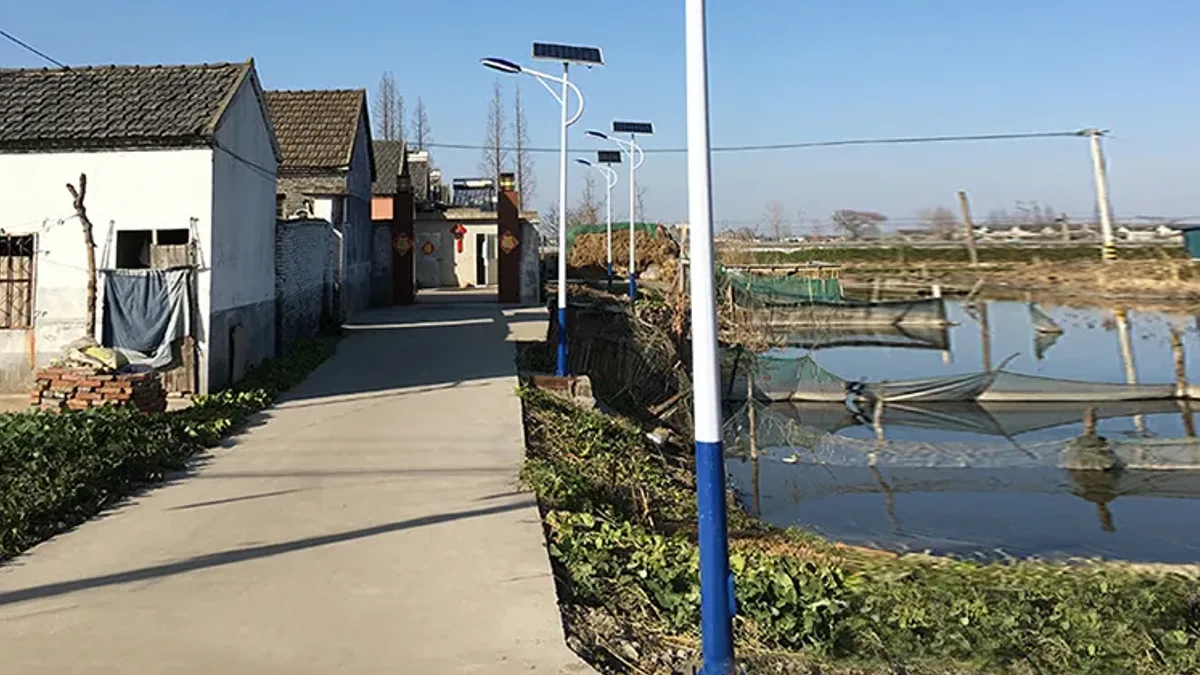
Why the System Type Comes Before the Wattage
Most solar street light enquiries open with a wattage, and that is the wrong starting point. Long before power is discussed, the architecture decides what any wattage can deliver: whether the panel, battery, controller and luminaire share one housing or are mounted apart, and how the panel can be aimed.
Three architectures are sold today: all-in-one (integrated), all-in-two, and split-type. The first half of this guide defines each one and compares them on the points that actually decide projects. The second half shows how to write your choice into a specification that competing suppliers can be held to.
What All-in-One (Integrated) Actually Means
An all-in-one solar street light puts the monocrystalline panel, the MPPT charge controller, the LiFePO4 battery and the LED module inside one die-cast aluminium housing. It clamps to the pole as a single item, with no separate battery box, no external cable between components and no field wiring to commission on site.
VOLTIC builds its ZHENYE SERIES this way: 100W to 300W units producing 6,000 to 18,000 lumens at 210LM/W, with 60W to 180W panels and 240Wh to 720Wh LiFePO4 batteries in ADC12 die-cast bodies sealed to IP65. Because the panel and the lamp share one body, any mounting angle you set applies to both.
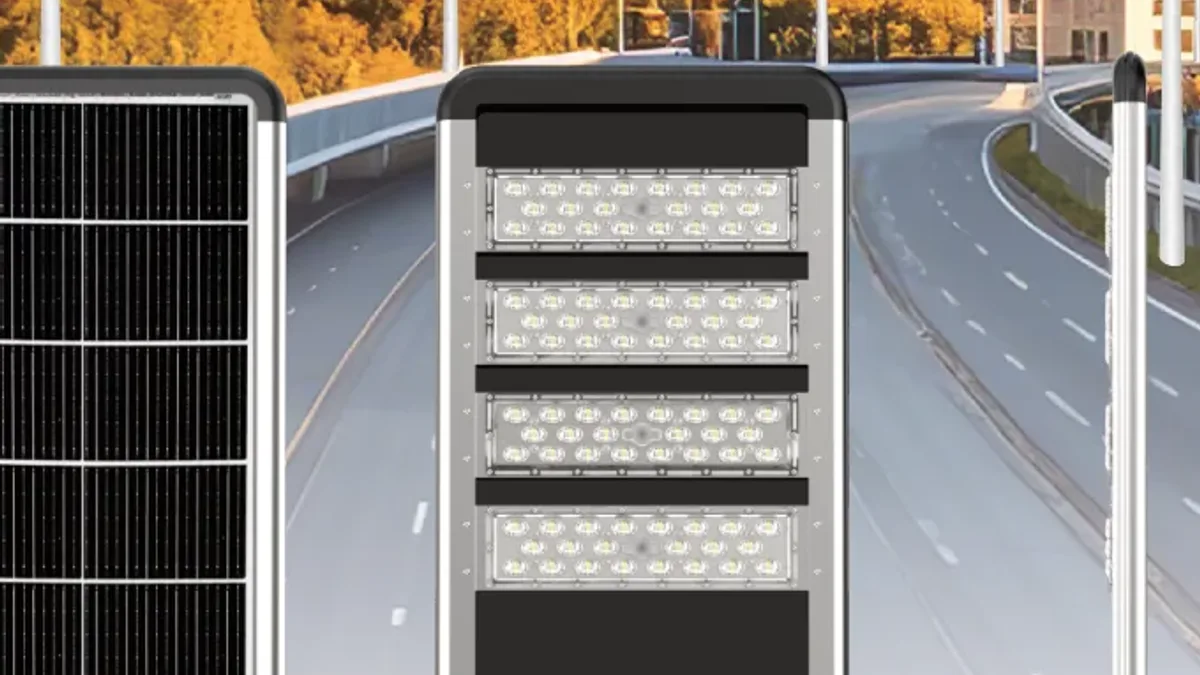
What Split-Type Actually Means
A split-type system separates the parts. The solar panel is mounted on its own bracket, the battery sits in a separate enclosure, and the luminaire is a distinct fixture, all connected by cable to a charge controller. Separation allows a larger array, a bigger battery bank and a panel tilt that is independent of the light.
The cost of that freedom is scope. Split systems add brackets, a battery enclosure, cable and cable protection, more mounting points and more site labour. They also expose more valuable components in positions that a thief with basic tools can reach.
All-in-Two: The Middle Ground
An all-in-two design keeps the battery and the luminaire together and moves only the panel to a separate mount. You gain independent panel tilt and aim while still installing two items instead of five. It suits projects where panel orientation matters but the pole should not carry a separate battery enclosure.
In practice all-in-two is the least common of the three, and it is worth asking about mainly when a site has one shading or orientation problem and no other constraint forcing a full split.
The Trade-Offs, Side by Side
The table compares the three architectures on the points that decide real projects. Read it before you read a quotation, because the cheapest unit price usually hides the largest installed cost. Every row below maps to a clause you can place in your own specification.
| Factor | All-in-one (integrated) | All-in-two | Split-type |
|---|---|---|---|
| Panel position and tilt | Fixed to the fixture, same direction as the light | Separate mount, adjustable tilt and aim | Separate mount, tilts freely and can be oversized |
| Battery capacity | Limited by housing volume (VOLTIC range: 240Wh to 720Wh) | Larger than integrated, still one main unit | Largest; a battery bank in its own enclosure |
| Installation | One item on the pole, no inter-component cabling | Two items, short cable to the panel | Panel, battery box and luminaire mounted and cabled separately |
| Theft and vandalism | One locked housing, components not reachable from the ground | Panel exposed, core unit protected | Panel and battery enclosure exposed on unsupervised sites |
| Service access | Module-level replacement; some subsystems are factory-serviceable only | Battery accessible in the main unit | Every component individually replaceable on site |
| Upfront cost | Lowest per unit and least site labour | Mid, between the two extremes | Highest: more parts, more cable, more civil work |
| Best fit | Residential and village roads, car parks, campuses, fast rollout | One orientation or shading problem, simple install | High latitudes, heavy shading, large arrays, main-road projects |
| Weaker choice when | The array must be bigger than the housing allows | Pole space is very constrained | Budget rollouts and theft-prone locations |
The Panel Angle Problem That Decides Most Projects
In an integrated fixture the panel and the lamp face the same way, so the panel angle is set by the lighting requirement. On a road running east to west, where the light must aim along the carriageway, the panel inherits that angle instead of facing the sun. Off-angle harvest is the first thing to check.
A panel tilted away from its ideal angle produces less energy each day, and that shortfall has to be recovered somewhere: a larger panel, a larger battery, or a lower evening output. On a split system the panel can aim at the sun while the light aims at the road, and the array can be oversized. Above roughly 40 degrees of latitude, where winter sun stays low, this difference often decides the project. Ask both suppliers to state the design tilt, the winter harvest assumption and the resulting autonomy in days.
Battery Capacity, Autonomy and Cloudy-Day Backup
Battery capacity is where the architectures separate most sharply. In an integrated unit the pack must fit inside the housing, which caps how much energy it can store. A split system can carry a battery bank sized independently of housing volume, which is why it suits regions with long cloudy seasons and weak winter sun.
The number that matters is autonomy: how many consecutive low-sun days the system keeps running at a stated lighting profile. Ask for it in days, with the profile written down. VOLTIC publishes its dimming schedule, running at 100 percent output with people present and 50 percent standby in hours 1 to 4, at 70 and 40 percent in hours 5 to 8, and at 60 and 30 percent in hours 9 to 12, so autonomy can be calculated against a real profile rather than a rated wattage. Battery chemistry and sizing are covered in more detail in our solar street light battery guide.
Theft and Vandalism Change the Answer for Many Sites
On unsupervised roads, split systems lose to integrated units for one practical reason: the parts can be removed. A separate panel, a battery enclosure and a lamp head each have resale value, and each can be taken with basic tools. An integrated fixture presents a single housing whose components are not reachable from the ground.
Where theft is a known risk, integrated units are usually specified for the whole route, with tamper-resistant fasteners on the mounting bracket and the battery cover. If a project genuinely needs a split system in a high-risk area, budget for anti-tamper hardware and a secure battery enclosure as separate line items rather than assuming the standard hardware is enough.
Cost Is the Installed Cost, Not the Unit Price
A split system unit price can look competitive until you cost the rest of the scope: panel brackets, a battery enclosure, cable, cable protection and additional site labour. An integrated fixture arrives as one item and needs one mounting operation. That is why rural rollouts of several hundred poles usually standardise on integrated units.
Compare quotations on installed cost per pole, and ask each supplier to quote the complete bill of materials rather than the fixture alone. Poles are the other half of that bill. Our solar street light pole range covers 6m to 12m Q235 hot-dip galvanised columns, and the solar light pole guide explains the foundation and load data a civil contractor needs before delivery.
How to Specify Either Type for a Tender
Whichever architecture you choose, a tender is decided by the figures you fix in writing. The list below is what a factory needs in order to quote without guessing, and what an evaluator needs in order to compare two bids fairly. Send the identical brief to every supplier.
- Lighting task. State the road class or the required illuminance and uniformity, referencing the standard your market uses, such as EN 13201 in Europe or IES RP-8 in North America. A wattage is not a lighting requirement.
- Lumen output and beam type. Give the lumen target at the fixture and the light distribution the road width needs.
- Pole height and spacing. These fix the layout: our integrated models pair 100W with 6-7m at 25-30m spacing and 300W with 10-12m at 40-45m spacing, with the full ladder on the solar street light range.
- Panel power and design tilt. Panel wattage, cell type and the tilt assumption for the site latitude.
- Battery capacity and chemistry. State watt-hours and chemistry; watt-hours is the only figure comparable across different system voltages.
- Autonomy. Days of backup at a named dimming profile, in writing.
- Controller and dimming. MPPT is the default expectation; write down the profile and the control modes you require.
- Colour temperature and IP rating. 3000K, 4000K and 5700K are not interchangeable in a municipal specification.
- Wind load. State the design wind speed and ask for the calculation matching your pole height; a report for an 8m pole does not cover a 12m pole.
- Warranty and documents. Warranty length and what it covers, plus the test reports and certificates your market requires. Ask which market each certificate is valid in before you accept it.
Which Type Fits Your Project
Match the architecture to the site rather than to a preference. Village and residential roads, car parks, campuses and industrial yards are almost always best served by integrated units, where installation speed and theft resistance matter more than the maximum possible array size.
- Residential, village and rural access roads - integrated. Fast rollout, minimal civil work, low theft exposure.
- Car parks, plazas, campuses and industrial yards - integrated. Even coverage at 8m and below, where motion dimming pays for itself.
- Main roads and highways in good-sun regions - high-power integrated units of 200W to 300W first; move to split only if the array must grow beyond the housing.
- High latitudes, heavy winter cloud or heavy shading - split or all-in-two, where panel tilt and a larger array outperform a fixed integrated unit.
- North-facing luminaires on east-west roads - split or all-in-two, where panel and light can be aimed independently.
- Sites with acute theft risk - integrated, with tamper-resistant fasteners specified for the bracket and battery cover.
- Coastal and cyclone-exposed sites - either type, but the wind-load calculation and mounting hardware decide the outcome, so verify both against the local design speed.
Frequently Asked Questions
Is all-in-one or split-type better for solar street lights?
Neither is universally better. All-in-one wins on installation speed, unit cost, theft resistance and simple maintenance, and it covers most residential, village, car park and campus projects. Split-type wins where the panel needs an independent tilt, where the array must be larger than a housing allows, or where winter sun is weak. Choose by site conditions, not by category.
Can an all-in-one solar street light be mounted on any pole?
It mounts on a standard pole of the right diameter and wall thickness for the fixture weight and wind load. The fixture and the pole must be sized together, and the recommended mounting height differs by model, from 6-7m for a 100W unit to 10-12m for a 300W unit. Confirm the bracket diameter and the pole top detail before ordering.
How many cloudy days will a solar street light keep running?
That depends on battery watt-hours, the lighting profile and the local solar resource, so it must be quoted as an autonomy figure in days at a named profile. Ask your supplier for the design autonomy and the winter harvest assumption in writing. A rated wattage alone says nothing about cloudy-day backup.
Which type is cheaper to install?
All-in-one, in almost every case, because the fixture arrives as one item and needs one mounting operation. Split systems add brackets, a battery enclosure, cable and cable protection, plus more labour on site. Compare installed cost per pole rather than unit price, and ask for the complete bill of materials.
Can I upgrade an all-in-one light later?
Only within the limits of the housing. You cannot fit a larger battery or panel than the enclosure was designed for, and some subsystems are serviceable only at the factory. Plan capacity at specification stage. If you expect the lighting requirement to grow, a split or all-in-two architecture leaves more room to expand.
Which type is easier to maintain?
A split system is easier to repair component by component, because the panel, battery and luminaire are separately accessible. An integrated unit is easier to keep running as a fleet, because there are fewer parts to inspect and a failed unit is swapped rather than rebuilt on the pole. Fleet size and distance to site usually decide this one.
Next Step: Send Your Site Details
Bring us the road width, the pole height, the lighting requirement and the daily operating hours, and we will tell you whether an integrated unit covers the project or whether your site conditions point to a split system. We will state the specifications in writing rather than leaving them to a brochure.
As a solar street light manufacturer we supply the integrated fixture, the pole and the battery, so the whole assembly can be specified together. Review the integrated solar street light range and then send your project details for a factory-direct quotation.