Malaysia is one of the few markets where a solar street light is bought against a written public-works specification rather than a catalogue page. Contractors who search for the “JKR specification” usually want one thing: a document list they can hand to a supplier. What they find instead is a chain of four documents — a design standard, an installation specification, an approved-materials list and the tender schedule — and each one asks a different question. This guide explains what each document controls, which numbers a supplier must evidence, and how to read a distributor’s “JKR spec” label.
Why “JKR Spec” Is Not a Single Document
JKR is Jabatan Kerja Raya, the federal public works department, and the road-lighting documents a Malaysian tender cites come from two of its roles: the design standard the industry works to, and the material approval the department keeps for its own works.
They are separate instruments with separate owners, and a quotation that satisfies one does not automatically satisfy the other.
The confusion is practical. A distributor advertises a luminaire as “JKR spec”, a contractor forwards that page to a consultant, and the consultant asks for the listing certificate. The product may meet the design requirement and still not appear on the approved list, or appear there in a different wattage.
The Four Documents Behind a Malaysian Tender
Four documents govern a Malaysian road-lighting procurement, and each fixes a different part of the problem. Read them in order, because the earlier ones constrain the later ones: a luminaire schedule cannot rescue a wrong class, and a good luminaire cannot rescue a pole that fails its wind calculation.
| Document | Who issues it | What it fixes | What it does not fix |
|---|---|---|---|
| MS 825, Code of practice for the design of road lighting (parts 1–6) | Department of Standards Malaysia | The lighting class a road section must meet, and how performance is calculated and measured | Which luminaire, pole or battery you buy |
| L-S20, Specification for road lighting installation | JKR Electrical Engineering Branch | How the installation is built, inspected and documented | The photometric target of the road, which comes from MS 825 |
| JKR EMAL (Electrical Material Approved List, also written JMAL) | JKR Electrical Engineering Branch | Whether a specific model from a specific manufacturer is listed for JKR works | Whether another wattage in the same family is listed |
| Tender schedule and bill of quantities | The project consultant | Quantities, warranty terms, testing, payment and delivery milestones | Anything the three documents above already fix |
Most failed bids are lost on one of those rows rather than on price: a class quoted for the wrong road type, an unlisted product, a wind calculation made on the housing instead of the panel, or a warranty that starts at delivery when the consultant expected commissioning.
MS 825 Sets the Target, Not the Luminaire
MS 825 is the Malaysian road-lighting design standard, published in parts: general design of roads and public amenity areas, tunnels, selection of lighting classes, performance requirements, calculation and measurement. A tender usually quotes the performance part, because that is where the M, C, P and EV classes are defined.
The M classes apply to traffic routes and are judged on road-surface luminance with uniformity, glare and surround ratios attached; the C classes cover conflict areas such as junctions and roundabouts, where illuminance is the working measure; the P classes cover pedestrians and cyclists, and the EV classes apply where a vertical surface has to be seen. None of them names a wattage, a lens or a battery.
That is the point worth taking into a supplier conversation: a class is a property of a layout, not of a luminaire. It is proved by a photometric simulation run on your geometry with the luminaire’s own photometric file, which is why the same 150 W head can satisfy one road section and fail the next. How a solar dimming profile interacts with those classes is set out in our guide to dimming and road lighting classes.
Editions matter: MS 825-1 was first revised in 2007 and MS 825-4 dates from 2012, and revised drafts of Part 1 and Part 4 went out for public comment up to the end of 2025. Quote the edition your consultant names.
What L-S20 Adds on the Installation Side
L-S20 is JKR’s specification for road lighting installation, published by its Electrical Engineering Branch, with the 2024 revision of its early sections available on JKR’s reference portal. It refers back to MS 825 for the lighting design, then governs what a design report leaves out: how the installation is erected, tested, commissioned and handed over.
For a solar project this shifts the burden of proof towards the structure. On a mains installation the hard engineering sits in the cable network; on an off-grid pole the load-bearing decisions are the pole, the foundation, the anchor bolts and the panel mounting, and those are the items an installation specification inspects before it accepts the works.
Two consequences follow. The pole and foundation belong in the quotation rather than in a separate civil package the buyer assumes someone else will price, and the documents that travel with the delivery — drawings, test records, torque values, as-built notes — are part of the deliverable. The structural questions to ask before an order are in our solar light pole guide.
JKR EMAL: What an Approved-Material Listing Proves
EMAL is the Electrical Material Approved List kept by JKR’s Electrical Engineering Branch, and it is the document behind the phrase “JKR approved” on a Malaysian product page. It is an approval of materials for JKR works, granted per product model and per manufacturer, and it is separate from the safety and performance test reports a laboratory issues.
What a listing proves is narrow and useful: that this model, from this manufacturer, has been assessed and accepted for the works it is listed for. What it does not prove matters just as much. It does not extend to another wattage in the same family unless that variant is listed too, it does not describe the bill of materials actually shipped, it does not make an imported product compliant in another market, and it says nothing about who honours the warranty in your country.
Ask for four things in writing: a copy of the certificate, the listed model code including wattage, the validity date, and the manufacturer’s name exactly as it appears on the list. Where a product page claims a specification but shows no listing, treat the claim as a design statement, not an approval. Our position is plain: VOLTIC publishes CE, RoHS and ISO 9001 evidence, and where a project needs an EMAL-listed model we confirm the current listing for that exact model before the order — we do not print “JKR approved” without the certificate.
Autonomy Is the Number the Monsoon Tests
A solar street light in Malaysia is specified against a rainy season, not an average day. Autonomy has to be a testable sentence: how many consecutive days without useful sun the installation must keep working, at what output, while still holding its lighting class. Without those three parts the number means nothing.
The arithmetic is short and the buyer can do it. Take usable battery energy in watt-hours at the end of the warranty period rather than when new, divide it by the nightly energy demand at the specified dimming profile, and you have the number of no-sun nights the system can carry. Both inputs must come from the supplier’s published data, and both are routinely missing from quotations that state only a wattage.
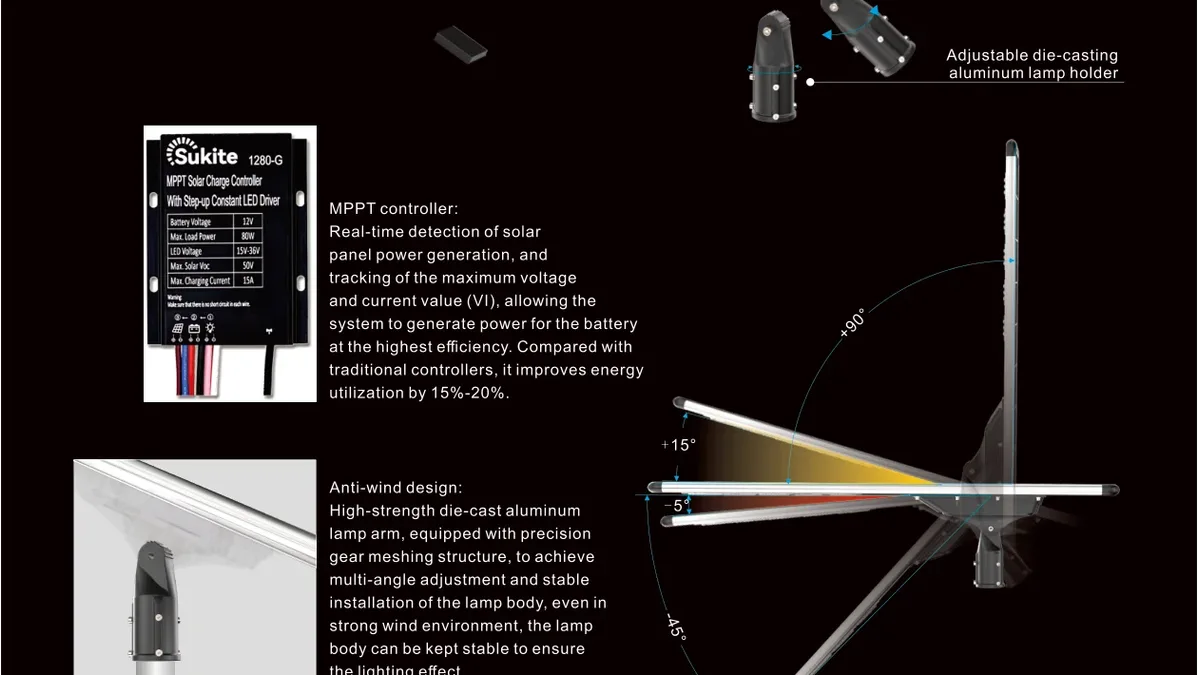
A published example from our own range shows what those inputs look like: the 150 W integrated model lists a 6 V/90 W monocrystalline module, a 3.2 V 360 Wh LiFePO4 battery, 9,000 lm output and an MPPT controller with light control, timer control and presence detection, printing a documented profile of full output for four hours at 50 percent standby, 70 percent from hours five to eight and 60 percent from hours nine to twelve. One caution when reading a page like that: the 150 W in the model name is a series designation, not the system’s power draw. Ask the supplier for the nightly energy demand of the profile above in watt-hours and compare that with usable battery energy — a battery sized from the nameplate wattage alone will not carry the profile it is quoted against. Push those numbers through your site’s worst-month sun hours; if the tender asks for more no-sun days than the result delivers, the module and battery are resized upward and the bill of materials says so. The survey inputs that feed the calculation are in our site survey guide, and the pole and head are usually quoted together for this market, so check the split against our solar street light pole range before the layout is fixed.
The Evidence Pack to Send With a Bid
A tender evaluation is a document exercise before it is a technical one, and a supplier who cannot produce the pack below loses points regardless of product quality. Each line must name the exact model, because a report for a sister product is not evidence for the product you are buying.
| Requirement | Document that evidences it | What it must show |
|---|---|---|
| Lighting class achieved | Photometric file (IES or LDT) plus a simulation on the tender geometry | The class, the calculation grid and the luminaire file used |
| Luminous output | LM-79 test report from an accredited laboratory | Measured lumens and efficacy for the exact model |
| Lumen maintenance | LM-80 data with a TM-21 projection | The maintenance percentage at the warranty year, method stated |
| Ingress and impact | IEC 60529 report; IEC 62262 if an IK rating is claimed | The levels actually tested, and on which enclosure |
| Battery safety and transport | UN 38.3 summary; IEC 62619 report for industrial lithium cells | Cell chemistry, capacity and tested configuration |
| Corrosion resistance | ISO 9227 salt-spray report; ISO 1461 certificate for hot-dip galvanizing | Test duration and coating thickness applied |
| Structural adequacy | Wind calculation to MS 1553:2002 using the panel’s projected area | Design pressure, projected area, resulting pole and foundation loads |
| Electrical safety | Luminaire safety report to the IEC 60598 series | The luminaire category and the tested model |
| Market approval | EMAL certificate where the works require it | Listed model, wattage and validity |
| After-sales | Warranty terms, spare parts list and response commitments | Start date, exclusions and who performs the replacement |
Two document habits decide arguments later. Check the model number on every report against the quotation, because families share names. Then check the market: a report issued for one destination does not satisfy a tender in another, as our certification guide by market explains.
Wind Load and Coastal Corrosion: Two Items That Fail Audits
The commonest structural mistake in a solar tender is pricing a pole for a luminaire and then mounting a panel on it. A module adds projected area at the top of a lever arm, so the wind load is decided by the panel outline rather than the housing, and the foundation follows it.
MS 1553:2002 is the Malaysian wind-loading code, and the figure quoted in practice for main wind-force-resisting systems is a minimum design pressure of 0.65 kN/m² on the projected area, before the shape and height factors your engineer applies. Give that calculation the panel dimensions, the mounting angle and the pole height, and require the foundation drawing to come from the same calculation rather than a standard detail sheet.
Corrosion is the second audit item, and Malaysia’s coastal humidity, monsoon rain and frequent thunderstorms make it a specification line rather than a maintenance hope. Specify hot-dip galvanizing to ISO 1461 with a stated coating thickness, stainless fasteners at the frame and bracket, and a salt-spray report if the site is within reach of the sea. Ask where the sealing boundary sits: an IP66 optical compartment behind an IP65 housing is a different product from a fully sealed one, and wind-driven rain finds that difference in the second year. Earthing and surge protection belong in the same conversation, as our guide to earthing and surge protection sets out.
Buying Checklist for “JKR-Spec” Lights
Each line is answerable in a short email, and a supplier who cannot answer one is telling you something useful.
- Which edition of MS 825 the tender cites, and which class applies to each road section.
- The photometric file and a simulation run on the tender geometry, not a demo road.
- Watt-hours at end of warranty, module watts, night profile and the autonomy basis in no-sun days.
- The EMAL certificate with listed model code and wattage, where a listing is required.
- A wind calculation using the panel’s projected area, with the foundation drawing that follows it.
- Corrosion specification: galvanizing standard and thickness, fastener material, salt-spray evidence.
- Warranty start point, exclusions, and who performs the replacement on site.
- Pre-shipment testing, who witnesses it, and the handover document set.
Frequently Asked Questions
Is JKR approval the same thing as a type-test report?
No. A type-test report is laboratory evidence that a model met a stated test standard; an EMAL listing is a market approval for use on the listed works. A tender can require both, and neither substitutes for the other.
Which MS 825 part should a tender reference for performance?
The performance part, which defines the lighting classes, supported by the part that guides selection of a class for a given road. Quote the edition the consultant names, since the standard is being revised in parts rather than as a single document.
What autonomy should I specify for a Malaysian site?
Let the consultant set the no-sun days for the site, then require the supplier to show the arithmetic against them using usable watt-hours and the night profile. A supplier who quotes “three rainy days” without a watt-hour basis has not answered the question.
Can an integrated light meet a JKR road class?
Sometimes, and the answer comes from a simulation rather than a datasheet. Integrated heads have a fixed module area and a fixed optic, so the class they can hold depends on mounting height, road width and spacing — the geometry a simulation tests. The published figures for our 150 W integrated solar street light are 7–8 m mounting height at 30–35 m spacing.
Does CE marking satisfy a Malaysian tender?
No. CE is a European declaration of conformity against European directives. Malaysian requirements are expressed through the Malaysian standards and the material-approval route described above, so a CE declaration is evidence of process, not a substitute for the market requirement.
Next Step: Send the Road and the Documents You Must Meet
Send us the road sections, the class or lighting target the tender names, the pole height you are working to and the document list your consultant requires. We will return the model that fits, the photometric file for the simulation, the watt-hours and profile behind the autonomy claim, and an honest note on which market documents we can supply and which ones your importer must obtain locally.
Where a listing or a test report does not exist for the model you need, we will say so before you commit rather than after. A tender lost on a missing document is cheaper than a delivery blocked at site. Send the site details to the VOLTIC technical team and we will take it from specification to a comparable quotation.