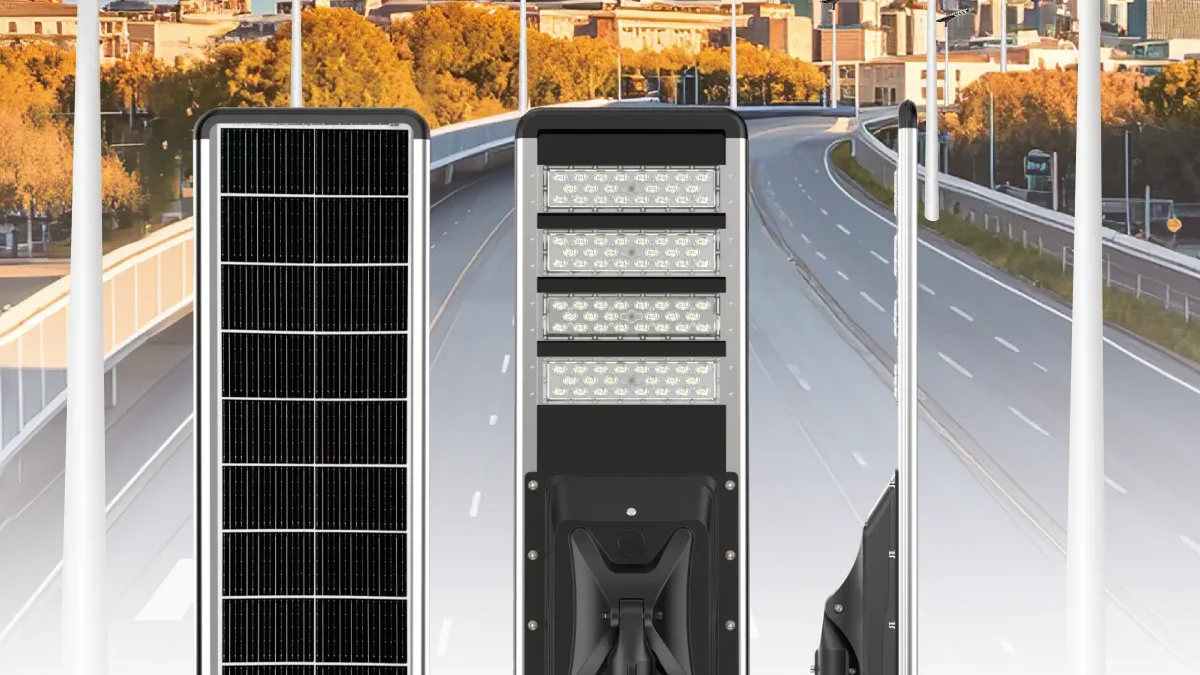
Ask a solar street light to hold a road lighting class and the first objection you will hear is that it dims. Off-grid lighting runs on a fixed daily energy budget, so most systems reduce output in the small hours to guarantee that the battery reaches sunrise. That objection deserves a better answer than reassurance: the real questions are which hours must hold the class, which hours may be dimmed, and what evidence proves the result.
This guide is written for the people who have to sign off on that answer — project buyers, EPC contractors, consultants and distributors selling into municipal and highway work. It explains how the two class systems you will meet in a tender actually work, how a solar dimming profile interacts with them, why light distribution matters more than a lumen figure, and what to write into a request for quotation so that competing bids can be compared at all.
Why Dimming and Road Lighting Classes Collide on Solar Projects
Solar street lights are sized around a fixed daily energy budget, so output is often reduced after midnight to guarantee that the battery reaches sunrise. A road lighting class is a promise made to the road authority, and that promise does not lapse because the light is off-grid.
On a grid-connected installation the dimming decision is largely a lighting-design choice: the energy saving is welcome but rarely decisive, because the mains can always supply more. Off-grid, the same decision is structural. Every hour at full output is paid for in panel watts and battery watt-hours, and those two items dominate the unit cost of the pole. A project that quietly flattens the night-time profile to save battery, and never revisits the class requirement, is the most common way a solar lighting scheme ends up arguing with its own specification.
The practical consequence is that dimming cannot be an afterthought added at commissioning. It has to be agreed with whoever wrote the specification, because it changes the required class, the required optics and the required battery at the same time.
The Two Class Systems a Tender Will Cite
Most specifications you will meet come from one of two families. The European EN 13201 series defines road lighting classes in Europe and is widely referenced elsewhere, while the IES roadway recommended practice is the reference used across North America and much of Asia-Pacific.
EN 13201 is published in parts, and it helps to know which one a clause is pointing at. Part 1 covers the selection of lighting classes, Part 2 sets the performance requirements, Part 3 defines the calculation, Part 4 the measurement and Part 5 the energy performance indicators. A tender that names "EN 13201" without a part is usually quoting Part 2 performance values.
The IES family works differently. Roadway practice sets illuminance and uniformity targets by road classification rather than by a single luminance table, and where uplight or light trespass is a constraint the specification often adds a BUG rating for backlight, uplight and glare. Because the two systems are built on different criteria, a class from one cannot be converted into a class from the other by arithmetic — the calculation has to be run in the system the authority adopted.
What a Class Actually Requires: M, C and P
The European standard sorts roads into three groups. M classes cover areas for motorised traffic and are judged on road surface luminance, C classes cover conflict areas, and P classes cover pedestrian and low-speed areas judged on horizontal illuminance rather than luminance.
The values below are the Part 2 requirements for the M classes, the group that matters most on highway and collector-road work. They are the maintained figures: the level the road must still reach at the end of the maintenance cycle, not the figure measured the day the poles go up.
| Lighting class | Road surface luminance (cd/m²) | Overall uniformity Uo | Longitudinal uniformity Ul | Threshold increment TI (%) |
|---|---|---|---|---|
| M1 | 2.00 | 0.40 | 0.70 | 10 |
| M2 | 1.50 | 0.40 | 0.70 | 10 |
| M3 | 1.00 | 0.40 | 0.60 | 15 |
| M4 | 0.75 | 0.40 | 0.60 | 15 |
| M5 | 0.50 | 0.35 | 0.40 | 15 |
| M6 | 0.30 | 0.35 | 0.40 | 20 |
Values are taken from EN 13201-2:2015 and are reproduced here as an orientation only; confirm the edition your specification names and check the national annex that applies, because adoption differs between countries.
Three of those columns deserve a plain-English reading. Overall uniformity is the ratio of the lowest to the average luminance on the carriageway, and it is what stops a road looking like a series of bright pools. Longitudinal uniformity controls the bright-dark pattern seen by a driver travelling along the row of poles, which is the effect behind the familiar zebra pattern on badly spaced schemes. Threshold increment measures disability glare — the veiling brightness in front of a driver's eyes — and it is the value most easily broken by a badly aimed luminaire on a short pole.
The performance values are also defined for roads long enough for the luminance concept to hold, roughly twenty to twenty-two times the mounting height. Short stretches, junctions and roundabouts fall into the C classes instead, which is why a scheme that satisfies one class on a long link can still fail at the intersection at the end of it.
Class Selection Is Time-Dependent: The Basis for Curfew Dimming
The guidance for choosing a class does not treat traffic as constant. Design speed, traffic volume, traffic composition, junction density, parked vehicles, ambient luminance and navigational difficulty all carry weighting values, and the class number is derived from their sum.
That is not a technicality — it is the legitimate basis for night-time dimming. A road that carries heavy mixed traffic at 20:00 and almost nothing at 03:00 does not have the same lighting requirement at both times, because two of the selection parameters, traffic volume and ambient luminance, have changed. Where the authority accepts the argument, the class that must be held between, say, 22:00 and 05:00 is the lower class, and the system only has to deliver the higher class during the evening hours.
What the authority will not accept is a supplier deciding this unilaterally. Dimming is a design decision taken with the road owner, documented in the specification, and then implemented as a timetable. A lighting scheme with a dimmed night and no written agreement is not an efficient scheme — it is an unapproved deviation that will surface at handover, when the poles are already standing.
How a Solar Dimming Profile Interacts With the Class
A dimming profile is a timetable that fixes an output level for each block of the night, and for an off-grid light it is the single biggest lever on battery size. The published default for the VOLTIC ZHENYE integrated range is set out below.
| Night block | Output with presence detected | Output with no presence |
|---|---|---|
| Hours 1-4 | 100% | 50% |
| Hours 5-8 | 70% | 40% |
| Hours 9-12 | 60% | 30% |
These are factory settings published for the range, and they are confirmed against the ordered model in writing; the same profile can be adjusted for a project, but the adjustment must be requested rather than assumed.
The arithmetic that matters is simple, and it is worth doing before the tender goes out. Twelve hours at full output is 1,200 percent-hours of energy per night. The profile above, with the sensor never triggered, works out to 480 percent-hours; with the sensor triggered through every block it reaches 920 percent-hours. So the same fixture faces a night that ranges from 40 percent to 77 percent of a full-output night, depending on how busy the road actually is.
Now apply the class. If the specification says the full class must be held from dusk to dawn, the profile has to be a flat 100 percent, the system must be sized for 1,200 percent-hours, and the panel and battery grow accordingly. If the specification permits the lower class after midnight, the required energy falls sharply and the same pole can be quoted with a smaller battery — or the same battery can be quoted with more autonomy margin. Either answer is defensible. A bid that answers neither, and quietly assumes the cheaper one, is the one that fails at the first winter inspection.
Optics: Matching Light Distribution to the Road and the Class
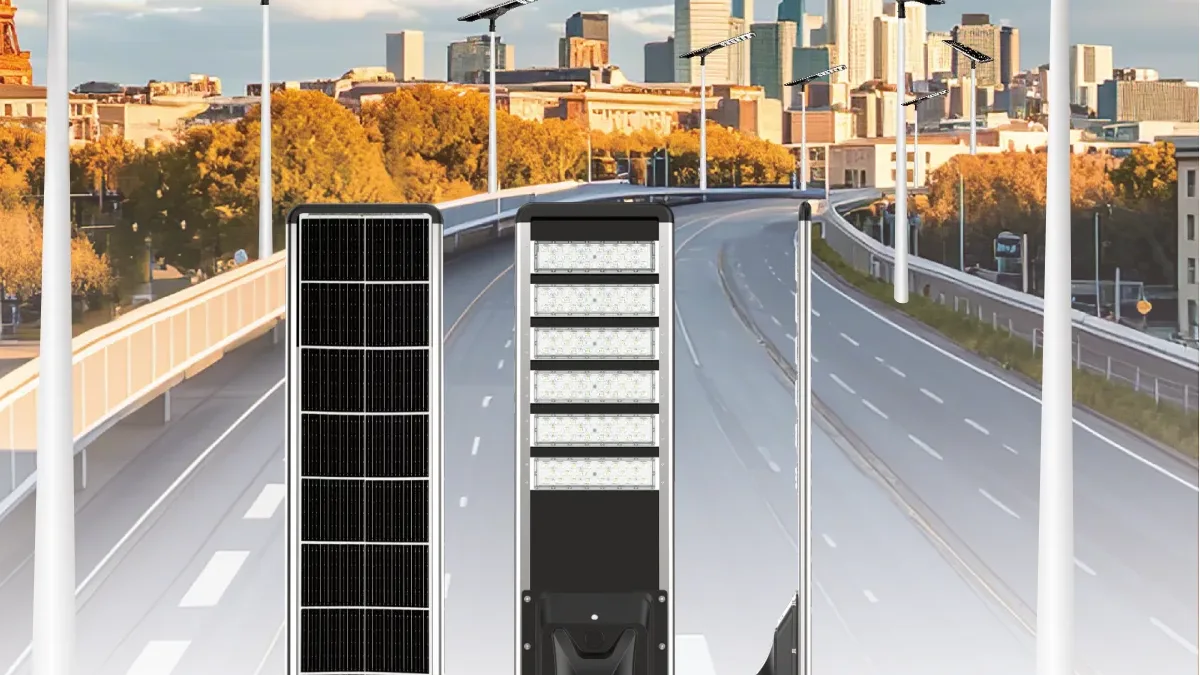
A class is delivered by the shape of the light, not by the lumen figure on the box. Two luminaires with the same lumens can produce completely different luminance on the carriageway, which is why specifications call for a distribution type and a photometric file rather than an output figure.
The transverse classifications commonly quoted in tenders describe how far the useful beam reaches across the road when the luminaire is mounted near the edge. The practical geometry rule uses the mounting height as the unit of measurement, so the same optic suits a wide road on a tall pole and a narrow road on a short one.
| Distribution | Typical application | Practical geometry rule |
|---|---|---|
| Type II | Narrow carriageways, residential lanes, shared paths | Roadway width up to about 1.75 times the mounting height |
| Type III | Medium-width carriageways, parking aisles, collector roads | Beyond 1.75 and up to about 2.75 times the mounting height |
| Type IV | Wider carriageways, one-sided mounting on wide roads | Beyond about 2.75 times the mounting height |
| Type V | Areas, junctions, roundabouts, plazas | Symmetric pattern; spacing set by uniformity rather than width |
The type labels follow the transverse classification commonly quoted in tenders. Treat the ratios as a starting point and confirm the definition in the standard edition your specification names, because the boundaries have been restated between editions.
On an integrated solar fixture there is a second constraint that grid-connected guides never mention. The panel and the lamp head share one housing, so the panel azimuth and the optic direction are mechanically linked. A fixed all-in-one unit can be aimed for the road or angled for the sun, but not independently for both, and the compromise has to be decided at installation rather than at order. That is one reason split-type systems still win on north-south roads and on sites where the array must be larger than the housing allows — the trade-off is set out in our guide to all-in-one versus split-type solar street lights.
Here is the part most quotations leave out. Our published product data covers output, panel size, battery capacity, mounting height and recommended spacing, but it does not publish a distribution type per model. So do not accept "Type III" as a claim in a bid — ask for the photometric file for the exact model and optic being quoted, and have the calculation run in DIALux, Relux or AGi32 on your road geometry. If a supplier cannot produce the file for the specific configuration, the class promise is not evidence-based.
Autonomy, Worst-Case Nights and the Dimmed Baseline
Autonomy is the number of consecutive low-sun days a system supports at a stated dimming profile, and it is meaningless without that profile attached. Two suppliers can both say three cloudy days while one assumes the light runs at full output all night and the other assumes a steep night-time cut.
Autonomy also depends on the sun hours assumed in the energy budget. A figure quoted for five peak sun hours and a figure quoted for three describe completely different hardware at the same latitude, and neither is wrong — they are simply answers to different questions. The fix is to state both the profile and the assumed daily sun hours in the specification, so that every bid answers the same question.
The published mounting heights and spacing for the ZHENYE integrated range are useful here, because they show how the system grows with the road.
| Model | Published output | Recommended mounting height | Recommended spacing |
|---|---|---|---|
| 100W integrated | 6,000 lm | 6-7 m | 25-30 m |
| 150W integrated | 9,000 lm | 7-8 m | 30-35 m |
| 200W integrated | 12,000 lm | 8-10 m | 35-40 m |
| 300W integrated | 18,000 lm | 10-12 m | 40-45 m |
| Solar parking lot light | 9,000 lm | 8 m | 20-25 m |
Those spacing figures are the factory recommendation for a general-purpose uniformity target, not a class result. Spacing is what actually decides uniformity, so the spacing has to be recalculated against your road width, your mounting height and your class — which is exactly the calculation that should come back with the quotation. For a worked example on a large site, see the solar parking lot lighting guide.
Two further published points are worth carrying into the enquiry. Our standard models are rated IP65, which is the level the fixtures are built and tested to for outdoor service, and the LED life is published at 50,000 hours with a five-year fixture warranty and an eight-to-ten-year LiFePO4 battery life. The battery is the component that usually decides the maintenance economics, and it is discussed further in our guide to batteries for solar street lights.
One honest caveat before the specification is frozen: our standard models publish a 6000K colour temperature. Many municipal specifications now fix a warmer 3000K to 4000K range for residential areas, and where the specification does so, raise it with the factory at enquiry stage and ask for written confirmation before quoting rather than assuming the option exists.
What to Write Into the RFQ
An RFQ that names a class but nothing else will attract bids that are not comparable, because each supplier fills the gaps with its own assumptions. The clauses below force those assumptions into the open, and most of them cost the supplier nothing more than an honest answer.
- Class and hours. State the class per road type, the standard and part it comes from, and the hours during which it must be held.
- Dimming profile. Write the permitted profile hour by hour, in both the presence and no-presence states, or state explicitly that flat output is required.
- Photometric file. Require the IES or LDT file for the exact model and optic quoted, with the candlepower plot that demonstrates the distribution.
- Calculation. Require a maintained performance report on the real geometry — mounting height, pole offset, spacing and carriageway width — with the average and minimum values and the uniformity ratio stated.
- Maintenance factor. Require the maintenance factor assumed in the calculation to be stated, together with the cleaning cycle it implies.
- Spill light. If the authority limits uplight or trespass, require the BUG figures or the equivalent photometric evidence, not the phrase "full cut-off".
- Autonomy. Require the autonomy in days at the stated profile, together with the daily sun hours assumed.
- Colour temperature. Fix the required range, and require written confirmation where the standard product differs.
- Documents on delivery. Agree the test reports, drawings and manuals that ship with each order, and the language they must be in. Our certification and compliance guide sets out how to check which certificate is valid in which market.
Two clauses in that list are routinely skipped and routinely cause disputes. The first is the calculation: a class is a property of a layout, not of a luminaire, so a report run on someone else's geometry proves nothing about yours. The second is the maintenance factor, because a generous assumption silently promises a brighter road than the hardware will deliver after two years of service.
Glare is the third area that rewards attention before the order, and the limits are usually written as an uplight or threshold-increment requirement rather than a preference. Our notes on glare and light pollution cover how those limits are expressed, and the same calculations are the ones used to check a class.
Frequently Asked Questions
Does a dimmed solar street light still meet EN 13201?
It can, if the class that applies during the dimmed hours is the class the system still delivers. Class selection depends on traffic volume and ambient conditions, which change through the night, so a lower class can be legitimate after the evening peak — but the authority must agree it in writing.
What is the difference between M, C and P classes?
M classes apply to roads used mainly by motorised traffic and are judged on road surface luminance and its uniformity. C classes apply to conflict areas such as junctions. P classes apply to pedestrian and low-speed areas, where the criteria are horizontal and semi-cylindrical illuminance rather than luminance.
Which light distribution type suits a 7 m pole on a six-metre road?
As a starting point, compare the road width with the mounting height. Type II is the narrow class, Type III covers medium-width carriageways, Type IV reaches further across wider roads, and Type V spreads light symmetrically for areas. Confirm the choice with a calculation on your real geometry.
Can a solar street light hold a class all night without dimming?
Yes, but it must be sized for it. Twelve hours at full output is 1,200 percent-hours of energy per night, against about 480 to 920 percent-hours for a stepped profile. Panel wattage and battery capacity both rise, so the decision belongs in the design stage.
What is a maintenance factor and who sets it?
A maintenance factor is the allowance a lighting calculation makes for dirt on the lens and gradual light depreciation between cleaning cycles. The value must be stated in the calculation, because a supplier who assumes a generous factor is quietly promising a brighter road than the hardware will deliver.
Do I need an IES file, or is a lumen figure enough?
A lumen figure is not enough for a class-based specification. Ask for the photometric file for the exact model and optic being quoted, not a family file, and ask for the candlepower plot that demonstrates the distribution. Without it, the calculation is an assumption rather than evidence.
Does a split-type system make class compliance easier?
Sometimes. A split system lets the panel and the lamp be aimed independently, so the optic can face the road while the array faces the sun. That helps on north-south roads and tight layouts, and it removes the compromise that a fixed all-in-one housing imposes.
Next Step: Send the Road, Not Just the Wattage
If you send only a wattage, any factory can quote you something. Send the road width, the mounting height you intend to use, the class your specification names and the hours it must hold, and the answer you get back can be checked.
Start from the 150W integrated solar street light or the wider solar street light range, and check the published mounting heights and output figures against your own road. Where the layout is still open, our notes on motion sensor and dimming profiles explain how the night-time timetable is set, and the solar parking lot light covers site lighting where the geometry is an area rather than a lane. When the requirement is clear, send it to our engineering team and we will answer it against the exact model, with the photometric file and the assumptions stated.