Why the Module Is Usually the Last Part Anyone Reads
A solar street light is specified around its night output, so attention goes to lumens, battery capacity and dimming. The photovoltaic module — the part that must refill that battery every day for the next ten years — is often accepted as whatever wattage the quotation lists. That is how a project meets its lighting class on paper and loses its autonomy in the second winter.
The module is also the component with the most information published about it, and the problem is not a lack of data but knowing which few fields decide whether it will charge the battery at your site. This guide is written for the people who sign the specification, and it ends with the lines to put in an RFQ so two quotations can be compared line by line.
Where the Module Sits in a Solar Street Light
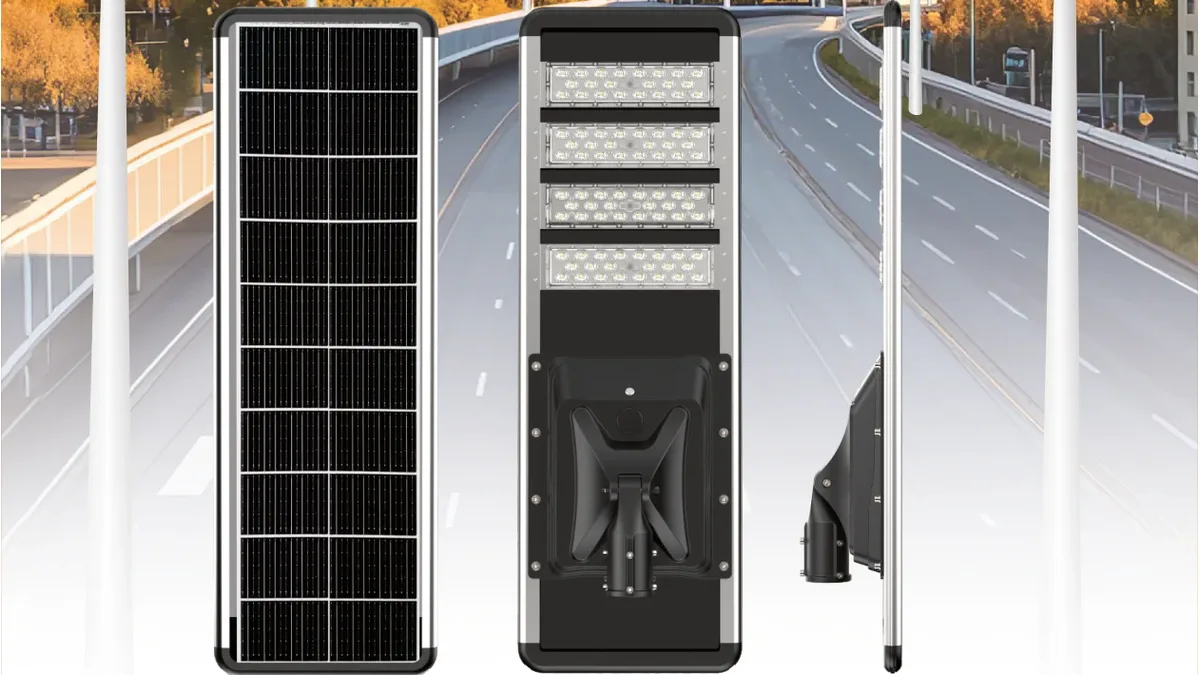
The module is fixed to a solar street light in one of three ways, and the mounting method decides the questions you have to ask at design stage: how much module area is available, whether the tilt can be set for the site, and who owns the cable run to the battery.
| Mounting type | How the module is fitted | What it changes |
|---|---|---|
| Integrated (all-in-one) | It is the top surface of the luminaire housing | Module area is fixed by the housing, so wattage and cell efficiency are the only levers |
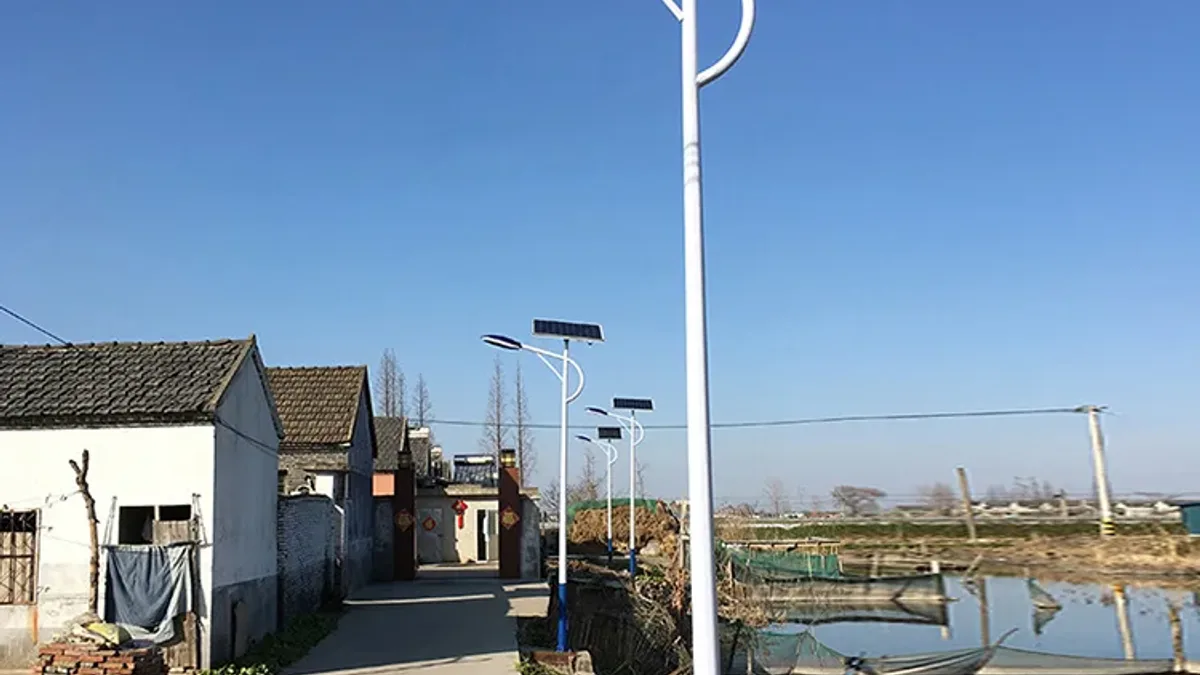
| Split type | A separate module on its own bracket above the luminaire | The module can be larger than the housing and the tilt set per site; cable runs and volt drop become design items |
| Array or off-grid pole | One or more modules on a pole-top or ground frame, feeding a controller and battery bank | Array size, series/parallel wiring and mechanical loading are open design decisions |
If the mounting type is still open, the trade-offs are in our comparison of all-in-one and split-type solar street lights. The point here is narrower: the mounting decides how much module area you can buy, and area is the part of “how many watts” that is easiest to get wrong.
The Module Families You Will Be Offered
Almost every quotation today names monocrystalline modules; polycrystalline still appears where a tender was written years ago or price is the only criterion. Thin film is rare in street lighting because it needs more area for the same output.
| Family | What it looks like | Where it still makes sense |
|---|---|---|
| Monocrystalline, full-cell | Uniform dark cells, visible busbars | Standard choice where the housing allows the area |
| Monocrystalline, half-cut cells | Cells cut in half and wired as two parallel halves | Common today: lower resistive loss, better behaviour when part of the module is shaded |
| Polycrystalline | Blue, visibly multi-crystal cells | Legacy designs and low-cost replacements where area is generous |
| Thin film | Dark, uniform, often larger for the same wattage | Special cases; usually too large for an integrated luminaire |
Cell technology is a starting point, not a specification: two factories offering “monocrystalline, grade A” can differ in cell supplier, encapsulation and junction box, none of which appears in the word “mono”.
Reading the Datasheet: The Fields That Decide the Project
A module datasheet describes one operating point in close detail and the rest of the module in a table. Most of the fields are useful, but a few decide whether the module will actually charge your battery: the voltage and current at maximum power, the cold-weather open-circuit voltage, the temperature coefficients and the tolerance on rated power.
| Field | Unit | What it decides |
|---|---|---|
| Pmax (rated power) | Wp | The nameplate figure every comparison is built on — but only at the standard test condition |
| Power tolerance | W or % | What you may actually receive; a positive-only tolerance is a stronger statement than a symmetric one |
| Vmp | V | Whether the module sits inside the controller’s input window for your battery voltage |
| Imp | A | Cable size, connector rating, controller input current limit |
| Voc | V | The cold-weather check: it must stay under the controller’s maximum PV input voltage when the site is coldest |
| Isc | A | Fuse and connector rating, and the value to compare against a field measurement |
| Temperature coefficient of Pmax / Voc | %/°C | Output lost in heat, and voltage gained in cold |
| NMOT / NOCT, efficiency, size, weight | °C, %, mm, kg | Operating temperature, output per unit area, and whether the module physically fits |
One caution applies to the whole table: Pmax is quoted at standard test conditions — a defined irradiance, cell temperature and spectrum. It is a laboratory reference for comparing modules, not a prediction of what one will produce on a pole in February. Sizing is done on the worst month at your site, and the survey fields that matter are in our solar street light site survey guide.
Matching the Module to the Controller and the Battery
Modules and controllers are usually quoted by different people, and that is where most compatibility problems begin. Four checks close them: the voltage class of the battery bank, the controller’s PV input window at the site’s temperature extremes, its input current and array power limits, and the wiring topology you intend to use.
- Voltage class of the battery bank. A 12 V, 24 V and 48 V system each expect a different module voltage class. What matters is Vmp against the controller’s specified input range, not a nominal label on the module.
- Controller PV input window. Ask for the minimum and maximum PV input voltage at the coldest and hottest site temperatures, not only a “12/24 V” label: a module that behaves on a warm bench can exceed the controller maximum on a cold morning.
- Input current and array power. The controller has a maximum input current, and often a maximum array power. Some controllers allow a stated amount of array oversizing and others cap it, so get the limit in writing for the exact model; the difference between the two controller types is set out in our MPPT versus PWM comparison.
- Wiring topology. Modules in series add voltage; in parallel add current. The combination must stay inside the controller window all year, and it fixes DC cable size and fuse rating.
The Question Every Buyer Asks: How Many Watts?
“How many watts of panel for a 100 W light?” cannot be answered from the luminaire wattage alone, and a supplier who answers it in one sentence without asking where the project is has answered a different question. The method is a daily energy balance.
Night energy demand is the light’s consumption across the whole dark period, including curfew dimming and any motion profile. If a light draws 60 W for the first hours and drops to a lower level for the rest of the night, the night total is the sum of those periods — 4 h at 60 W plus 6 h at 30 W is 420 Wh. Array sizing divides that figure by the energy a module of that class delivers at your site in the worst month, after temperature, soiling and system losses. None of those factors is a catalogue value.
So ask for a calculation, not a ratio: the daily energy balance sheet of the exact model quoted, showing night load, worst-month array yield, usable battery capacity, and the assumed depth of discharge and autonomy days.
Shading, Bypass Diodes and Half-Cut Cells
Shading is the most common reason a correctly sized array still underperforms, and a pole is a difficult place to avoid it: trees, buildings, a second luminaire on the same pole or a cable tray can cover part of a module for part of the day.
Modules are protected against partial shading by bypass diodes: when a substring is shaded, its diode conducts and bypasses that group of cells so the rest keeps working. The consequence is worth stating plainly — the diode protects the module, it does not recover the shaded energy. Half-cut cells behave better because the string is split into two parallel halves. Nothing substitutes for measuring shading at the site before ordering.
The Mechanical and Environmental Lines on the Same Datasheet
Half of a module datasheet describes a product that has to survive a decade outdoors, and these lines deserve the same attention as the electrical table: glass and encapsulation against hail and humidity, frame sealing above the electronics, junction box ingress protection, and the mechanical load rating you must compare with the wind load at your site.
- Glass and encapsulation. They decide how the module behaves under hail, thermal cycling and humidity, and are covered by design qualification testing rather than a marketing claim.
- Frame and edge sealing. In an integrated luminaire the frame doubles as the housing surface; the sealing detail is what keeps water out of the electronics below.
- Junction box and connectors. Ingress protection and a stated connector type matter more on a pole than on a roof: the joint is exposed and hard to service.
- Mechanical load rating. Datasheets quote front and back loads in pascals from a mechanical load test. Compare them with the wind load your site produces, and check the mounting method the figure assumes.
- Dimensions and weight. On an integrated luminaire they decide whether the module fits at all; on a split type they decide the bracket and the load on the pole.
Soiling, Salt and Snow
Output falls when the surface is dirty, and how much depends on the site: dust and sand in dry regions, pollen and bird droppings in green areas, salt spray on the coast. Two consequences follow for specification work, both decided long before the first cleaning visit.
First, cleaning has to be planned while the pole is being chosen: a module lying flat on top of a luminaire is far harder to clean than a split module at a reachable angle, and ten years of access cost belongs in the project cost. Second, corrosive environments should be matched to the module’s tested scope: a coastal or island site should ask for the corrosion-test evidence instead of assuming it. Where a soiling figure is used in a design, it should come from site data rather than a datasheet.
Documents to Request With the Module
Ask for the paperwork before you compare prices: a quotation that arrives with documents attached is easier to verify than one that promises them later. For a street light module the list is short but specific, and each item has to name the exact model you are buying rather than the family it belongs to.
- Datasheet of the exact model quoted, model number matching the quotation.
- Design qualification and safety reports for the module type, from a laboratory you can look up, with report number, date and model tested.
- Corrosion test evidence for coastal sites or heavy agriculture — a separate test from general module safety testing.
- Flash-test data or an electroluminescence record for the production batch, if your quality plan requires it.
- ISO 9001 in the manufacturer’s own name, for the site that actually makes the module.
- Market documents: which certificate is valid in the destination country, and what the importer still has to obtain locally. Certification is national — the structure is in our solar street light certification guide.
Two habits save arguments later: check every document’s model number against the quotation, and check the market, because a report issued for one region does not automatically satisfy a tender in another. If a document does not exist for the model you want, ask for that in writing.
Ten Lines for the Module Section of Your RFQ
Put the following ten lines into the module section of the enquiry, and ask every supplier to answer them in the same order. Quotations written against the same list can be compared line by line; quotations written freely cannot.
- Mounting type and available module area, with the drawing.
- Site location and worst-month design condition.
- Night load profile, with dimming or motion stages and hours.
- Required autonomy in days and assumed depth of discharge.
- Battery voltage class and controller model, with PV input voltage and current limits.
- Module family, dimensions and weight limits.
- Document list required with the offer, per market.
- Mechanical load requirement, referenced to the site wind condition.
- Test and inspection requirements before shipment, and who witnesses them.
- Spare modules or parts to be held, and module warranty terms.
Four lines decide most disagreements: the worst-month design condition, the night load profile, the controller input window and the document list. Send those four with the enquiry.
Frequently Asked Questions
Monocrystalline or polycrystalline for a solar street light?
Monocrystalline in most cases: more watts for the same area, and area is the binding constraint inside a luminaire housing. Polycrystalline still works where the mounting gives generous area and budget decides. Compare the exact model, not the family name.
How many watts of panel do I need for a 100 W solar street light?
Not from the luminaire wattage. It follows from the night energy demand at your dimming profile divided by the worst-month daily yield at your location, after temperature, soiling and system losses. Ask for the daily energy balance sheet and check the worst-month condition in it.
Can I fit a larger module than the controller allows?
Only within the limits the controller manufacturer publishes. Some controllers permit a stated amount of array oversizing, others cap input power, and every controller has a maximum PV input voltage that must not be exceeded at the coldest expected temperature. Put both limits in the enquiry.
Does module efficiency matter for a street light?
It matters as watts per unit of area. Where the module is the top of an integrated luminaire, efficiency decides how much array you can have at all. Where it is mounted separately, efficiency matters less than price per watt, because the area constraint has been removed.
How do I check whether the module is why a light stopped working?
Measure open-circuit voltage and short-circuit current at the module terminals in daylight and compare them with the datasheet, after checking the obvious causes: dirt or snow, new shading, a corroded connector. The method is in our guide to diagnosing a solar street light that is not working.
Next Step: Send the Site and the Load, Not Just the Wattage
Send us the mounting type and module area, the site location or its worst-month condition, the night load profile, the battery voltage class and the controller model. We will return the module lines filled in and the datasheet of the model we would quote — and where a figure is not published, we will say so rather than estimate it.
Modules for street lighting and off-grid poles are part of our solar panel range, for portable and remote sites there is a foldable panel series, and projects combining generation, storage and distribution are covered by our distributed PV station solution.
Contact the VOLTIC technical team with the site details and load profile, and we will take the enquiry from module selection to a comparable quotation.