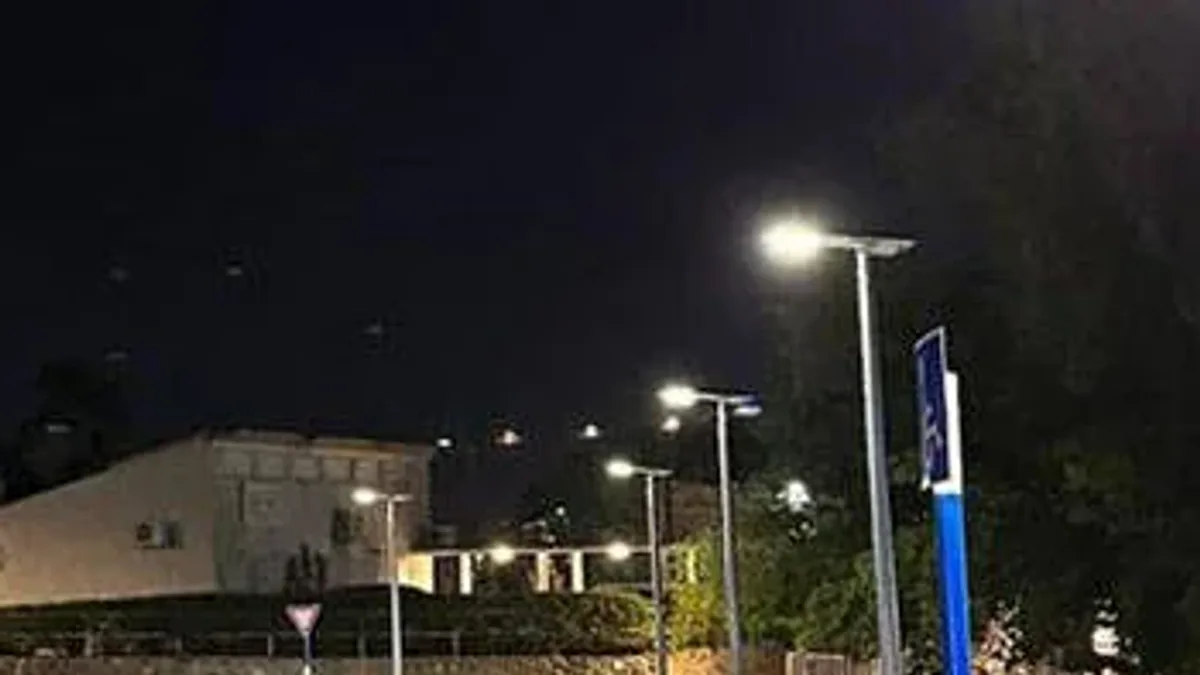
A street light that puts light on the road and none in the sky is a design decision, not an accident. Light-pollution clauses are now written into municipal specifications and tender documents across Europe, North America and a growing number of other markets, which turns glare and upward light into acceptance criteria that can hold up a delivery or a final payment.
This guide explains what light pollution from a street light actually is, the numbers a specification should fix, how the IES BUG rating is read, and the documents to request from a solar street light supplier before an order is placed. It is written for project buyers, EPC contractors and distributors who have to answer one practical question: will this installation pass the lighting clause?
What Counts as Light Pollution from a Street Light
Light pollution is not a single effect. The widely used definition groups it into four components — sky glow, light trespass, glare and clutter — and one badly aimed street light can produce all four at once. The first step in meeting a lighting clause is knowing which component it is actually targeting.
Sky glow is the brightening of the night sky over a town or city, caused by light that leaves a luminaire upward or at a high angle and is then scattered by dust, water vapour and aerosols in the atmosphere. Uplight is the part a buyer controls directly, and blue-rich white light scatters more strongly than warmer light, which is why colour temperature appears in almost every light-pollution clause.
Light trespass is light that falls outside the area the installation is meant to serve. In practice it is the complaint that arrives first: light in a bedroom window, on a neighbouring facade, or across a property line. It is dealt with by shielding the fixture on the offending side, by lowering the mounting height, by aiming, or by all three.
Glare is brightness in the field of view that reduces visibility rather than improving it. Disability glare interferes with the eye's ability to see, which is why a driver is briefly blinded by an unshielded head, while discomfort glare is the same effect at a level that is merely unpleasant. Both are controlled by optics and mounting angle rather than by wattage.
Clutter is the confusing grouping of bright sources, typical of roads where several sign, shop and street lighting systems compete inside one view.
Why Solar Street Lights Deserve Their Own Glare Check
A solar street light concentrates several compromises in one head. Panel, battery, controller and LED share a housing, the panel angle is fixed by the mounting angle, and standard models are frequently supplied in cool white. Each choice affects how much light escapes upward and how the installation is judged at night.
The first consequence is geometric. In an integrated luminaire the panel and the optics sit in the same body, so any angle added to catch the sun is also added to the light distribution. A head tilted upward to improve winter harvest can aim part of its beam above the horizontal, which is exactly the condition that light-pollution rules prohibit. Where a project carries a strict uplight clause, the mounting and tilt assumptions have to be checked against the photometry, and in some cases against a split-type design in which the panel and the luminaire are mounted separately. That trade-off is worked through in our comparison of all-in-one and split solar street lights.
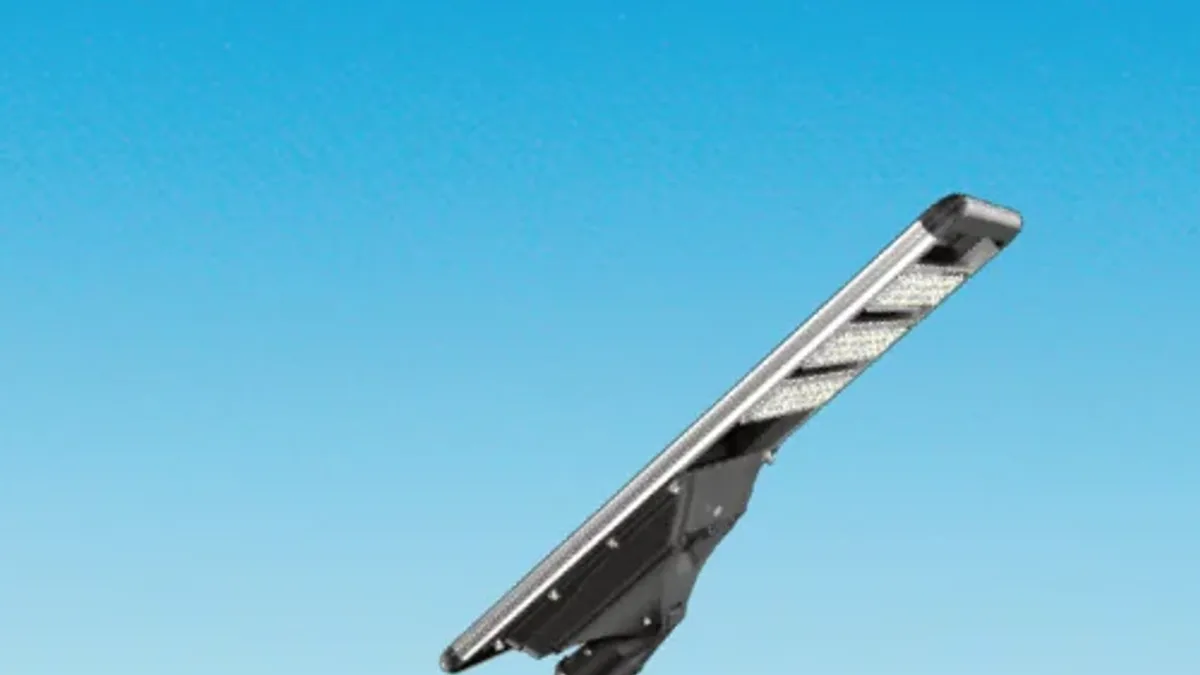
The second consequence is colour. Cool-white light is popular because it looks bright on camera and on the road, and it is common in standard catalogues. Our own ZHENYE SERIES integrated models are documented at 6000 K. That figure is worth stating plainly, because a 6000 K head will not satisfy a clause that caps correlated colour temperature at 3000 K or below, however well the optics are shielded. Where a project carries such a clause, warmer colour temperatures can be requested as a factory adjustment; confirm availability for the exact model, in writing, before the order is placed.
Solar lighting also has one advantage that mains lighting does not. Because every watt-hour has to come from the panel, dimming and part-night operation are normal rather than an add-on, and light that is simply not produced after midnight cannot pollute anything. The way those levels are written into a specification is covered in our motion sensor and dimming guide.
Six Numbers to Fix in the Specification
Almost every light-pollution dispute comes down to a handful of quantities that can all be written into a purchase specification. None of them is exotic, but each has to be named, because a supplier cannot meet a limit that was never stated in the enquiry.
| Quantity | What it controls | What to write |
|---|---|---|
| Correlated colour temperature (CCT) | Blue content, and therefore sky glow | Not above 3000 K; 2700 K or lower in sensitive areas |
| Uplight, as the U value or ULOR | Light sent above the horizontal | Zero uplight, U0 |
| High-angle light, 80-90 degrees | Spill and distant glare | Not more than 3% of output, 5% for Type V distributions |
| BUG classification | Backlight, uplight and glare together | Typical wording: not to exceed B1-U0-G1 |
| Illuminance against the road class | Over-lighting | Within 20% of the recommended level for the class |
| Dimming and part-night profile | Hours of unnecessary light | Dimmable to 10% or lower, with a written profile |
The figures above are drawn from published criteria rather than from any single product: the DarkSky Approved luminaire guidelines for colour and uplight, the IES BUG classification for the distribution, and the environmental-zone guidance described further down for the local level. Use them as the wording your own engineer signs off, and quote the clause number from the project specification beside each one so the supplier knows which requirement it answers.
Reading a BUG Rating
The BUG rating is the shorthand the lighting industry uses to describe three of the effects above at once. It comes from IES TM-15, the Illuminating Engineering Society's classification of outdoor luminaires, and it has become the standard wording in tenders because it turns a photometric file into a single line.
BUG stands for backlight, uplight and glare, and each of the three letters carries a number from 0 to 5, where 0 is the lowest emission in that zone:
- B, backlight — light thrown behind the fixture, the zone that causes most trespass complaints on a roadside installation.
- U, uplight — light above the horizontal, in the two zones that feed sky glow. U0 means nothing measurable is emitted above the horizontal.
- G, glare — light at the high angles that reach the eye from a distance, the zone behind most driver complaints.
A luminaire described as B1-U0-G1 is therefore well shielded backwards and upwards and has a low glare rating, which is the combination most dark-sky clauses are trying to buy. Two cautions are worth repeating. First, the BUG line in a datasheet belongs to one photometric file; if the supplier offers several distributions or wattages under the same model name, ask which file produced which line. Second, a BUG rating says nothing about colour temperature, so a fixture can be U0 and still fail a warm-light clause.
Environmental Zones: Why the Same Luminaire Passes in One Place and Fails in Another
Light-pollution limits are not universal; they scale with how dark the surroundings are. Professional guidance, in particular the Institution of Lighting Professionals' GN01, divides sites into ambient environmental zones from E0, the most sensitive, to E4, the brightest urban centre, and applies tighter limits in the darker ones.
The practical effect is that the identical luminaire can be acceptable on a town-centre street and unacceptable on a rural road thirty kilometres away. Before you quote a limit to a supplier, establish which zone the project sits in. The specification usually names it, and in the United Kingdom the CPRE night-sky maps are commonly used to set it. Then apply the skyglow, light-trespass and glare values that go with that zone.
Two consequences follow. A luminaire that passes in E4 does not automatically pass in E2, so a specification written for one zone should never be copied to another without rechecking the photometry. And in the most sensitive zones the cheapest way to comply is usually to light less: fewer poles, lower output per pole, and a profile that drops the level further once the area has seen its last legitimate use of the evening.
What to Put in a Solar Street Light Specification
A specification that mentions light pollution in one line and then lists nothing else gives the supplier nothing to comply with. Translate the clause into the items below, and require each one to be confirmed against the exact model quoted rather than against the supplier's general catalogue.
- The environmental zone, and the obtrusive-light limits that go with it.
- The maximum colour temperature, in kelvin, for the LED module, stated with a tolerance.
- A zero-uplight requirement, with the photometric file named as the evidence.
- A BUG line that must not be exceeded, for the distribution actually offered.
- A shielding accessory that is listed in the product datasheet rather than offered as a special.
- The dimming or part-night profile, with the level and the hours written out.
- The illuminance target and the uniformity that accompany it, so the luminaire is not selected by wattage alone.
- The documents that must travel with the shipment, listed below.
Documents to Request Before You Order
Claims about shielding, colour and light distribution are easy to make and hard to check. Ask for the documents below for the specific model on the quotation; a supplier who has tested the product will already hold them, and the request costs nothing but a reply.
| Document | What it proves | Why the evaluator asks |
|---|---|---|
| Photometric file in IES or LDT format, plus the test report behind it | The actual light distribution, backlight, uplight and glare zones | A simulated file is not equal evidence to a measured one |
| LM-79 test report from an independent laboratory | Output, efficacy, colour temperature and colour rendering | This is the first document a tender evaluator requests |
| Shielding or back-light accessory datasheet | The part number that achieves the house-side cut-off | It shows the accessory is a listed option, not a promise |
| Current safety and compliance certificate for the exact model | That the unit is certified for the market it will be installed in | It must state which market the certificate covers |
| Dimming profile, in writing, as percentages by hour | That the after-midnight level in the design is what the controller will run | It is the only way to check the energy claim used for sizing |
An independent LM-79 report is available for our solar street light range, and our declared certifications are CE, RoHS and ISO 9001; the market-by-market position of those certificates is set out in our certification guide by market. Where a tender insists that a luminaire appear on a published approval list, treat that as a hard filter and check the listing before the bid rather than after it. Some tender documents go further and refuse wording such as "dark-sky friendly" unless the product is actually listed, which is a useful reminder that an adjective in a brochure is not the evidence.
Reducing Glare and Light Trespass on Existing Installations
Not every problem needs a new luminaire. Much of the obtrusive light on a completed site can be removed with shielding, aiming, control settings and a colour change, at a fraction of the cost of replacing the units. The order below runs from cheapest to most expensive.
- Re-aim and level. A head that has been tilted upward to chase the sun or the road can often be brought closer to level without losing useful illumination.
- Fit a shield or back-light accessory. The house-side cut-off solves most trespass and bothersome-glare complaints at a single address.
- Change the dimming profile. Bringing the after-midnight level down removes the hours of light that produce no benefit; on a solar system it also buys battery autonomy, which is why our controllers ship with light, timer and human-presence control.
- Move to a warmer colour temperature where the clause is written around sky glow rather than trespass.
- Re-place or shorten a pole only after the cheaper options have been tried, since it is the most expensive intervention and the one most likely to require civil works.
Whichever route is taken, keep the record. A photograph taken before and after, together with the photometric file and the settings used, is what converts a complaint into a closed file, and it is also the first thing an auditor asks to see.
Frequently Asked Questions
Does a solar street light cause more light pollution than a mains-powered one?
No, not by itself. Light pollution is a property of the optics, the mounting angle and the colour temperature, and a solar head with the same distribution behaves like any other luminaire. Solar systems have one advantage: dimming and part-night operation are natural, and there is little incentive to over-light a pole charged by its own panel.
Can a 6000 K solar street light meet a dark-sky clause?
Usually not. Published dark-sky criteria cap the light source at 3000 K or warmer, and sensitive areas often ask for 2700 K, so a 6000 K head fails the colour requirement however well it is shielded. Warmer colour temperatures can be requested as a factory adjustment; confirm the exact model in writing before ordering.
What is the difference between light trespass and glare?
Light trespass is light that lands where it is not wanted, such as a neighbouring property, so it is judged by where the light ends up. Glare is brightness in the eye's field of view that reduces what a driver or pedestrian can see, so it is judged at the observer rather than at the boundary line.
Is "dark-sky friendly" the same as being on an approved list?
No. A descriptive phrase in a brochure is a marketing statement, while approval is a third-party review of measured photometry against published criteria. Some tender documents now reject the phrase outright and require the product to be listed, so check the status of the exact model rather than the wording of the catalogue.
Do I need a photometric file to prove compliance?
Yes, for any project where the clause is written in numbers. Request the IES or LDT file for the distribution being quoted together with its test report, and have your lighting designer confirm the uplight, backlight and glare zones from that file. A datasheet summary is useful for shortlisting but is not evidence at handover.
How do I cut uplight from lights that are already installed?
Work through the cheap steps first: re-aim or level the head, fit the house-side shield, and lower the after-midnight level through the controller. Only if the clause is written around colour does the LED module need changing, and replacing the pole itself should be the last option considered.
Which colour temperature should I specify?
Write 3000 K as the maximum, and step down to 2700 K or lower where the project sits near a dark-sky area, a wildlife corridor or an observatory. Whatever figure is chosen, state it as a nominal value with a tolerance, because a module quoted only as "warm white" is not something a factory can be held to.
Next Step: Check Your Lighting Clause Against the Model You Are Buying
If your project carries a light-pollution, obtrusive-light or dark-sky clause, send it with the road type, the environmental zone if it is named, the lighting class, the colour temperature required and any uplight or BUG limit. Our engineers will confirm which configuration meets it and which documents will travel with the shipment.
Start with the integrated solar street light range to see the wattage ladder and the published luminaire data, and check the solar street light pole heights and foundation drawings that set the mounting angle. If the same tender also asks for safety approvals, read the market certification guide first. When your clause is ready, send it to our engineering team and we will answer it against the exact model rather than against the catalogue average.